

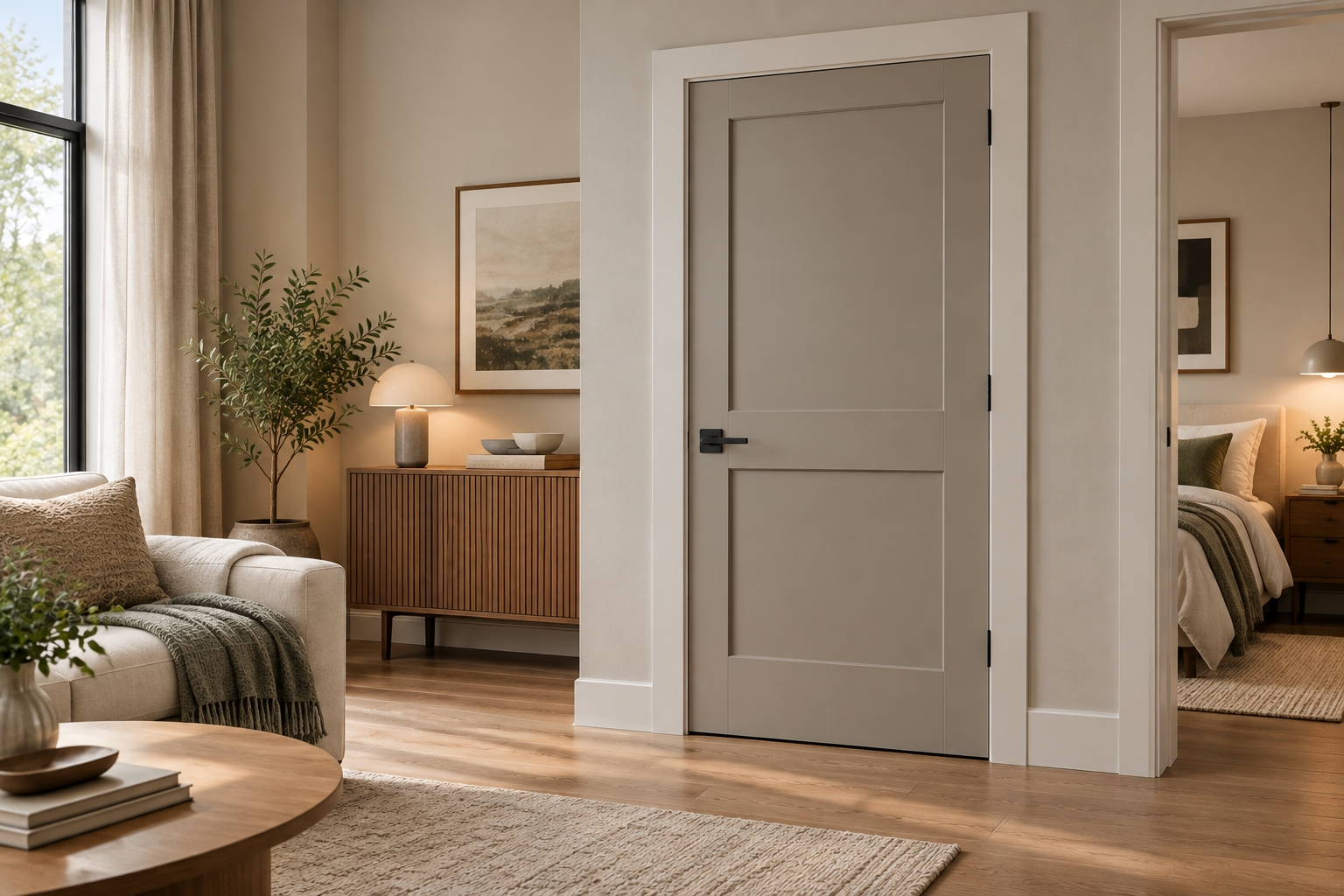

The comfort of a home depends on more than furniture, lighting, and decorative finishes. Everyday details, including the doors between rooms, can influence privacy, noise levels, durability, and the overall feeling of quality. A well-chosen door can help create a more comfortable environment while complementing the design of the home.
Door construction is particularly important when selecting products for bedrooms, home offices, living rooms, and other frequently used spaces. Lightweight doors may be suitable for some applications, but homeowners who want a more substantial feel and improved separation between rooms often consider denser construction.
Solid core interior doors combine a durable internal structure with a wide range of possible surface finishes and styles. They can help reduce everyday sound transmission, provide a sturdy feel, and withstand regular use when properly manufactured and maintained. Their suitability depends on the room, the door's specifications, and the requirements of the installation.
Understanding the practical advantages of different door constructions can help homeowners make informed decisions during renovations or new builds. This guide explores how core material, sound control, durability, design, maintenance, and installation contribute to everyday living.
What Are Solid Core Doors?
A solid-core door contains a dense internal core rather than the lightweight hollow structure commonly found in many budget-friendly doors. The core may consist of engineered wood, composite materials, or other dense materials, depending on the product's construction.
The term does not necessarily mean that the entire door is made from one solid piece of natural timber. Many products combine an engineered core with outer surface materials designed to provide the required appearance and finish.
This construction can create a heavier and more substantial door. It may also provide better resistance to everyday noise than a comparable lightweight hollow-core product.
The visible surface can vary considerably. Some designs have smooth faces, while others feature recessed panels or other decorative details. This allows homeowners to consider construction and appearance separately when selecting a suitable option.
Create a More Comfortable Home Environment
Comfort often comes from how well different areas of a home serve their intended purposes. A bedroom should support rest, an office should allow concentration, and a living room should provide space for relaxation.
Doors help establish boundaries between these activities. However, the level of separation depends partly on the construction of the door and how well it fits within the frame.
A denser door can help reduce the movement of everyday sounds between adjoining rooms. This may be particularly useful when someone is working while other household members are watching television or talking nearby.
The result is not complete silence, but potentially better acoustic separation. When combined with appropriate installation and suitable perimeter seals, the right door can contribute to a more comfortable living environment.
Reduce Everyday Noise Between Rooms
Noise can affect concentration, relaxation, and sleep. Conversations, television programs, music, and household activities can become distracting when rooms are separated by lightweight doors or poorly fitted openings.
One of the key solid core door benefits is the additional mass that can help resist airborne sound transmission. A dense construction generally offers better sound reduction than many lightweight alternatives.
However, acoustic performance depends on several factors. The door's materials, thickness, frame, perimeter gaps, seals, and installation all influence the final result.
For example, replacing a lightweight bedroom door with a denser model may help reduce sounds from a nearby hallway. If the noise also travels through the adjoining wall or ceiling, replacing the door alone may not solve the entire problem.
Homeowners should assess the complete opening when noise reduction is a priority.
Improve Privacy in Bedrooms and Home Offices
Privacy is important in rooms where people sleep, work, study, or hold conversations. A well-fitted door helps create a physical boundary, while its construction can influence how much sound passes between spaces.
Bedrooms may benefit from better separation from busy living areas. A home office may need to limit distractions during calls or focused work. Bathrooms and guest rooms may also require a greater sense of privacy.
Soundproof interior doors are often considered for these situations, but it is important to understand that no ordinary door automatically blocks all sound. The level of improvement depends on the tested construction and the quality of the complete installation.
A dense core, suitable thickness, and properly fitted seals can help. Homeowners should also consider wall construction and gaps around the door to achieve more effective separation.
Compare Solid Core vs Hollow Core Doors
Choosing between different door constructions involves balancing price, weight, durability, and performance.
Hollow-core products typically use a lightweight internal structure, often with a honeycomb or similar support system inside a frame. They can be economical and easier to handle during installation.
Solid-core products contain denser internal material. This generally makes them heavier and can improve sound reduction and the substantial feel of the door.
When comparing solid core vs hollow core doors, consider how each room is used rather than assuming that one construction is always necessary.
Feature |
Solid-core construction |
Hollow-core construction |
|
Weight |
Generally heavier |
Generally lighter |
|
Sound reduction |
Usually better, depending on the assembly |
Generally more limited |
|
Everyday durability |
Often more resistant to dents and impacts |
May be more vulnerable to surface damage |
|
Installation |
May require stronger compatible hardware |
Often easier to handle |
|
Cost |
Usually higher |
Often more budget-friendly |
|
Suitable applications |
Bedrooms, offices, busy areas |
Closets and spaces with lower performance demands |
Actual performance varies by product, so specifications should be checked before purchasing. Both types can be useful when selected for the right application.
Support Durability in Busy Households
Doors are opened and closed repeatedly throughout the day. In busy households, they may also experience accidental impacts from furniture, bags, toys, and other everyday objects.
A dense core can provide a more substantial structure than a lightweight alternative. Depending on the outer material and finish, this may help the door withstand regular use.
Durability still depends on the complete product. Surface coatings, edge construction, manufacturing quality, hinges, and installation all influence how well a door performs over time.
Homeowners should also consider where each door will be installed. A frequently used hallway or family room may benefit from a sturdier construction, while a closet door may have different requirements.
Selecting a suitable product for each location can help balance long-term performance with project costs.
Choose a Style That Complements Your Interior
Practical performance does not mean sacrificing appearance. Door design plays an important role in connecting rooms and maintaining a consistent interior style.
Smooth surfaces can work well in contemporary homes because they create clean visual lines. Paneled designs can provide additional architectural detail in traditional or transitional spaces.
Color also affects the overall impression. White and light neutral finishes can help maintain a bright appearance, while charcoal, black, beige, or wood-inspired finishes can introduce contrast or warmth.
The right selection depends on the surrounding walls, flooring, cabinetry, furniture, and trim. Homeowners should consider how the door will look from both sides and how it relates to nearby openings.
A consistent design approach can make the home feel more cohesive without requiring every room to look exactly the same.
Explore Flush Doors for a Clean, Modern Appearance
A smooth door face can be a good choice for homeowners who prefer minimal decoration. Its uninterrupted surface works with simple trim, understated hardware, and contemporary furniture.
Flush doors are available in different constructions and finishes, so the smooth appearance should not be treated as an indicator of core material or acoustic performance. Product specifications remain important when comparing options.
In a bedroom, a smooth finish can support a calm visual environment. In a home office, it can coordinate with a restrained, professional interior. In a hallway, a consistent finish can help multiple doorways appear connected.
Evolux Doors offers a Flush Doors collection for homeowners and design professionals exploring contemporary interior styles.
When evaluating a specific product, check its core construction, surface finish, dimensions, and recommended applications to ensure it suits the intended room.
Add Architectural Character With Shaker Designs
Some homeowners prefer a door with more visual detail. A Shaker-style design typically features a framed appearance around a central panel, creating depth without excessive ornamentation.
This style can complement classic interiors, transitional spaces, and many contemporary homes. The final appearance depends on panel proportions, color, trim, and hardware.
As with a smooth door, the visual style does not determine the core construction. Homeowners who prioritize sound reduction or durability should confirm the specifications of the selected product.
Evolux Doors also offers a Shaker Doors collection for those who prefer a paneled look.
Choosing between smooth and paneled styles is primarily a design decision. Construction, privacy, and durability should be evaluated alongside appearance.
Consider Door Weight and Hardware Compatibility
Because denser doors are generally heavier, their installation requirements deserve careful attention.
Hinges must be rated for the door's weight and dimensions. The frame should be secure and properly aligned, while the latch and handle must work with the selected slab.
Using unsuitable hardware can cause operational problems over time. A poorly supported door may sag, rub against the frame, or fail to close correctly.
Before replacing an existing door, confirm its width, height, thickness, hinge locations, and swing direction. Also inspect the condition and compatibility of the frame.
Professional installation can be helpful when the door is unusually heavy, the frame needs adjustment, or precise fitting is important for acoustic performance.
Understand the Role of Door Thickness
Thickness can influence a door's substantial feel, structural properties, and compatibility with hardware. A thicker door may contribute to better sound reduction when its construction and the complete assembly are appropriately designed.
However, thickness alone does not guarantee strong acoustic performance. Core density, surface materials, seals, frame construction, and installation also matter.
A replacement door should fit the existing opening and work with the intended hinges and latch. If the new slab differs from the original dimensions, additional adjustments may be required.
Careful measurement before ordering helps prevent unnecessary installation work. For guidance on common dimensions and compatibility, review Evolux Doors' article about standard interior door thickness.
Make Bedrooms More Restful
Bedrooms are among the spaces where privacy and noise control can have a noticeable effect on everyday comfort.
A denser door may help reduce sounds from the hallway or nearby living areas. This can be valuable in homes where bedrooms are positioned close to kitchens, entertainment spaces, or shared family areas.
The rest of the room also matters. Curtains, rugs, upholstered furniture, and other soft materials can help absorb sound within the bedroom, although they do not replace a properly designed door assembly.
When choosing a bedroom door, consider the finish as well as the construction. A simple design and a color that complements the room can support a calm visual atmosphere while meeting practical needs.
Create a More Functional Home Office
Home offices need to support concentration while fitting naturally into a residential setting.
A denser door can help reduce distractions from nearby activities. It may also limit the movement of conversations from the office into other rooms, depending on the complete assembly.
For better results, examine the surrounding walls, ceiling, and door frame. Noise may travel through more than one path, so a door replacement might need to be part of a broader acoustic improvement plan.
Design is also worth considering. A smooth surface with simple hardware can suit a contemporary workspace, while a paneled door can coordinate with a more traditional study.
Selecting the right combination of function and appearance can help the office feel like a purposeful part of the home.
Consider Energy Comfort and Air Movement
Doors can influence how air moves between rooms, but their effect on energy efficiency depends on the building layout and the specific installation.
A well-fitted door can help limit unwanted air movement between certain spaces. However, an interior door is not a substitute for exterior insulation, weatherstripping, or an appropriately designed heating and cooling system.
Homeowners should avoid sealing openings without considering ventilation requirements. Some rooms need deliberate airflow to maintain safe and effective operation of building systems.
If temperature differences between rooms are a concern, identify the underlying cause before replacing doors. Insulation, windows, HVAC balancing, and exterior air leakage may be more important factors.
A door should be selected as part of the home's overall comfort strategy rather than treated as a complete solution on its own.
Keep Maintenance Simple
Regular maintenance can help preserve the appearance and functionality of a door.
Dust the surface and clean marks with a soft cloth and a product suitable for the finish. Avoid harsh chemicals or abrasive materials unless the manufacturer specifically recommends them.
Inspect the hinges, handle, latch, and surrounding frame periodically. Tighten loose hardware when appropriate and address alignment issues before they worsen.
The finish and surface material determine the exact care requirements. Some coatings may need different cleaning methods from wood veneer or painted surfaces.
For more practical advice, consult Evolux Doors' guide to maintaining interior doors.
A simple inspection routine can help identify small problems early and reduce the likelihood of avoidable repairs.
Plan Door Selection Across the Whole Home
Replacing several doors at once provides an opportunity to create a more consistent interior.
Start by identifying which rooms need better privacy, greater durability, or a particular visual style. Bedrooms and offices may have different needs from closets and storage spaces.
Then choose a coordinated design direction. This might involve consistent finishes throughout the home, related hardware styles, or a combination of smooth and paneled doors that still share a common color palette.
Budget should be considered alongside performance. A denser construction may be worth prioritizing in frequently used rooms, while a more economical option may be sufficient for lower-demand areas.
Planning by room helps avoid spending unnecessarily while ensuring that important functional requirements are addressed.
How to Choose the Right Door for Everyday Living
Before making a final decision, consider these practical questions:
-
What is the room used for? Bedrooms and offices may need greater privacy than closets or storage spaces.
-
How much sound control is needed? Consider the source of noise and whether it travels through the door, wall, ceiling, or gaps.
-
What construction is appropriate? Compare core materials, weight, durability, and available product specifications.
-
Will the door fit the opening? Check dimensions, frame condition, hinge compatibility, and swing direction.
-
Does the style match the home? Consider the finish, hardware, trim, flooring, and nearby doors.
-
What maintenance is required? Review the recommended care for the surface and hardware.
Evolux Doors provides Flush Doors and Shaker Doors for different interior design preferences. Reviewing the available styles and specifications can help homeowners narrow their choices.
Final Thoughts
The doors throughout a home contribute to more than its appearance. Their construction can influence privacy, everyday noise, durability, and the overall experience of moving between rooms.
Choosing the right product requires balancing practical needs with design preferences. A dense core may be valuable in bedrooms, home offices, and busy areas where a substantial feel and better sound reduction are priorities. Lightweight options may remain appropriate for spaces with simpler requirements.
Homeowners should consider the full installation, including the frame, thickness, hardware, seals, and finish. These elements work together to determine how well the door performs and how naturally it fits into the home.
With thoughtful selection and regular maintenance, a well-chosen door can support comfortable, functional living spaces for years to come.
FAQs
Q: What are the main advantages of solid-core doors in a home?
A: They generally offer a substantial feel, improved resistance to everyday wear, and better sound reduction than many lightweight hollow-core alternatives. Actual performance depends on the core material, surface construction, hardware, installation, and condition of the surrounding frame.
Q: Are solid-core doors better for bedrooms?
A: They can be a useful choice for bedrooms where privacy and reduced household noise are priorities. A properly fitted door with suitable seals may improve separation, although sound can still travel through adjacent walls, ceilings, and other openings.
Q: Do solid-core doors completely block sound?
A: No. They can help reduce airborne sound transmission, but complete sound isolation is uncommon with ordinary residential doors. Core density, thickness, perimeter gaps, seals, installation quality, and surrounding construction all influence the result.
Q: Are solid-core doors worth the additional cost?
A: They may be worthwhile in frequently used rooms where durability, privacy, and sound reduction matter. For closets or lower-demand spaces, a lightweight option may be sufficient. Compare product specifications, installation requirements, and budget before deciding.
Q: How should I maintain a solid-core interior door?
A: Clean the surface with a soft cloth and a suitable finish-safe product. Periodically inspect hinges, handles, latches, and alignment. Follow the manufacturer's care instructions to avoid damaging the coating and address loose hardware or rubbing promptly.
