

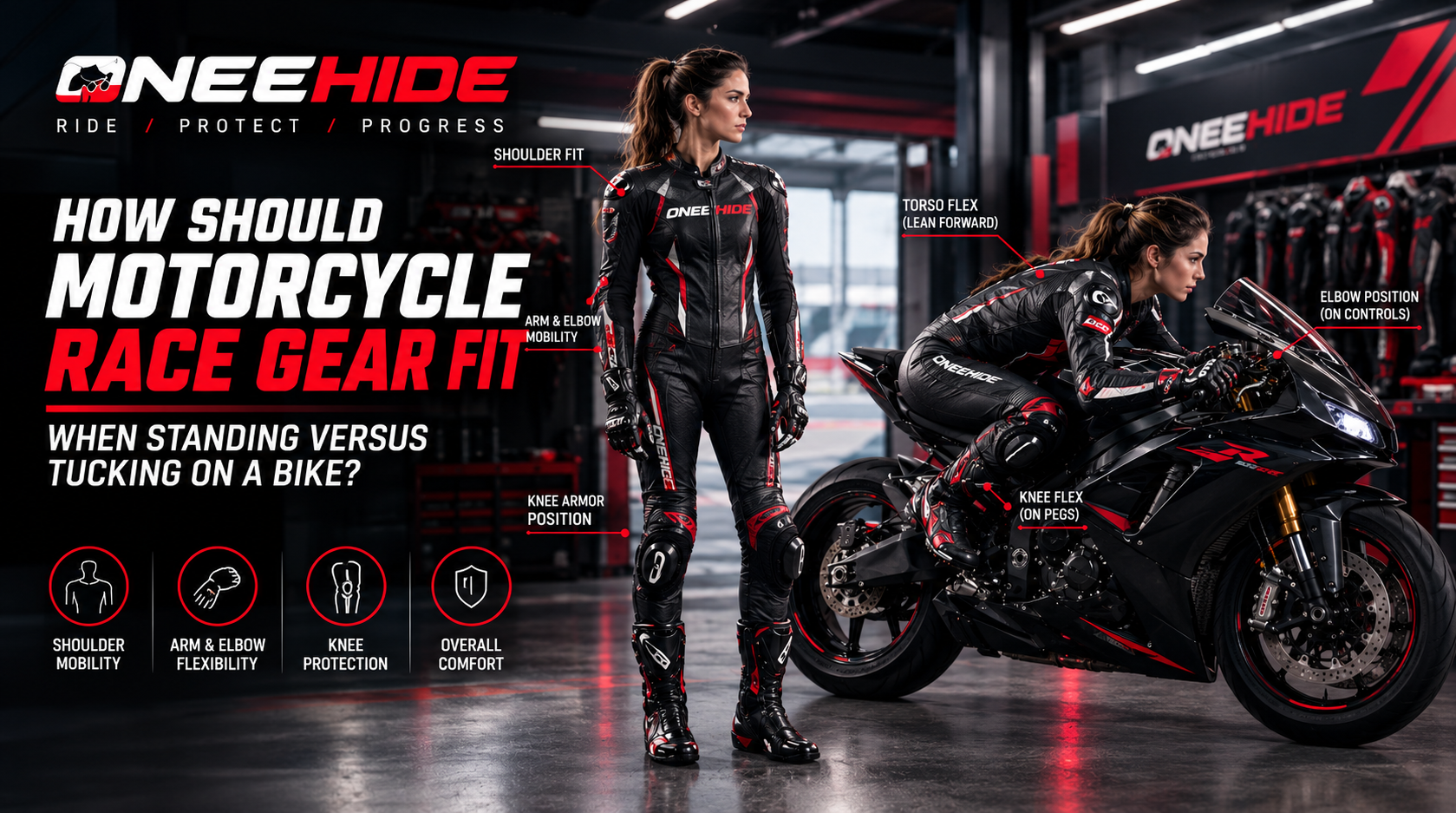

A motorcycle racing suit can feel restrictive when you stand upright yet fit correctly when you lean forward over the fuel tank. The opposite can also happen: a suit may feel comfortable in a showroom but pull across the shoulders, shift its protective armor, or restrict movement once you assume a racing position.
The difference comes down to how racing gear is designed around the rider's body. Pre-curved sleeves, articulated knees, stretch panels, and a forward-leaning torso are intended to accommodate the posture used on a sport bike. A proper fit must therefore be judged in both positions, with particular attention to protection, mobility, and pressure points.
For riders choosing a new suit, understanding these differences helps distinguish normal stiffness from genuine sizing problems. It also makes it easier to identify when a different size, a different cut, or a made-to-measure garment may be necessary.
Why Standing and Tucking Feel So Different
A racing suit is shaped around a riding posture rather than the neutral position used for everyday clothing. On a sport bike, the rider bends the elbows and knees, rotates the shoulders forward, and leans the torso toward the handlebars. Each movement changes how the garment sits against the body.
When standing upright, the suit's pre-curved construction may create tension around the knees, hips, lower back, or crotch. That tension can ease when the rider bends the joints and moves into the intended position.
The material and construction also matter. Leather has limited natural stretch, so manufacturers use strategically placed stretch panels, accordion sections, and flexible inserts to accommodate movement. The exact amount of flexibility varies between suits.
This is why riders should assess motorcycle racing suits in the position for which they were designed, rather than selecting a size based solely on how comfortable it feels while standing in front of a mirror.
A close fit is desirable, but it should not require the rider to tolerate severe pressure, restricted breathing, numbness, or difficulty operating the controls.
What Should a Racing Suit Feel Like When Standing?
Standing upright provides a useful first check for sizing, protective-component placement, and obvious construction problems. It should not be the only test, however, because racing suits are not generally cut like casual jackets and trousers.
Normal Tightness Versus a Poor Fit
A correctly sized leather race suit may feel snug through the torso, thighs, and arms. The pre-curved shape can also make the knees and elbows feel slightly bent even when the rider is standing straight.
Some resistance to movement is normal, but the suit should not cause pain or prevent ordinary movements needed to put on the gear and prepare to ride.
Look for these signs during the standing check:
-
Shoulders: The suit should sit securely without forcing the shoulders into an uncomfortable position.
-
Chest: You should be able to breathe deeply without excessive compression.
-
Arms: The sleeves should follow the bent-arm shape without severe pulling or excessive folds.
-
Hips and crotch: Mild tension from the suit's riding-oriented cut may be normal, but sharp pressure or restricted leg movement deserves attention.
-
Knees: Pre-curved legs may feel awkward when fully straightened, but the seams should not create painful pressure.
-
Wrists and ankles: The sleeves and legs should provide appropriate coverage without leaving large gaps when paired with the intended gloves and boots.
Protective components also need attention. Shoulder, elbow, hip, and knee protectors should be positioned over their intended areas, taking into account how their positions change with body movement. A protector that sits substantially out of place or moves freely inside its pocket is a reason to investigate the fit.
How Should a Racing Suit Fit in a Tucked Riding Position?
The tucked position is the more important test for a suit intended for sport riding or track use. The rider should be able to lean forward, bend the elbows, flex the knees, and reach the handlebars without excessive tension or protective components moving away from their intended positions.
If possible, try the suit on while seated on your own motorcycle or a similar stationary bike. Wear the base layers, gloves, boots, and compatible protective equipment you normally intend to use.
Check the shoulders, arms, and back
With your hands positioned as if gripping the handlebars, assess the shoulders and upper back. The suit should accommodate the forward reach without pulling painfully across the shoulder blades or forcing the sleeves to twist.
The elbows should bend naturally. Stretch panels should flex rather than become painfully taut, and elbow protectors should remain appropriately positioned over the joints.
Pay attention to the lower back, too. The suit should follow the forward lean without creating a large gap, pulling excessively at the waist, or forcing the torso into an unnatural position.
Check the knees, hips, and lower legs
Bend your knees as they would be on the motorcycle. The knee construction should allow the required bend, while the knee protectors remain aligned with the intended protection area.
Also check the following:
-
Hips: The suit should allow the hips to rotate and flex without sharp pressure or excessive looseness.
-
Thighs: The material should follow the legs without restricting movement or forming large folds.
-
Crotch and seat: The suit should accommodate the seated position without pulling the torso downward or creating painful pressure.
-
Ankles: The lower legs should work with your boots without exposing an unintended gap or preventing normal foot movement.
A suit that passes these checks is a better candidate than one that merely looks fitted. Still, a stationary fitting cannot reproduce every movement, vibration, or change in body position experienced on the track.
Standing Fit Versus Tucked Fit: What Is the Difference?
The two positions reveal different problems. Standing helps identify general sizing and obvious pressure points, while tucking reveals whether the garment's pattern, stretch panels, and protective components work with the riding posture.
|
Fit area |
Standing upright |
Tucked on the bike |
|
Torso |
May feel slightly restrictive through the chest or back |
Should allow a forward lean without excessive pulling |
|
Arms |
Pre-curved sleeves may feel unusual |
Elbows should bend naturally and reach the controls |
|
Knees |
Curved legs may resist full straightening |
Knees should bend without painful pressure |
|
Hips |
Some tension may appear around the seat |
Hips should flex without the suit pulling excessively |
|
Armor |
Check initial positioning |
Check whether protectors remain appropriately positioned |
|
Wrinkles |
Small folds may appear at joints |
Excessive bunching should not interfere with movement |
|
Breathing |
Deep breathing should remain comfortable |
The riding posture should not cause chest compression |
Neither position should be ignored. A suit that feels snug while standing but works well in the riding posture may be appropriate. A suit that feels comfortable standing but becomes painfully restrictive when tucked is not a good fit for its intended use.
How Protective Armor and Suit Construction Affect Fit
Fit is more than a question of comfort. The garment must allow movement while maintaining the intended coverage of its protective components.
Motorcycle suits use different combinations of leather panels, stretch materials, seams, linings, and impact protectors. Their construction determines how the garment responds when the rider bends, reaches, or changes posture.
Armor placement matters more than appearance
Shoulder, elbow, hip, and knee protectors should cover their intended areas when the rider moves through normal riding positions. A protector that shifts significantly can leave part of the intended area less protected.
Check the product's instructions for the correct placement and adjustment of removable armor. If a protector sits correctly while standing but moves substantially when tucked, do not assume that a tighter overall suit will automatically solve the problem. The pattern, protector pocket, or size may be unsuitable.
Also distinguish between the outer garment and its impact protectors. In the European system, the EN 17092 series addresses motorcycle protective garments, with classes including AAA, AA, A, B, and C. Individual impact protectors are assessed under separate standards, such as EN 1621-1 for specified limb and joint protectors.
The European Union's published harmonised-standard references provide a useful starting point for understanding garment classifications. Riders should verify the applicable documentation and certification for the actual product rather than relying on a general claim that a suit is protective.
Stretch panels and seams change the riding experience
Accordion panels around the knees, lower back, and elbows help accommodate bending. Stretch inserts in areas such as the crotch and inner arms can improve flexibility, depending on the design.
These features should work with the rider's natural movement rather than compensate for an incorrectly sized garment. If the suit pulls hard across several areas at once, a different size or pattern may be needed.
Seams deserve attention as well. During fitting, look for twisting, excessive tension, or construction that forces the garment away from the body. Do not attempt to solve a persistent fit problem by stretching or altering protective sections without guidance from the manufacturer or a qualified specialist.
How to Test a Motorcycle Racing Suit Before Buying
A structured fitting is more reliable than standing in front of a mirror for a few seconds. Allow enough time to notice pressure points, test the range of motion, and assess the suit with the equipment you will actually wear.
Use this practical checklist:
-
Measure before choosing a size. Compare your chest, waist, hips, inseam, and other required measurements with the manufacturer's specific size chart. Do not assume that your usual clothing size will translate directly to a race suit.
-
Fasten the suit completely. Close the zippers, adjust the cuffs, and secure the intended closures. An unfastened suit may feel more flexible than it will during use.
-
Stand and move naturally. Walk a short distance, bend your knees, raise your arms, and take a full breath. Identify any sharp pressure or restricted movement.
-
Assume the riding position. Bend forward, extend your arms, and flex your knees as if you were riding your motorcycle.
-
Recheck the armor. Inspect the shoulder, elbow, hip, and knee protectors in both positions. Follow the manufacturer's fitting instructions for their intended alignment.
-
Check compatibility with other gear. Make sure your gloves overlap the sleeves appropriately, your boots work with the lower legs, and any intended back protector or airbag system is compatible with the suit.
-
Wear it for several minutes. Some discomfort appears only after the garment has been worn for a while. Pay attention to pressure that increases rather than settles.
For a more accurate test, use a stationary motorcycle with the same general ergonomics as the bike you intend to ride. A relaxed upright road-bike position may not reveal the same problems as a deep sport-bike tuck.
When Should You Choose a Different Size or Custom Fit?
A racing suit should not be so loose that its protective components move freely, nor so tight that it prevents safe control of the motorcycle. The right choice depends on the garment's cut, your body proportions, and your intended riding position.
Consider a different size when the suit creates widespread tension across the chest, shoulders, hips, or thighs, or when the sleeves and legs are consistently too short or long. Sizing up is not always the answer, because extra room can introduce new problems with armor alignment.
A different cut or made-to-measure suit may be more appropriate when your torso, arms, and legs do not fit the same standard size range. For example, a rider with a relatively long torso may find that a suit fits the limbs but pulls across the shoulders in a tuck. Increasing the overall size could leave the knees or elbows too loose without resolving the torso issue.
Before ordering a custom garment, follow the manufacturer's measurement instructions carefully. Ask how the suit is patterned for riding posture, which protective components are included, and whether alterations are possible after fitting.
Leather may soften and settle with use, but the amount varies with the leather, construction, and care. Do not buy a suit that causes severe pressure or places armor incorrectly on the assumption that it will stretch enough to fix the problem.
How Riding Style Changes the Ideal Fit
The best fit also depends on the motorcycle and the way it is used. A suit designed for aggressive track riding may feel less comfortable while walking or standing than gear intended for touring or commuting.
-
Track riding: Prioritize mobility in a forward tuck, stable armor positioning, compatibility with track boots and gloves, and any required airbag system or competition rules.
-
Sport riding on public roads: Look for a balance between forward-leaning comfort and the more varied positions used during ordinary road riding.
-
Upright motorcycles: A strongly pre-curved racing suit may create unnecessary tension if the motorcycle's ergonomics keep the rider relatively upright. Consider whether a different garment cut is better suited to the bike.
-
Frequent walking or commuting: Comfort while standing and moving around becomes more relevant, but it should not come at the expense of appropriate protective coverage during riding.
A suit that works perfectly for one rider may not suit another, even when both riders choose the same nominal size. Body proportions, motorcycle ergonomics, protective equipment, and intended use all affect the result.
The most reliable decision is to evaluate the suit in the posture you will actually use, then confirm that it remains comfortable and correctly positioned in the other relevant positions. Standing is a useful first check; the riding tuck reveals whether the suit's design truly works for you.

