

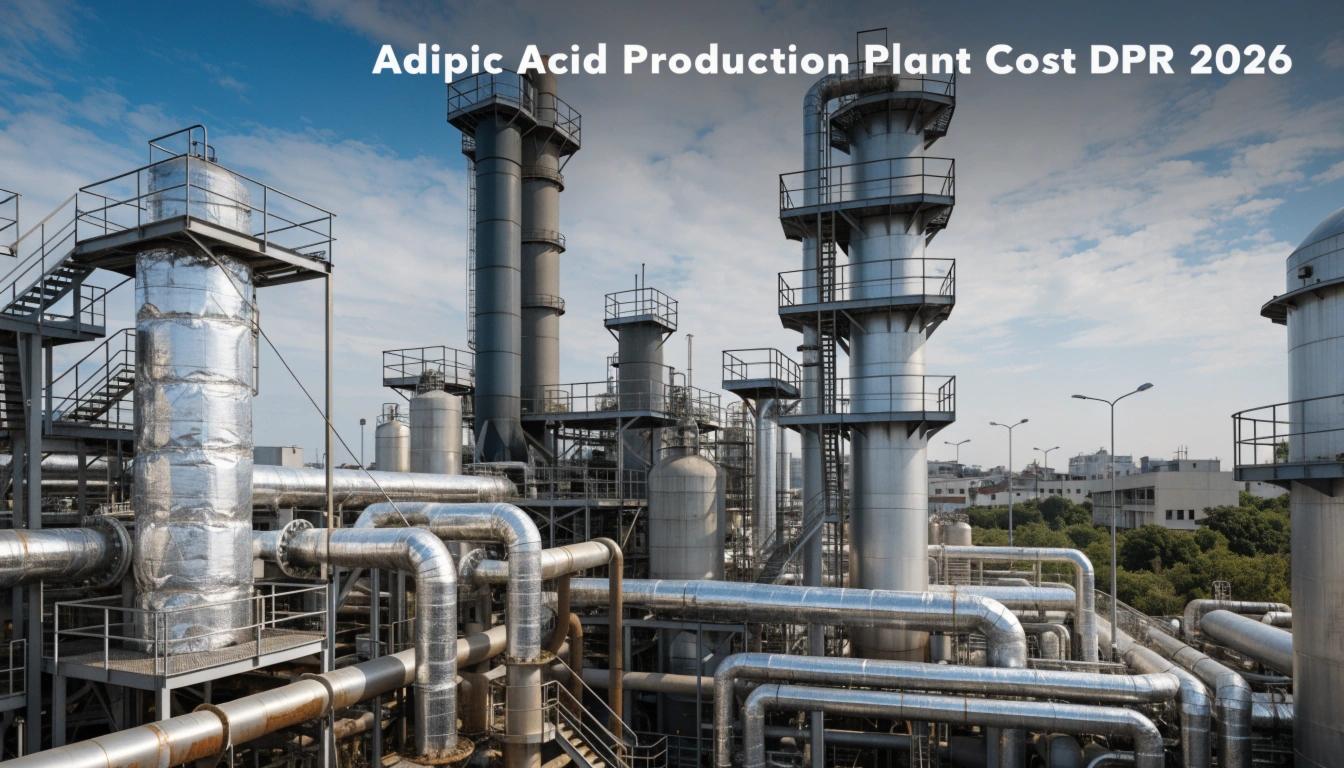
Adipic Acid Production Plant Cost 2026: Setup Details, Capital Investments, and Business Plan

Setting up an adipic acid production plant offers investors an opportunity to enter a vital segment of the global chemical industry, driven by demand from nylon, polyurethane, and industrial polymer manufacturers. Adipic acid is an important chemical intermediate primarily used in the production of nylon 6,6 fibers, engineering plastics, and other industrial materials. These materials are widely utilized in textiles, automotive components, packaging, electrical equipment, and consumer goods. As industrial applications continue to diversify, adipic acid remains an essential raw material supporting the development of durable and high-performance products across multiple end-use industries.
The adipic acid industry is expected to benefit from the expansion of textile production, rising automotive manufacturing, increasing demand for polyurethane materials, and the growing use of engineering plastics and synthetic lubricants. Furthermore, the emphasis on material durability, manufacturing efficiency, and sustainable production technologies is encouraging industry participants to improve their processes and optimize resource utilization. Preparing an adipic acid production plant DPR enables investors and entrepreneurs to evaluate capital investment, machinery requirements, manufacturing processes, operating expenses, market potential, and overall project feasibility before establishing a production facility.
Unveiling the World of Adipic Acid:
Adipic acid is a dicarboxylic acid with the chemical formula C6H10O4, appearing as a white crystalline solid with limited solubility in water. It is manufactured primarily through the oxidation of cyclohexanol and cyclohexanone, commonly processed together as KA oil, using nitric acid in the presence of a catalyst. Adipic acid dissolves readily in organic solvents and can undergo esterification and amidation reactions, while also offering low toxicity and strong thermal stability that allows it to withstand high temperatures without decomposing. The growing global demand for nylon fibers, engineering resins, and polyurethane products has made the adipic acid production plant an integral part of the specialty chemicals manufacturing sector.
What is Adipic Acid Used For?
Adipic acid is mainly used as the key raw material in the production of nylon 6,6 fibers and engineering resins, which have extensive applications across the textile and automotive industries. It is also used in manufacturing automotive components such as airbags, seatbelts, and carpets, and in producing synthetic lubricants valued for their performance and durability. Adipic acid is additionally employed in packaging materials such as films and coatings, and in the production of consumer goods including footwear, sporting goods, and electrical appliances. Because most downstream applications demand consistently high purity, the total cost of the adipic acid production plant must account for stringent quality control and purification requirements.
Plant Capacity and Production Scale:
This capacity range allows producers to cater to diverse end-use segments across the textile, automotive, packaging, and consumer goods industries, ensuring steady demand and consistent revenue streams driven by rising adipic acid consumption in nylon fiber production, engineering resin manufacturing, polyurethane applications, synthetic lubricant formulation, and other industrial uses.
Get the Sample Report: https://www.imarcgroup.com/adipic-acid-manufacturing-plant-project-report/requestsample
Key Factors for Adipic Acid Plant Setup Requirements
Establishing an adipic acid production plant requires careful consideration of several key factors that directly impact both the initial plant setup cost and long-term profitability.
● Raw Material and Feedstock Supply: The cost and availability of primary feedstocks such as cyclohexanol, cyclohexanone, and nitric acid are paramount. A secure and cost-effective supply chain is vital for managing the adipic acid manufacturing cost.
● Manufacturing Technology and Equipment: The choice of oxidation reactors, distillation and crystallization units, filtration systems, dryers, and emission recovery systems directly influences process efficiency and the final adipic acid production plant cost.
● Environmental Compliance and Approvals: Securing environmental clearances and adhering to regulations for nitrous oxide and nitric oxide emissions, effluent treatment, and waste management is essential. This ensures sustainable operations and avoids costly penalties and shutdowns.
● Location and Infrastructure: Proximity to feedstock suppliers, along with access to reliable power supply, water resources, and transportation networks, significantly impacts operational efficiency and overall adipic acid manufacturing cost analysis.
Detailed Process Flow and Quality Control
The manufacturing process for adipic acid involves a series of precisely controlled chemical operations. Initially, cyclohexanol and cyclohexanone feedstocks are stored under controlled conditions before being oxidized using nitric acid under regulated temperature and pressure to form intermediate compounds. These intermediates then undergo catalytic oxidation to form adipic acid, generating nitrous oxide as a by-product that must be captured and managed. The resulting adipic acid crystals are separated and purified through distillation, crystallization, and filtration, followed by drying to achieve the desired moisture content and purity. A thorough adipic acid production plant report would detail each of these critical steps.
● Unit Operations Involved: The process includes key stages such as feedstock oxidation, catalytic conversion, crystallization, filtration, drying, and nitric acid recovery. Each step is carefully controlled to ensure optimal yield and product quality.
● Mass Balance and Raw Material Requirements: A precise mass balance calculation is essential for determining the exact quantity of cyclohexanol, cyclohexanone, nitric acid, and catalysts needed per unit of finished adipic acid. This directly influences the total adipic acid manufacturing cost.
● Quality Assurance Criteria: Quality is assessed based on purity, particle size, and composition consistency. Technical tests, including chemical analysis, moisture content checks, and visual inspection, are performed to meet downstream processing requirements.
Buy Report Now: Checkout | Adipic Acid Production Plant Cost, DPR 2026, Setup Report
Cost of Setting Up an Adipic Acid Production Plant:
The cost of establishing an adipic acid production plant depends on plant capacity, technology selection, location, level of automation, and regulatory compliance obligations. A detailed cost assessment covering both capital and operational expenditure is essential for accurate financial planning.
CapEx and OpEx Analysis for Adipic Acid Manufacturing Cost:
● Raw Material Costs: As the largest component of variable costs, the price of cyclohexanol, cyclohexanone, and nitric acid is a major determinant of the final product's cost. Global feedstock price fluctuations significantly impact profitability and operating margins.
● Capital Investment: The initial plant setup cost for oxidation reactors, distillation and crystallization units, drying and filtration equipment, land, and construction constitutes a significant barrier to entry. This substantial one-time expense is amortized over the plant's operational life.
● Operational Costs: These include fixed costs like skilled labor, maintenance, and insurance, as well as variable costs such as utilities, catalyst replacement, and environmental compliance measures including emission control.
● Grade and Purity: The purity and particle size consistency of the adipic acid affect its suitability for nylon and resin production. Consistent quality is essential and impacts downstream processing requirements.
● Manufacturing Capacity: The scale of manufacturing significantly influences unit costs through economies of scale. Larger plants benefit from lower per-unit capital and operational costs, affecting the overall adipic acid production plant cost.
● Location and Market Conditions: The geographical location influences transportation costs for feedstocks and finished product, as well as access to skilled labor. Proximity to nylon and resin manufacturing hubs and regional market demand also affect pricing and logistics costs.
Why Invest in Adipic Acid Manufacturing?
Compelling factors:
● • Critical Raw Material for Nylon Production: Adipic acid is an essential intermediate in nylon 6,6 fiber and resin manufacturing, forming the backbone of the textile, automotive, and engineering plastics sectors
● • Alignment with Global Megatrends: Expanding textile production, rising automotive manufacturing, growth of the polyurethane industry, and increasing demand for engineering plastics are significantly increasing global adipic acid demand
● • Supply Chain Localization Advantage: Nylon and resin producers are increasingly prioritizing regional sourcing of adipic acid to reduce logistics costs, ensure consistent feedstock availability, and mitigate geopolitical and supply chain risks
● • Supportive Government Policies: Government initiatives promoting domestic chemical production, industrial development, and self-reliance in critical intermediates create a favorable investment environment for adipic acid manufacturing
● • Scalable Bulk Production: Advanced oxidation and crystallization technologies enable high-volume production with consistent quality, allowing manufacturers to achieve economies of scale while maintaining operational efficiency and cost competitiveness
Ask An Analyst: https://www.imarcgroup.com/request?type=report&id=9412&flag=C
Leading Adipic Acid Manufacturers
The market for adipic acid is dominated by several major integrated chemical companies who lead the industry in manufacturing capacity and technological advancement. These manufacturers set industry standards for quality and efficiency.
● Invista (Koch Industries)
● BASF SE
● Asahi Kasei Corporation
● Lanxess AG
● Radici Group
● Ascend Performance Materials
● Solvay S.A.
Timeline to Start the Plant
● Feasibility study and project report preparation
● Land acquisition and site development
● Regulatory approvals and environmental clearances
● Factory licence and fire safety compliance
● Machinery procurement and installation
● Raw material supplier agreements and supply chain setup
● Trial production and quality testing
● Commercial production launch
Licences and Regulatory Requirements
Starting an adipic acid production unit requires several approvals:
● Business registration (Proprietorship, LLP, or Pvt Ltd)
● Factory Licence under the Factories Act
● Environmental Clearance from State Pollution Control Board
● GST Registration
● Fire Safety NOC
● Effluent Treatment Plant (ETP) operational clearance
● Occupational Health and Safety compliance
Frequently Asked Questions:
1. How much does it cost to set up an adipic acid production plant?
The total setup cost varies depending on plant capacity, technology, and location. It typically includes expenses for land, civil construction, oxidation and crystallization equipment, filtration and drying systems, pollution control systems, utilities, and working capital. A detailed feasibility report provides accurate, project-specific cost estimates.
2. Is adipic acid manufacturing profitable in 2026?
Yes. Adipic acid manufacturing offers strong profitability potential, driven by robust demand from the nylon, automotive, polyurethane, and packaging industries. Profit margins depend on feedstock sourcing, energy costs, operational efficiency, and market prices of adipic acid.
3. What machinery is required for an adipic acid production plant?
Key equipment includes oxidation reactors, distillation columns, crystallizers, filtration systems and centrifuges, dryers, nitric acid handling and recovery systems, emission control and gas scrubbing equipment, and quality inspection instruments.
4. What licences and approvals are required to start an adipic acid production plant?
Typical requirements include business registration, factory licence, environmental clearance, GST registration, fire safety approval, and compliance with occupational health and safety regulations. Additional permits may be needed depending on local regulations.
5. What raw materials are needed for adipic acid manufacturing?
The primary raw materials include cyclohexanol and cyclohexanone (KA oil), which are oxidized using nitric acid in the presence of a catalyst. Ammonia and neutralizing agents are also used during purification and emission control.
6. What are the environmental compliance requirements for an adipic acid production plant?
Manufacturers must obtain environmental approvals, install nitrous oxide and nitric oxide emission recovery systems, and comply with emission standards, waste disposal regulations, and hazardous material handling guidelines.
7. What is the best location to set up an adipic acid production plant?
Ideal locations are those with easy access to feedstock supply, reliable power supply, strong logistics infrastructure, and proximity to downstream industries such as nylon fiber and resin manufacturers.
8. What is the break-even period for this type of plant?
The break-even period generally ranges from 5 to 8 years, depending on plant scale, capital investment, regulatory compliance costs, raw material pricing, and market demand.
9. What government incentives are available for manufacturers?
Governments may offer various incentives such as capital subsidies, tax exemptions, reduced utility tariffs, export benefits, and interest subsidies under industrial development and manufacturing promotion schemes.
Contact Us:
IMARC Group
134 N 4th St. Brooklyn, NY 11249, USA
Email: [email protected]
Tel No: (D) +91 120 433 0800
United States: (+1-201-971-6302)
