

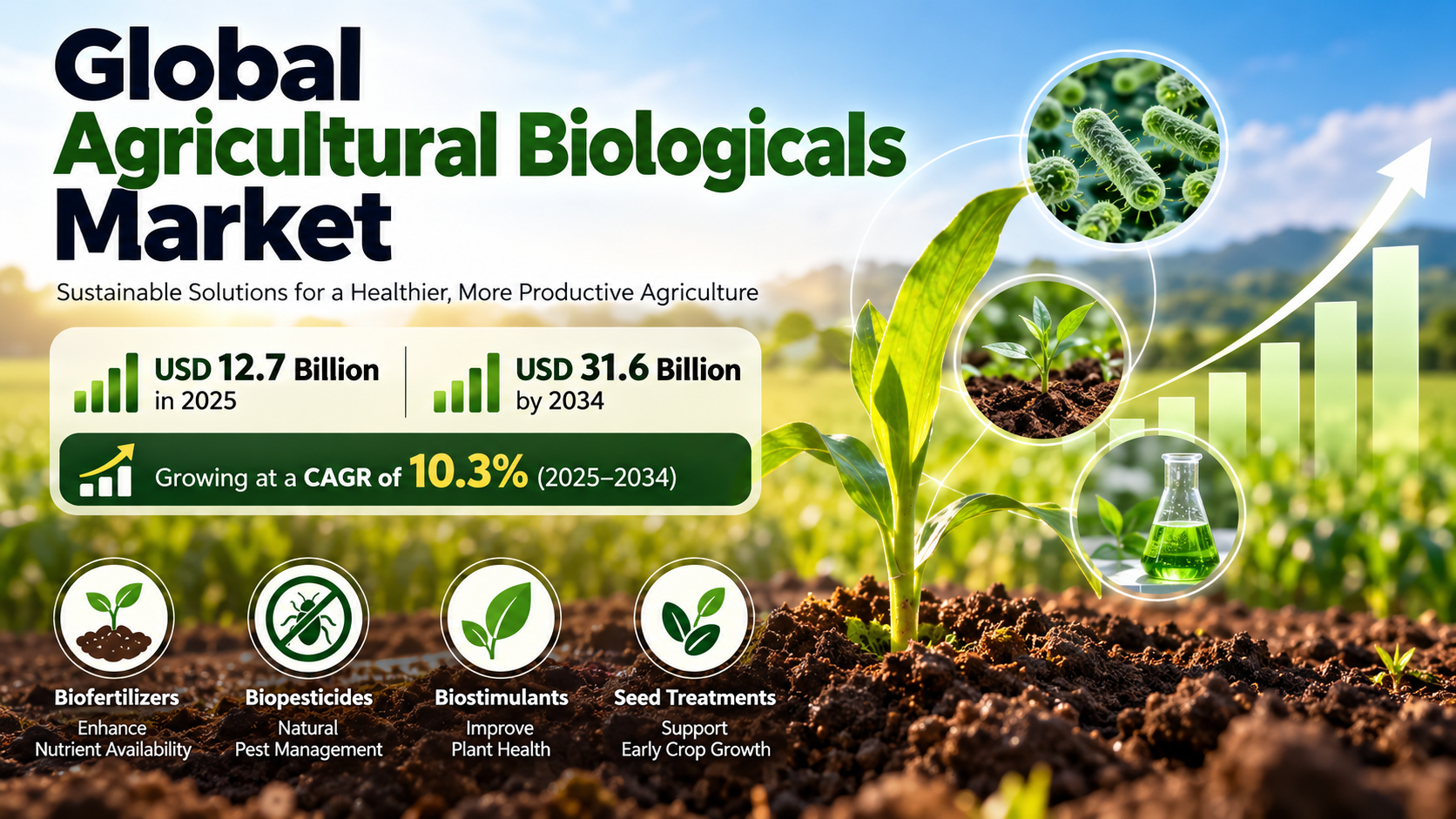

The Global Agricultural Biologicals Market is experiencing substantial growth as sustainable farming practices, biological crop protection solutions, and environmentally responsible agricultural technologies gain importance worldwide. Valued at USD 12.7 billion in 2025, the market is projected to reach USD 31.6 billion by 2034, expanding at a compound annual growth rate (CAGR) of 10.3%. Increasing concerns about soil degradation, chemical pesticide residues, and agricultural productivity are encouraging farmers to adopt biological alternatives.
Agricultural biologicals include naturally derived products developed from microorganisms, plants, animals, and biological compounds that improve crop performance, nutrient availability, and pest management. These solutions primarily include biofertilizers, biopesticides, and biostimulants. Unlike conventional chemical-intensive approaches, biological products support integrated crop management while helping agricultural producers improve soil fertility, maintain plant health, and manage environmental pressures.
According to Dimension Market Research, expanding organic agriculture, technological developments in microbial formulations, and growing investment in sustainable crop management are creating opportunities for biological input manufacturers. Agricultural producers are increasingly integrating biological products with conventional farming systems rather than relying exclusively on synthetic inputs. This transition is encouraging innovation across seed treatments, soil applications, foliar products, and targeted pest control solutions.
📄 Looking for Specific Data? Get a Free Customized Sample:
https://dimensionmarketresearch.com/request-sample/agricultural-biologicals-market/
Agricultural Biologicals Market Overview
The agricultural biologicals industry represents an expanding component of the global agricultural inputs sector. Its growth reflects the increasing need to produce food efficiently while protecting soil health, biodiversity, and natural resources. Agricultural biologicals offer targeted solutions that support nutrient utilization, plant development, and biological control of insects and pathogens.
The market is benefiting from advances in microbiology, biotechnology, and formulation technologies. Manufacturers are developing microbial strains with improved stability, longer shelf life, and greater compatibility with existing farming equipment. These improvements are particularly important for commercial agriculture, where predictable product performance influences purchasing decisions.
Rising demand for residue-conscious food production also contributes to adoption. Farmers supplying export markets and premium food categories are exploring biological crop protection products to complement conventional pest management programs and address changing buyer expectations.
Key Findings of the Global Agricultural Biologicals Market
● Market valuation reached USD 12.7 billion in 2025.
● Market revenue is projected at USD 31.6 billion by 2034.
● The forecast CAGR is 10.3% from 2025 to 2034.
● North America held a leading 36.4% market share in 2024.
● Asia-Pacific is anticipated to record the fastest regional growth.
● Cereals and grains lead agricultural biologicals demand by crop type.
● Crop protection is the leading functional segment.
● Seed treatment is the leading application segment.
● Sustainable farming is a major catalyst for biological inputs.
These findings indicate that agricultural biologicals are moving toward broader commercial adoption. Manufacturers that combine effective formulations, agricultural expertise, and reliable distribution networks are positioned to benefit from expanding demand.
Agricultural Biologicals Market Dynamics
Market dynamics are shaped by environmental priorities, agricultural productivity requirements, technological innovation, and changing expectations regarding chemical inputs. Although demand is increasing, manufacturers must address performance consistency, affordability, and farmer awareness to support sustained market penetration.
Growth Drivers: What Is Driving the Agricultural Biologicals Market?
Increasing Demand for Sustainable Agriculture
Sustainable agriculture is one of the primary forces supporting market expansion. Conventional agricultural practices can contribute to soil degradation, nutrient imbalances, and environmental contamination when inputs are applied inefficiently. Biological alternatives offer opportunities to improve crop management while supporting soil microbial activity and more targeted pest control.
Government initiatives encouraging environmentally responsible farming practices are also influencing agricultural investment decisions. Support for research, biological crop protection, and resource-efficient agriculture is creating a favorable environment for product innovation.
Growing Need for Agricultural Productivity
Increasing food requirements and pressure on agricultural resources are encouraging producers to adopt advanced biological solutions. Biofertilizers improve nutrient availability, while biostimulants can support plant resilience under certain environmental stresses.
● Biological inputs support integrated crop management.
● Biofertilizers improve nutrient availability and soil activity.
● Biopesticides offer targeted pest management alternatives.
● Seed treatments support early crop establishment.
Market Challenges and Restraints
Despite strong growth potential, biological agricultural products face several commercialization challenges. Product effectiveness can vary depending on temperature, soil composition, moisture, microbial interactions, and pest pressure. This variability creates uncertainty among growers accustomed to established chemical crop protection programs.
Production costs, specialized storage requirements, and distribution limitations can also restrict adoption. Smaller farming operations may hesitate to purchase biological products without clear evidence of economic returns.
Major Challenges
● Variable field performance across environmental conditions.
● Higher initial costs for selected biological formulations.
● Limited distribution networks in some rural markets.
● Technical knowledge gaps among agricultural producers.
● Storage and shelf-life requirements for microbial products.
Addressing these challenges requires stronger field validation, farmer training, improved packaging, and agricultural advisory services.
Emerging Agricultural Biologicals Market Trends
Advancements in Microbial Technology
Microbial innovation is transforming biological agricultural inputs. Research into beneficial bacteria, fungi, and naturally occurring compounds is enabling manufacturers to develop products targeting specific agricultural challenges.
Improved microbial screening, fermentation processes, and formulation technologies are helping companies pursue better product stability and consistent agricultural performance. Research is also expanding into combinations of microorganisms that may support complementary plant-growth functions.
Integration with Precision Agriculture
Precision agriculture creates opportunities for efficient biological product application. Digital farming platforms, crop monitoring systems, and precision spraying technologies can help farmers identify application requirements and improve resource utilization.
The integration of biological crop protection with data-driven agricultural management is particularly relevant for commercial farms seeking stronger productivity and sustainability outcomes.
Growing Interest in Integrated Crop Management
Agricultural biologicals are increasingly being positioned as complementary tools within integrated crop management systems. Biological pesticides, microbial fertilizers, and conventional agricultural inputs can serve different purposes throughout the production cycle.
● Microbial formulations are attracting research investment.
● Precision application can improve input efficiency.
● Biological seed coatings are expanding treatment options.
● Integrated farming encourages targeted biological adoption.
Agricultural Biologicals Market Segmentation Overview
The market is segmented by crop type, function, application, and source. Each category reflects different agricultural requirements and opportunities for manufacturers.
By Crop Type
Cereals and Grains
Cereals and grains represent the leading crop segment, supported by extensive cultivation of wheat, rice, corn, barley, and other staple crops. Biological products are used to improve nutrient availability, support crop establishment, and manage selected agricultural pests.
Oilseeds and Pulses
Oilseeds and pulses present opportunities for microbial inoculants, particularly products supporting nitrogen fixation and root development. Biological treatments are relevant to crops such as soybean, chickpea, and other legumes.
Fruits and Vegetables
Fruits and vegetables are important application areas because growers frequently manage disease pressure, product quality requirements, and residue-related expectations. Biological pest control and crop nutrition products can complement existing horticultural practices.
By Function
Crop protection represents the leading functional segment, primarily supported by biopesticides and biological control agents. These products help manage insects, pathogens, and other agricultural threats through biological mechanisms.
Crop nutrition includes biofertilizers, biostimulants, and organic fertilizers. Biofertilizers contribute to nutrient cycling, while biostimulants support selected physiological processes and plant responses to environmental stresses.
By Application
Seed treatment is the leading application segment because biological formulations can be introduced during early crop development. Seed-applied biologicals are designed to improve germination conditions, root establishment, and protection against selected soil-borne threats.
Other applications include foliar spraying, soil treatment, and post-harvest management.
By Source
● Microbials: Beneficial bacteria, fungi, and related organisms.
● Natural products: Plant-derived and biological compounds.
● Macrobials: Beneficial insects and other control organisms.
● Semiochemicals: Compounds used in pest communication systems.
Agricultural Biologicals Market Opportunities
Developing agricultural economies offer significant expansion opportunities as growers seek alternatives that improve productivity while managing environmental constraints. Countries with large farming populations represent important markets for affordable biofertilizers, targeted pest management products, and locally adapted microbial formulations.
Manufacturers can strengthen their competitive positioning through partnerships with agricultural cooperatives, research institutions, distributors, and farming organizations. Demonstration programs and field trials are especially valuable because farmers often prioritize measurable crop performance before adopting unfamiliar technologies.
Product differentiation also creates opportunities. Biological formulations developed for specific soil conditions, climatic environments, or crop varieties may help companies serve agricultural requirements more effectively.
📘 Purchase the Report for Comprehensive Details:
https://dimensionmarketresearch.com/checkout/agricultural-biologicals-market/
Agricultural Biologicals Market Regional Analysis
North America Agricultural Biologicals Market
North America led the global market in 2024 with a 36.4% revenue share. The region's leadership is supported by established agricultural manufacturers, advanced farming infrastructure, technological innovation, and substantial research capabilities.
The United States plays a central role in regional development because of its extensive agricultural production systems and presence of major agricultural input companies. Continuous improvements in farming technologies, product formulations, and sustainable agricultural practices are supporting market expansion.
Canada also offers opportunities through growing interest in soil health, crop productivity, and environmentally responsible agricultural inputs.
Asia-Pacific Agricultural Biologicals Market
Asia-Pacific is anticipated to experience the fastest regional growth during the forecast period. Major agricultural economies, including China, India, Japan, South Korea, and Southeast Asian countries, are increasingly exploring biological alternatives.
Growing food requirements, soil management challenges, and government initiatives supporting sustainable agricultural practices are contributing to regional demand.
Europe Agricultural Biologicals Market
Europe represents an important market for biological crop protection and nutrition products. Environmental priorities, agricultural sustainability initiatives, and demand for responsibly produced food are encouraging interest in biological farming technologies.
Manufacturers are focusing on regulatory compliance, product validation, and crop-specific solutions to address diverse European agricultural requirements.
Latin America Agricultural Biologicals Market
Latin America presents expansion opportunities, particularly in Brazil and Argentina, where commercial crop cultivation creates demand for biological nutrient management and crop protection.
Large-scale soybean, corn, and sugarcane cultivation supports opportunities for microbial inoculants and biological pest management programs.
Middle East and Africa Agricultural Biologicals Market
Agricultural biologicals adoption across the Middle East and Africa is developing alongside efforts to improve soil productivity, water efficiency, and agricultural resilience.
Products suited to challenging growing environments could become increasingly valuable as regional agricultural systems pursue more efficient input management.
Agricultural Biologicals Market Competitive Landscape
Competition in the agricultural biologicals industry centers on product performance, technological capabilities, distribution reach, and agricultural partnerships. Established agricultural input manufacturers are expanding their biological portfolios through research, product development, acquisitions, and commercial alliances.
Prominent companies identified in the market include BASF SE, Bayer AG, UPL, Corteva Agriscience, Syngenta AG, Lallemand, Valent BioSciences, and Pro Farm Group.
Smaller biological technology specialists also contribute through microbial strain development, crop-specific formulations, and regional distribution partnerships.
Competitive differentiation increasingly depends on documented product efficacy, formulation reliability, regulatory approvals, and the ability to integrate biological products into existing farm management practices.
Future Market Outlook: Agricultural Biologicals Market Through 2034
The agricultural biologicals industry is expected to maintain strong growth as biotechnology innovations and sustainable agriculture requirements influence agricultural investment strategies.
The projected increase from USD 12.7 billion in 2025 to USD 31.6 billion by 2034 reflects substantial commercial opportunities across crop nutrition and biological pest management.
Future market development will increasingly depend on scalable manufacturing, reliable field performance, competitive pricing, and farmer education. Companies offering crop-specific solutions supported by technical services may be better positioned to secure long-term customers.
● Biological products will gain relevance in sustainable farming.
● Microbial innovation will support product differentiation.
● Asia-Pacific offers considerable expansion opportunities.
● Distribution partnerships will influence adoption rates.
Frequently Asked Questions About the Agricultural Biologicals Market
1. What is the global agricultural biologicals market size?
The market was valued at USD 12.7 billion in 2025 and is projected to reach USD 31.6 billion by 2034, expanding at a CAGR of 10.3%.
2. What are agricultural biologicals used for?
Agricultural biologicals are used for crop protection, plant nutrition, soil health improvement, seed treatment, and selected post-harvest applications. They help growers manage pests, improve nutrient availability, and support crop development.
3. Which region leads the agricultural biologicals market?
North America led the global market with a 36.4% share in 2024, supported by advanced agricultural technologies, established manufacturers, and sustainable farming initiatives.
4. Which segment dominates agricultural biologicals demand?
Cereals and grains represent the leading crop segment. Crop protection leads by function, while seed treatment represents the leading application category.
5. What factors will influence agricultural biologicals market growth through 2034?
Major factors include sustainable farming adoption, microbial biotechnology advancements, biological pest management demand, agricultural productivity requirements, and expanding distribution across developing economies.
Summary of Key Insights
The Global Agricultural Biologicals Market is evolving into an increasingly important part of modern agriculture. With projected revenue of USD 31.6 billion by 2034 and a 10.3% CAGR, biological crop protection and nutrition products offer substantial opportunities for manufacturers, agricultural distributors, and technology developers.
North America's established agricultural ecosystem supports its market leadership, while Asia-Pacific presents significant expansion potential. Cereals and grains, crop protection, and seed treatment remain central to market demand.
Continued advances in microbial technologies, improved formulation performance, and stronger collaboration between manufacturers and growers will help determine adoption rates. As agriculture increasingly balances productivity with environmental responsibility, biological solutions are positioned to play a growing role in global crop management strategies.
Related Reports:
https://dimensionmarketresearch.com/report/biopesticides-market/
https://dimensionmarketresearch.com/report/crop-protection-chemicals-market/
