

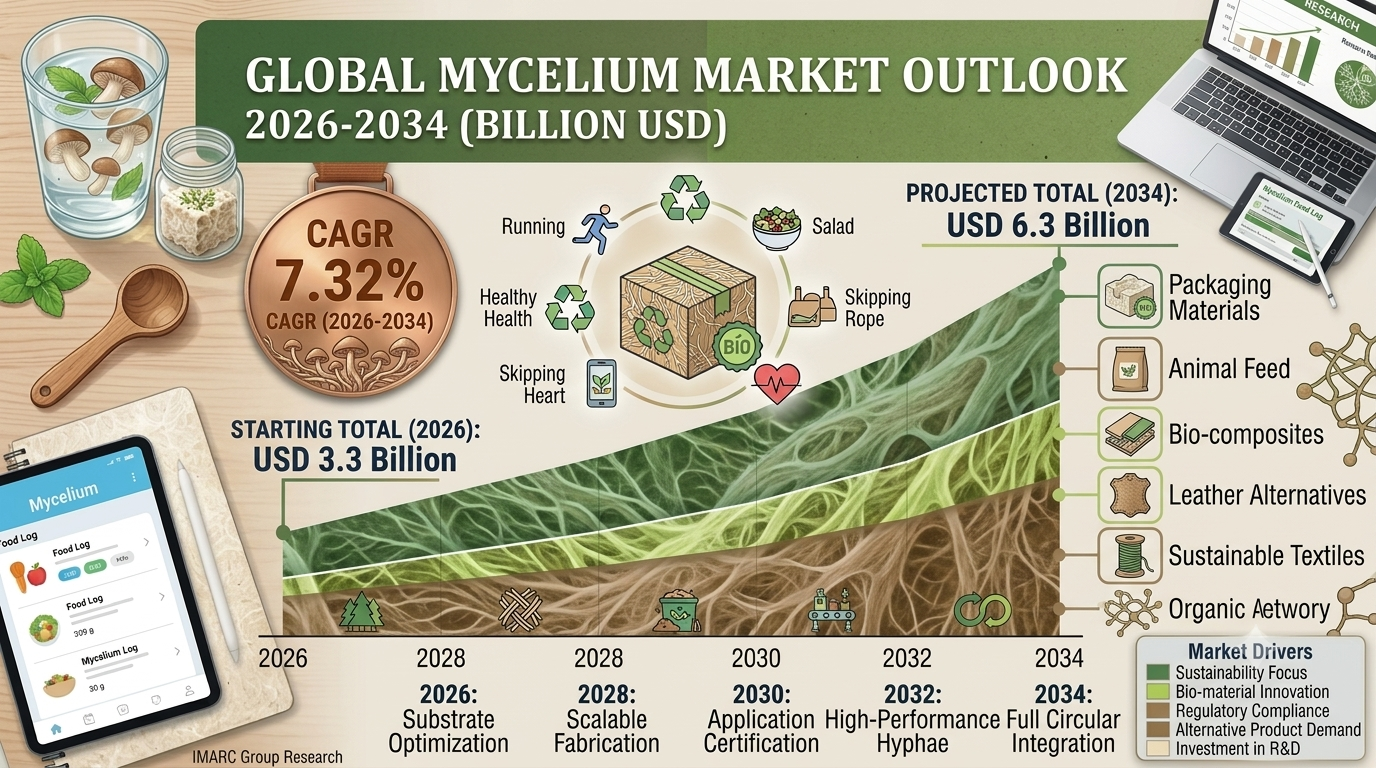
Mycelium Market Size, Share, In-Depth Insights, Analysis and Forecast 2026-2034

According to IMARC Group, the global mycelium market size reached USD 3.3 Billion in 2025 and is projected to reach USD 6.3 Billion by 2034, expanding at a CAGR of 7.32% during 2026-2034. This steady mycelium market growth reflects rising demand for alternative proteins, tightening environmental regulations on plastics and synthetic materials, and the rapid commercialization of fermentation-based biomaterials across food, packaging, textile, and construction sectors worldwide.
Mycelium Industry Overview
Mycelium is the vegetative, thread-like root structure of fungi, cultivated through fermentation into a versatile biomaterial that can be grown into sheets, blocks, powders, or custom-molded shapes. By leveraging the natural growth behavior of fungal networks, manufacturers can engineer materials with a combination of biodegradability, structural strength, and low resource intensity that conventional plastics, synthetic leather, and foams cannot match on sustainability metrics.
Mycelium is deployed across a broad continuum of commercial use cases:
- Food and beverages: Meat substitutes, dairy alternatives, and functional protein ingredients with a fibrous, muscle-like texture
- Packaging: Biodegradable, compostable protective packaging, cushioning materials, and food containers that replace plastic and polystyrene
- Clothing and apparel: Leather-alternative textiles for footwear, bags, accessories, and upholstery
- Animal feed: High-protein, highly digestible feed ingredients that reduce dependency on soy and fishmeal
- Construction, pharmaceuticals, and cosmetics: Insulation panels, bioactive compounds for drug development, and antioxidant-rich skincare formulations
Global Mycelium Market Size & Key Statistics
Below are the key mycelium market statistics drawn from IMARC Group's comprehensive market analysis:
|
Report Attribute |
Key Statistics |
|
Base Year |
2025 |
|
Historical Period |
2020-2025 |
|
Forecast Period |
2026-2034 |
|
Mycelium Market Size in 2025 |
USD 3.3 Billion |
|
Market Forecast in 2034 |
USD 6.3 Billion |
|
Market Growth Rate (2026-2034) |
7.32% CAGR |
|
Largest Region |
North America |
|
Leading Product Type Segment |
Powder (38.5% share in 2025) |
|
Leading Nature Segment |
Processed (78.5% share in 2025) |
|
Leading Application |
Food and Beverages |
Request for a Sample Report for Detailed Mycelium Market Share Evaluation: https://www.imarcgroup.com/mycelium-market/requestsample
Key Market Drivers & Mycelium Market Trends in 2026
Several powerful forces are shaping mycelium market trends and fuelling sustained growth expectations across global biomaterials and alternative-protein markets:
1. Growing Demand for Alternative Proteins and Meat Substitutes
Rising consumer demand for plant-based and sustainable food options is driving the use of mycelium as a meat substitute and alternative protein. Mycelium-based proteins offer a meat-like texture, high nutritional value, and efficient production with minimal land and water use, positioning mycelium as a compelling alternative to soy and pea protein in the evolving alternative-protein landscape.
2. Increasing Demand for Mycelium-Based Textiles
The textile industry is shifting toward mycelium-based materials as a biodegradable, resource-efficient alternative to animal-derived leather and synthetic petroleum-based fibers. Lower water, energy, and chemical requirements, combined with durability and aesthetic appeal, are driving adoption across fashion and upholstery supply chains seeking to meet waste-reduction and carbon-emission regulations.
3. Rising Applications in the Construction Industry
Mycelium composites are gaining traction in construction for insulation panels, bricks, and acoustic materials due to their lightweight, fire-resistant, and biodegradable properties. Companies are developing fungal-based materials as replacements for carbon-intensive concrete, while researchers explore self-healing structures and bio-receptive facades for sustainable architecture.
4. Shift Toward Eco-Friendly Materials Across Industries
The broader shift toward sustainable materials is accelerating mycelium adoption in packaging, textiles, and construction. Mycelium-based composites are biodegradable, lightweight, and durable, making them viable alternatives to plastics, synthetic foams, and leather as companies integrate them into supply chains to meet sustainability goals and regulatory requirements for reduced carbon footprints.
5. Regulatory Support and Corporate Sustainability Initiatives
Strong research capabilities, government support, and corporate sustainability commitments are accelerating commercialization, particularly in North America and Europe, where escalating demand for eco-friendly alternatives is strengthening regional mycelium market share across the food and beverage, packaging, and textile sectors.
Key Market Segmentation
By Product Type
- Pre-Formed Product
- Powder
- Tablets & Capsules
- Liquid
- Others
Powder - Largest Segment: Powder accounted for 38.5% of the market in 2025, owing to its versatility, ease of incorporation, and extended shelf life. It is widely used in plant-based protein formulations, meat alternatives, dairy substitutes, functional food and nutraceutical products, and skincare formulations, with companies refining drying and milling processes to improve solubility and functionality.
By Nature
- Raw
- Processed
Processed - Largest Segment: Processed mycelium held 78.5% of the market in 2025, driven by enhanced functionality, improved shelf stability, and an expanded application range across meat substitutes, dairy alternatives, biodegradable packaging composites, sustainable leather alternatives, and fire-resistant insulation materials.
By Application
- Food and Beverages
- Packaging
- Clothing and Apparel
- Animal Feed
- Others
Food and Beverages - Leading Application: The food and beverages segment is expanding as mycelium gains traction as a sustainable protein source and texturizing agent, with its fibrous structure mimicking animal proteins to improve texture and sensory appeal while acting as a natural thickener in plant-based formulations.
Packaging, clothing and apparel, and animal feed round out the application landscape, with mycelium-based packaging replacing plastic and polystyrene, textiles offering a leather alternative, and feed formulations enhancing gut health and feed conversion ratios. The "Others" category spans construction, pharmaceuticals, cosmetics, and biomedical applications such as wound healing and tissue engineering.
Regional Mycelium Market Analysis
|
Region |
Key Highlights |
|
North America - Largest |
United States & Canada; strong R&D capabilities, advanced biotechnology infrastructure, government support, corporate sustainability initiatives, and a dense startup and investor ecosystem |
|
Europe |
Germany, France, UK, Italy, Spain, Others; strict environmental regulations, strong government support for sustainable materials, F&B adoption of mycelium-based meat substitutes, and funded fungal-biotechnology research initiatives |
|
Asia Pacific |
China, Japan, India, South Korea, Australia, Indonesia, Others; expanding fermentation-based production, rising environmental and health consciousness, and growing investment in affordable mycelium-derived protein |
|
Latin America |
Brazil, Mexico, Others; rich biodiversity supporting fungal-biotechnology research, growing interest in biodegradable packaging, and government policies promoting sustainable agriculture |
|
Middle East & Africa |
Growing interest in sustainable construction, food innovation, and biodegradable packaging, with early-stage adoption supported by rising investment and policy support |
North America leads the global mycelium market share, underpinned by strong research and development capabilities, advanced biotechnology infrastructure, and a well-established ecosystem of startups, academic institutions, and investors. Within North America, the United States accounted for 81.70% of the regional market, driven by significant investment in biotechnology, sustainable materials, and alternative proteins.
Asia Pacific represents a fast-growing regional market, supported by expanding fermentation-based production capacity, rising environmental consciousness, and a shift toward plant-based foods that is increasing the region's demand for scalable, cost-effective mycelium protein production.
Connect for Detailed Mycelium Market Share Segmentation Analysis - Speak to an Analyst: https://www.imarcgroup.com/request?type=report&id=27828&flag=C
Leading Players in the Global Mycelium Industry
The global mycelium market features a mix of food-technology innovators, materials-science specialists, and biotechnology companies. Key companies covered in the IMARC Group report include:
- MyForest Foods Co.
- Biomyc Ltd.
- Bolt Threads
- Ecovative LLC
- Four Sigma Foods, Inc.
- Fungi Perfecti, LLC
- GROWN bio
- Meati Inc.
- MOGU S.r.l.
- MycoBee Mushrooms C.I.C.
- Mycotech Lab
- Mycoworks Inc.
Latest Mycelium Market Industry Developments
October 2024 - Fungi Perfecti, LLC
Fungi Perfecti launched BrainPower Stack™, a mycelium-based brain health supplement combining Lion's Mane mushroom with Niacin (B3) and Vitamin B12, developed by mycologist Paul Stamets to support memory, cognition, and nerve regeneration, now available online and in US health food stores.
July 2024 - MycoWorks Inc.
MycoWorks announced a collaboration with Cadillac to incorporate Fine Mycelium™ materials into the SOLLEI concept vehicle, marking the first automotive application of its bio-based material, developed in partnership with General Motors.
June 2024 - MyForest Foods Co.
MyForest Foods introduced its mycelium-derived MyBacon strips on the US West Coast via online retailer Good Eggs, created from organic oyster mushroom mycelium as a sustainable replacement for bacon.
January 2024 - MOGU S.r.l.
Italian biotech company Mogu secured €11 million in Series A funding to expand its mycelium-derived materials business and establish a new manufacturing facility, with the company soon rebranding as SQIM to develop sustainable alternatives for textiles, leather, interiors, and automotive applications.
January 2024 - Infinite Roots
German biotech company Infinite Roots raised $58 million in a Series B round to scale mycelium-based products and expand production, with investors including Dr. Hans Riegel Holding, REWE Group, and Betagro Ventures.
About Us
IMARC Group is a leading global market research company providing data-driven insights and expert consulting services to businesses seeking to achieve their strategic objectives. With a multi-disciplinary team of industry experts, IMARC delivers thorough, reliable market intelligence across sectors including Healthcare, Technology, Chemicals, Energy, Food & Beverages, and more.
Contact Us
IMARC Group
United States: +1-201-971-6302
India: +91-120-433-0800
United Kingdom: +44-753-714-6104
