

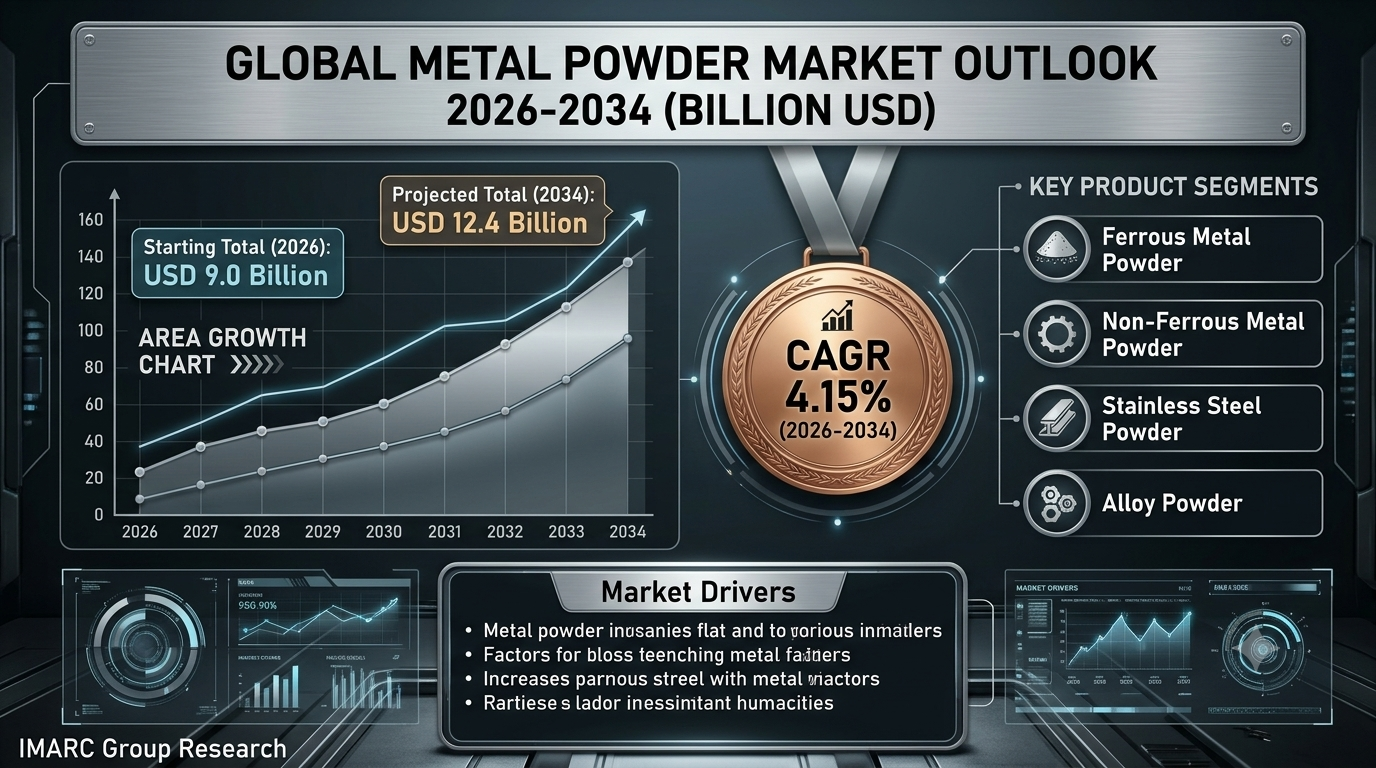

According to IMARC Group, the global metal powder market size increased from USD 8.5 Billion in 2025 to USD 9.0 Billion in 2026, and is projected to reach USD 12.4 Billion by 2034, expanding at a CAGR of 4.15% during 2026-2034. This steady metal powder market trends trajectory reflects rising demand for lightweight components in the automotive and aerospace sectors, growing adoption of additive manufacturing, continuous advances in powder metallurgy technologies, and increasing requirements for cost-efficient, high-performance materials across diverse industrial end uses.
Metal Powder Industry Overview
Metal powders are alloys processed into fine, grain-like particles through atomization, chemical, electrolysis, and solid-state reduction techniques. Manufactured primarily from stainless steel, brass, copper, iron, and bronze, they are engineered to deliver the precise material properties required for a given application. Compared with conventional metal-forming processes, metal powders consume less energy, improve material utilization, and require fewer manufacturing steps, while enabling the production of complex geometries such as irregular curves, radial projections, keyways, splines, counterbores, bosses, and axial projections.
A core use case is powder metallurgy, where compacted powdered metals are heated below their melting point to form finished parts and components, offering reduced manufacturing time, cost efficiency, high-volume capability, minimal wastage, and enhanced recyclability. Metal powders are deployed across a broad continuum of use cases:
- Automotive components: Gears, bearings, bushings, shock absorbers, anti-lock braking systems, exhaust systems, chassis parts, variable valve timing systems, exhaust gas recirculation systems, and turbochargers
- Aerospace and defense: High-strength, lightweight structural and engine components manufactured through additive manufacturing and powder metallurgy
- Healthcare applications: Connecting and blacking plates, surgical blades, forceps, graspers, and blacking hooks
- Electronics and energy: Electric vehicle batteries, electronic gadgets, and magnetic composites
- Industrial and specialty uses: Chemical processes, food supplements and additives, friction materials, polymer filtration, printing, surface coatings, and welding
Global Metal Powder Market Size & Key Statistics
Below are the key metal powder market size statistics drawn from IMARC Group's comprehensive market analysis:
|
Report Attribute |
Key Statistics |
|
Base Year |
2025 |
|
Historical Period |
2020-2025 |
|
Forecast Period |
2026-2034 |
|
Metal Powder Market Size in 2025 |
USD 8.5 Billion |
|
Metal Powder Market Size in 2026 |
USD 9.0 Billion |
|
Market Forecast in 2034 |
USD 12.4 Billion |
|
Market Growth Rate (2026-2034) |
4.15% CAGR |
|
Largest Region |
Asia Pacific |
|
Leading Material Segment |
Ferrous |
|
Leading Technology Segment |
Pressing and Sintering |
|
Leading Application Segment |
Automotive |
Request for a Sample Report for Detailed Metal Powder Market Share Evaluation: https://www.imarcgroup.com/metal-powder-market/requestsample
Key Market Drivers & Metal Powder Market Trends in 2026
Several powerful forces are shaping metal powder market trends and fuelling sustained growth expectations across global manufacturing and industrial materials markets:
1. Rising Demand for Lightweight Automotive and Aerospace Components
The ever-growing demand for high-strength and lightweight materials in the aerospace and automotive industries continues to fuel metal powder adoption. Manufacturers increasingly rely on powder metallurgy to produce gears, bearings, bushings, and structural components for engine, transmission, and chassis systems, enabling precise production with minimal material loss while supporting fuel-efficiency and emission-reduction targets.
2. Expansion of Additive Manufacturing and 3D Printing
The growing use of additive manufacturing is a defining force behind the market's expansion. Metal powders, particularly ferrous types such as stainless steel and tool steel, are increasingly used in layer-by-layer 3D printing processes that enable rapid prototyping, design flexibility, and on-demand production of complex, high-precision components across aerospace, automotive, and industrial applications.
3. Advances in Powder Metallurgy and Atomization Technologies
Continuous improvements in manufacturing technologies, including plasma atomization and gas atomization, are reducing production costs while optimizing powder quality and consistency. These advances are making metal powders increasingly affordable and accessible for price-sensitive industries, broadening their application scope across both established and emerging end-use sectors.
4. Growing Emphasis on Cost Efficiency and Material Sustainability
Rising interest in reducing energy consumption and material wastage during production is increasing the attractiveness of metal powders, given their low wastage and high recyclability relative to conventional metal-forming techniques. This sustainability advantage is becoming a key purchasing consideration for manufacturers across automotive, industrial, and consumer-facing end markets.
5. Rapid Urbanization and Industrialization in Emerging Markets
According to industry reports, approximately 80% of the public resides in urban areas in many high-income countries, while urbanization in upper-middle-income nations ranges between 50% and 80%. This rapid urbanization and industrialization in emerging economies is fuelling demand for sophisticated metal-based products used in construction, heavy equipment, agricultural machinery, motorcycles, and home appliances.
6. Expanding Use in Electric Vehicles and Electronics
The increasing application of metal powders in electronic devices, including electric vehicle batteries and electronic gadgets, is strengthening market growth. As the automotive industry shifts toward electrification, metal powders are becoming increasingly important for motors, battery systems, and magnetic components used in next-generation vehicle platforms.
7. Growing Adoption in Healthcare and Specialty Applications
The rising demand for metal powders in the healthcare industry, used to produce connecting and blacking plates, surgical blades, forceps, graspers, and blacking hooks, is bolstering market growth. This diversification beyond traditional automotive and industrial applications is broadening the addressable market for metal powder manufacturers globally.
Key Market Segmentation
By Material
- Ferrous -- Largest Segment: Ferrous powders, comprising iron and its alloys, are extensively used across industries owing to their affordability, superior mechanical strength, wear resistance, and magnetic character. The automotive sector depends heavily on ferrous powders for manufacturing gears, bearings, and sintered components that aid fuel efficiency and weight-reduction programs. Growing use of additive manufacturing has further boosted demand for high-quality ferrous powders such as stainless steel and tool steel types, supported by their recyclability and ease of processability.
- Non-Ferrous: Non-ferrous metal powders, including aluminum, copper, brass, and bronze, serve applications requiring corrosion resistance, electrical conductivity, or lighter weight, spanning electronics, friction materials, and specialty industrial components.
By Technology
- Pressing and Sintering -- Largest Segment: One of the most traditional and widely used production methods, pressing and sintering compacts metal powders at high pressure into shape before heating the compacted component below its melting temperature for bonding and densification. The process is valued for producing highly accurate, intricate parts with minimal material wastage, and is extensively applied across automotive, aerospace, and machinery industries for gears, bushings, filters, and structural components.
- Metal Injection Molding: Combines the design flexibility of plastic injection molding with the material properties of metal, enabling high-volume production of small, complex-shaped components.
- Additive Manufacturing: Encompasses layer-by-layer 3D printing techniques that use metal powders to build complex, high-precision parts with reduced material waste and design freedom.
- Others: Includes metal spraying, hot isostatic pressing, and related powder-based fabrication techniques used in specialty applications.
By Application
- Automotive -- Largest Segment: The automotive industry's ongoing need for light, strong, and cost-effective components makes it the leading application segment. Metal powders are extensively used in manufacturing sintered gears, bearings, bushings, and structural components critical to engine, transmission, and chassis systems. The growth of electric vehicles is adding further demand for advanced metal powder applications in motors, battery systems, and magnetic components.
- Aerospace and Defense: Metal powders support the production of high-strength, lightweight structural and engine components manufactured through additive manufacturing and powder metallurgy processes that meet stringent aerospace performance standards.
- Healthcare: Used to manufacture connecting and blacking plates, surgical blades, forceps, graspers, and blacking hooks for medical device applications.
- Others: Covers industrial uses including chemical processing, food supplements, friction materials, polymer filtration, printing, surface coatings, and welding.
Regional Metal Powder Market Analysis
|
Region |
Key Highlights |
|
Asia Pacific -- Largest |
China, Japan, India, South Korea, Australia, Indonesia; rapid industrialization, growing automotive manufacturing, strong manufacturing capacity, affordable labor pool, rising investment in additive manufacturing and powder metallurgy |
|
North America |
United States & Canada; advanced automotive and aerospace manufacturing base, strong additive manufacturing adoption, established powder metallurgy infrastructure |
|
Europe |
Germany, France, UK, Italy, Spain, Russia; mature automotive and industrial manufacturing sector, strong emphasis on lightweight component engineering and emissions regulation compliance |
|
Latin America |
Brazil, Mexico; expanding automotive manufacturing footprint and growing industrial production base |
|
Middle East & Africa |
Growing industrialization and infrastructure investment supporting demand for metal-based industrial and construction products |
Asia Pacific dominates the global metal powder market share, propelled by industrialization, growing automotive manufacturing, and robust manufacturing capacity in key economies such as China, India, Japan, and South Korea. The region benefits from a vast and affordable labor pool, strong infrastructure, and rising investment in new-generation manufacturing technologies including additive manufacturing and powder metallurgy. Asia Pacific's automotive and electronics sectors are among the world's largest, generating substantial demand for non-ferrous and ferrous metal powders used in sintered parts, electronic components, and structural applications. According to the metal powder market forecast, increasing R&D spending and growing industrial uses will keep the region dominant going forward, supported by government policies encouraging domestic manufacturing.
Connect for Detailed Metal Powder Market Share Segmentation Analysis -- Speak to an Analyst: https://www.imarcgroup.com/request?type=report&id=3721&flag=C
Leading Players in the Global Metal Powder Industry
The global metal powder market features a mix of diversified materials conglomerates and focused powder-metallurgy specialists. Key companies covered in the IMARC Group report include:
- Advanced Technology & Materials Co., Ltd.
- ATI Inc.
- Carpenter Additive (Carpenter Technology Corporation)
- Continuum Powders
- GKN Powder Metallurgy
- H.C. Starck Tungsten GmbH
- Höganäs AB
- JSC POLEMA
- Kymera International
- Linde PLC
- Rio Tinto
- Sandvik AB
Latest Metal Powder Market Industry Developments
May 2025 -- PyroGenesis Inc.
PyroGenesis announced that its Ti-6Al-4V (Ti64) coarse metal powder was added to Boeing's qualified list of additive manufacturing materials, recognizing the company as an approved supplier and highlighting the performance of its NexGen plasma atomization technology, reinforcing its position in the high-specification metal powder market.
April 2025 -- Epson Atmix Corporation
Epson Atmix, a subsidiary of Seiko Epson, announced the establishment of a new sales office in Munich, Germany, in collaboration with Epson Europe Electronics, aimed at enhancing its European presence for metal powder and metal injection molding products, particularly serving additive manufacturing and 3D printing demand.
March 2025 -- Metal Powder Works / K-TIG
U.S.-based Metal Powder Works announced its merger with Australian welding technology company K-TIG, with the combined entity trading on the Australian Securities Exchange as Metal Powder Works, raising AUD 10 Million through a public offering and targeting integrated manufacturing solutions across defense, aerospace, and nuclear energy.
March 2025 -- EOS GmbH
EOS GmbH expanded its laser powder bed fusion metal powder portfolio with two new nickel-based materials, EOS NickelAlloy IN718 API for oil & gas applications and EOS Nickel NiCP for the semiconductor industry, with the IN718 API alloy meeting API 6ACRA standards for high-impact toughness and corrosion resistance.
About Us
IMARC Group is a leading global market research company providing data-driven insights and expert consulting services to businesses seeking to achieve their strategic objectives. With a multi-disciplinary team of industry experts, IMARC delivers thorough, reliable market intelligence across sectors including Chemicals and Materials, Healthcare, Technology, Energy, Food & Beverages, and more.
Contact Us
IMARC Group
134 N 4th St. Brooklyn, NY 11249, USA
Phone: +1-201-971-6302
Website: https://www.imarcgroup.com
