

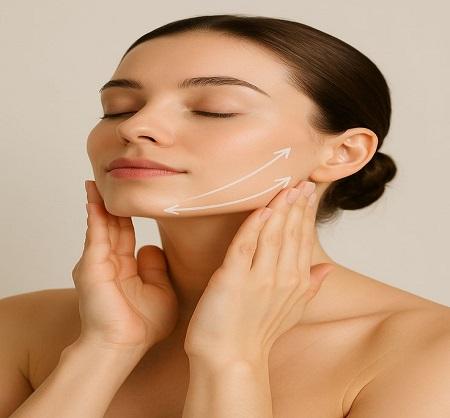

Walk into three clinics with the same concern and you may leave with three different recommendations. One suggests focused ultrasound, another proposes a filler-based plan, a third recommends threads. All three might be defensible — or none might be. The problem is that "non-surgical facelift in dubai" describes a category, not a procedure, and the differences between modalities matter more than the shared label. This comparison breaks down how the main options actually differ, so you can evaluate recommendations on their merits rather than their branding.
The Four Main Approaches at a Glance
| Approach | Mechanism | Typical Concerns Addressed | Results Appear |
|---|---|---|---|
| Focused ultrasound | Deep heat stimulates collagen | Mild-moderate laxity, jawline | 6–12 weeks |
| Radiofrequency | Superficial-mid heat, collagen remodeling | Skin texture, early firmness loss | 4–8 weeks |
| Dermal fillers | Volume restoration, structural support | Hollowing, folds, contour loss | Immediate |
| Thread lifting | Mechanical support via absorbable sutures | Mild descent, jawline definition | Immediate |
Each row represents a genuinely different tool. A clinician recommending one over another should be able to explain why it fits your specific tissue pattern — not simply that it is the clinic's preferred device.
Non-Surgical Facelift in Dubai: Ultrasound vs Radiofrequency
These two are often discussed together because both use energy to stimulate collagen, but they operate at different depths and suit different concerns.
Focused ultrasound delivers energy to deeper structural layers, including the SMAS region that surgical lifting addresses. This makes it better suited to patients with early structural descent along the jawline and lower face. Results build gradually as collagen matures.
Radiofrequency works more superficially, heating the dermis to improve skin quality, texture, and mild crepiness. It is often the better choice for patients whose primary complaint is skin surface quality rather than deep laxity.
A patient with both concerns may benefit from combining them, though not necessarily in the same session. The key question to ask is which tissue layer your concern originates in — the answer determines which device is appropriate.
When Volume Restoration Outperforms Tightening
Not every aging face needs tightening. Some need volume.
Flattening cheeks, hollow temples, and deep folds caused by fat pad descent often respond better to strategic filler placement than to energy-based tightening. In fact, applying tightening energy to a volume-depleted face can produce a gaunt rather than youthful appearance.
This is why assessment matters more than technique preference. A clinician who examines tissue distribution before selecting a modality will recognize when restoration should come first. In our clinical experience, patients who assumed they needed "lifting" are sometimes surprised to learn that restoring mid-face volume resolves the shadowing they attributed to sagging.
Threads: Where They Fit and Where They Don't
Thread lifting occupies an awkward middle ground. It offers immediate mechanical support, which appeals to patients wanting visible change quickly. But its durability is limited, and results depend heavily on thread placement, tissue quality, and patient selection.
Threads tend to suit:
-
Patients with mild descent seeking modest, immediate definition
-
Those wanting a temporary option before committing to something more durable
-
Cases where volume alone would not address the concern
Threads tend to disappoint:
-
Patients with significant skin laxity
-
Those expecting surgical-level lifting
-
Patients with thin skin prone to visible dimpling
The technique has a legitimate role, but it is frequently oversold. A clinician who presents threads as equivalent to surgical lifting is misrepresenting what the method can do.
Combination Plans: Layered Logic or Upselling?
Many clinics recommend combining modalities — for example, ultrasound for deep tightening plus filler for volume restoration. When done thoughtfully, this layered approach addresses multiple tissue changes simultaneously and can produce more natural results than a single modality.
When done poorly, combination planning becomes a package sale with little clinical rationale. The distinction is whether each component addresses a specific, identifiable concern or whether the plan simply stacks treatments because more seems better.
Ask your clinician to justify each element separately. If they cannot explain what each component contributes, the plan may be padding rather than precision.
Non-Surgical Facelift in Dubai: Matching Option to Concern
A simplified decision framework:
-
Primary concern is skin texture and mild crepiness → radiofrequency or similar skin-quality device
-
Primary concern is early jawline laxity → focused ultrasound
-
Primary concern is facial hollowing or lost contour → dermal fillers
-
Primary concern is mild descent with desire for immediate change → threads, with realistic durability expectations
-
Multiple concerns across tissue layers → staged combination plan with clear rationale for each element
This framework is a starting point for discussion, not a self-diagnosis tool. Only physical assessment can confirm which pattern applies to you.
Why Clinics Recommend What They Recommend
It is worth understanding the commercial reality behind recommendations. Clinics invest in specific devices and train staff on particular techniques. This creates a natural bias toward what is available in-house, even when another modality might suit the patient better.
An honest clinic acknowledges this. If a provider does not offer the option that best fits your case, they should say so rather than steering you toward an available alternative. During assessment at Tajmeels Clinic in Dubai, recommendations are matched to tissue findings, and patients are informed when a concern falls outside what minimally invasive options can address.
Questions That Sharpen the Comparison
-
Which tissue layer is my concern located in, and how did you determine that?
-
Why is this modality better for me than the alternatives?
-
What would happen if we chose a different approach?
-
Is this plan addressing the cause of my concern or only the visible symptom?
-
If I wanted a second opinion, would that change your recommendation?
A clinician comfortable with these questions is thinking clinically. One who deflects them is thinking commercially.
Conclusion
Comparing options for a non-surgical facelift in Dubai requires looking past the shared label to the mechanism beneath it. Ultrasound, radiofrequency, fillers, and threads each address different tissue layers and different types of aging, and the right choice depends on what your face is actually doing rather than what a clinic prefers to sell. If you have received conflicting recommendations, that is a signal to ask more precise questions rather than to choose the cheapest or most convenient option. A thorough assessment should be able to explain, in plain terms, why one approach fits your anatomy better than another.
Contact us:
WhatsApp: +971 56 203 8751
Phone: +971 4 373 9000
Social Media:
