

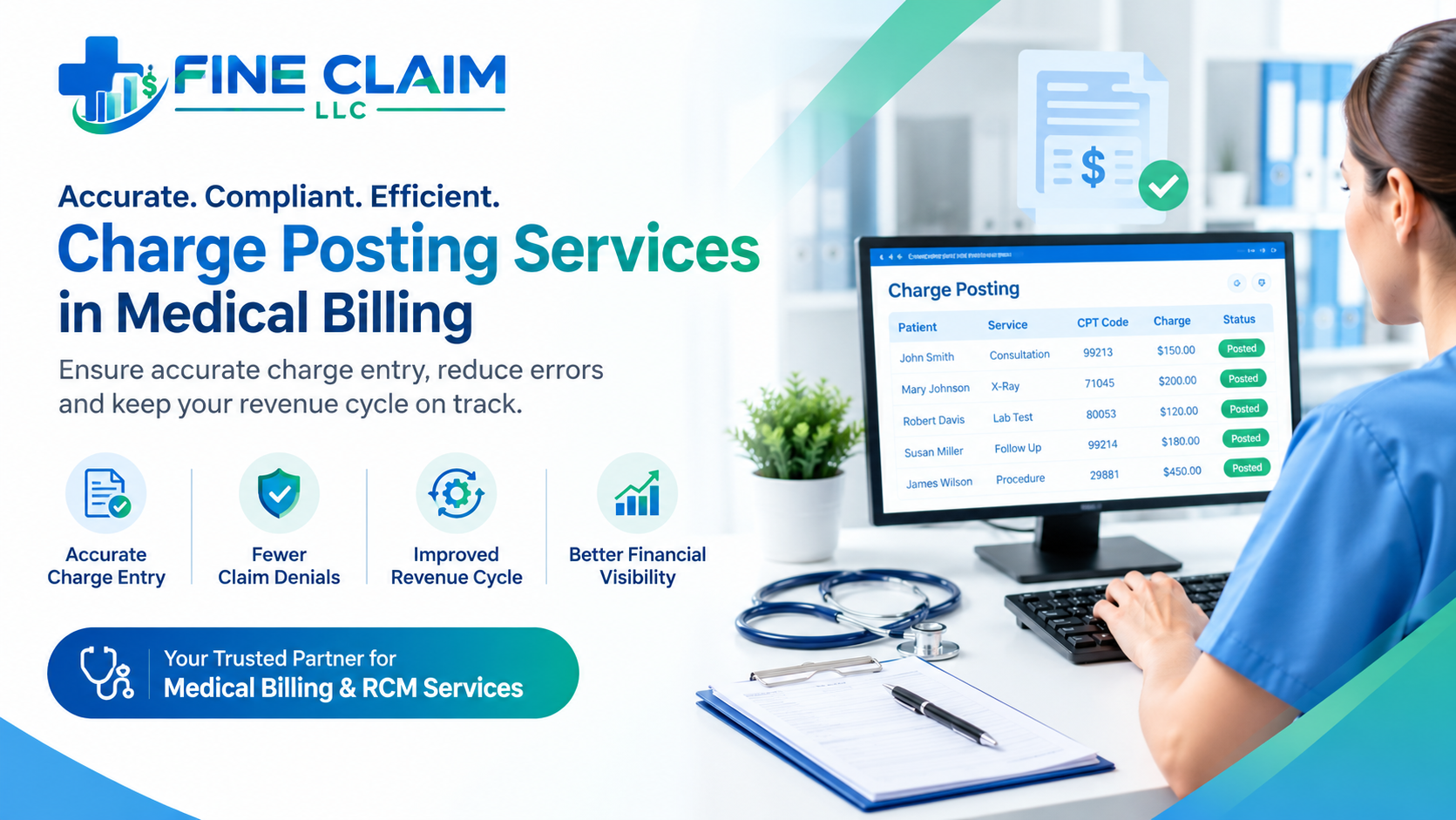

Medical practices handle numerous administrative responsibilities alongside patient care. From maintaining encounter records to preparing insurance claims, each billing activity requires accurate information and consistent follow-through. When internal teams struggle to keep up with completed patient encounters, charge posting backlogs can affect the efficiency of the billing workflow.
Outsourced charge posting services in the USA provide an option for healthcare providers that need additional support with medical charge entry and billing administration.
Understanding the Outsourced Charge Posting Process
Outsourced charge posting involves assigning charge entry responsibilities to an external medical billing provider. The provider works according to the practice's approved procedures and uses the relevant encounter information to record charges in the designated billing system.
The workflow typically includes reviewing patient account details, confirming the date of service, checking documented services and relevant charge information, and identifying discrepancies that require clarification.
The exact scope depends on the service agreement. Some providers handle charge entry alone, while others offer additional medical billing services, such as coding, claim submission, denial management, and accounts receivable follow-up.
Key Benefits for Healthcare Providers
1. Additional processing capacity
An external team may help manage fluctuating workloads when patient volumes increase or internal staff members are unavailable.
2. More consistent procedures
Standardized charge entry guidelines can help reduce variations in how billing tasks are performed across staff members or practice locations.
3. Reduced administrative pressure
Outsourcing may allow internal employees to focus on other responsibilities, including patient coordination, documentation follow-up, and practice administration.
4. Improved workflow visibility
Depending on the agreement, providers may supply reports showing completed entries, pending encounters, unresolved discrepancies, and turnaround times.
These benefits depend on the provider's capabilities, documentation quality, and the effectiveness of communication between the practice and the external billing team.
What Should Practices Consider Before Outsourcing?
Healthcare providers should first identify the problems they want to solve. Common concerns include delayed charge entry, limited staffing, repeated corrections, and inconsistent reporting.
Next, define the service requirements. Establish which tasks the external team will perform, who handles missing documentation, how corrections are approved, and how unresolved issues are escalated.
Technology compatibility is another important consideration. The provider must be able to work within approved billing systems and follow appropriate access controls.
Practices should also evaluate how patient information is protected. Depending on the relationship, appropriate safeguards may include a business associate agreement, secure data transmission, role-based access, workforce training, and incident response procedures.
Measuring Service Performance
A medical practice should evaluate outsourced charge posting using clearly defined indicators. Useful measures include processing turnaround time, unposted encounter volume, correction frequency, and the number of unresolved exceptions.
These indicators help managers understand whether the workflow is improving and where further changes may be necessary. Outsourcing should not be viewed as a guarantee of faster reimbursement because payer processing, documentation, coding, and other factors also affect claim outcomes.
Fine Claim LLC provides medical billing and revenue cycle management support for US healthcare providers seeking organized billing workflows.
Frequently Asked Questions
Is outsourced charge posting suitable for small practices?
Yes. It may help practices with limited billing staff manage encounter volumes and maintain consistent charge entry procedures.
Can an external team use our existing billing software?
Potentially, provided the provider supports the system and the practice establishes appropriate access and security procedures.
Does outsourcing include payment posting?
Not necessarily. Charge posting and payment posting are separate services, so the contract should clearly define the included responsibilities.
Conclusion
Outsourced charge posting services can provide additional capacity and structured billing support for US medical practices. Choosing the right partner requires evaluating service scope, quality controls, reporting, software compatibility, and information security.
Healthcare providers exploring medical billing outsourcing can consider Fine Claim LLC for support with charge posting and broader revenue cycle management workflows.

