

Argentina Battery Energy Storage Market Size, Share, Industry Trends and Forecast 2026-2034

IMARC Group has recently released a new research study titled "Argentina Battery Energy Storage Market Size, Share, Trends and Forecast by Type, Connectivity, Application, Ownership, Capacity, and Region, 2026-2034", offering a detailed analysis of the market drivers, segmentation, growth opportunities, trends, and competitive landscape to understand the current and future market scenarios.
Argentina Battery Energy Storage Market Size & Share 2026-2034
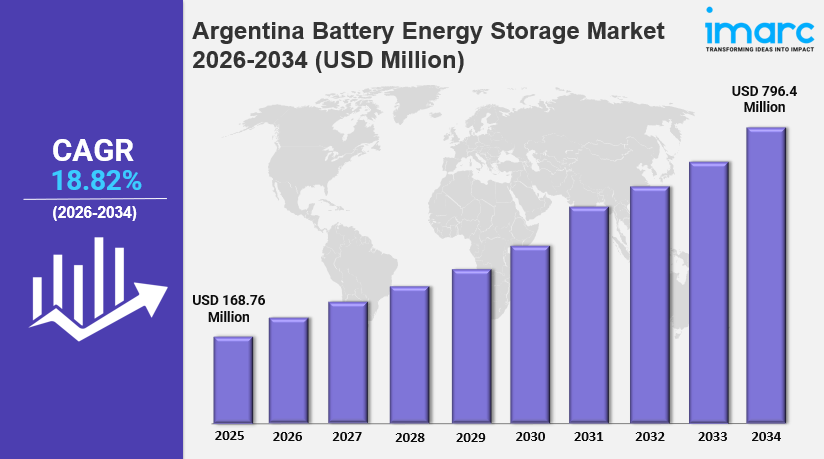
The Argentina battery energy storage market size reached USD 168.76 Million in 2025 and is projected to reach USD 796.4 Million by 2034, expanding at a CAGR of 18.82% during 2026-2034. In 2026, the market continues to gain momentum, shaped by government-led tender programs attracting substantial private investment, domestic lithium industry development enabling value chain integration, and rising renewable energy deployment that requires grid modernization.
Growth in 2026 is further reinforced by the need for energy storage solutions to ensure system reliability as variable solar and wind generation expands. These dynamics are expected to strengthen the Argentina battery energy storage market share throughout the forecast period.
Key Market Statistics at a Glance
- Base Year: 2025
- Historical Years: 2020-2025
- Forecast Period: 2026-2034
- Market Size (2025): USD 168.76 Million
- Projected Market Size (2034): USD 796.4 Million
- Growth Rate: CAGR of 18.82% (2026-2034)
Explore Opportunities in the Argentina Battery Energy Storage Market: Download the IMARC Sample Report: https://www.imarcgroup.com/argentina-battery-energy-storage-market/requestsample
Key Growth Drivers and Trends in the Argentina Battery Energy Storage Market
Growth in the Argentina battery energy storage market is being driven primarily by government policy and tender programs. The government has introduced policy frameworks and competitive tenders to accelerate battery storage deployment as part of its energy transition strategy. The AlmaGBA tender is a cornerstone initiative to enhance grid reliability in the Buenos Aires Metropolitan Area while attracting private investment through transparent procurement. CAMMESA, the wholesale market operator, acts as payment guarantor for contracts with the distribution companies Edenor and Edesur, a risk-mitigation structure that has produced significant oversubscription and competitive pricing. The government's 2024 Contingency Plan also aims to restore and modernize the electricity infrastructure after years of underinvestment.
One of the leading Argentina battery energy storage market trends is the development of the domestic lithium industry and value chain integration. Argentina holds approximately 20% of global lithium resources and ranks as the world's fifth-largest producer, with output expected to reach 130,000 tonnes of lithium carbonate equivalent in 2025, a 75% increase from 2024. This resource base supports the potential for vertical integration from lithium extraction to battery cell production and storage deployment. In September 2025, the International Finance Corporation signed a mandate letter with Central Puerto for potential financing of up to USD 300 million to support the country's first utility-scale battery storage systems awarded under the AlmaGBA tender, covering 205MW of capacity across two projects.
Another key factor supporting Argentina battery energy storage market growth is renewable energy integration and grid modernization. The RenovAr program and the corporate power purchase agreement (MATER) framework have stimulated solar and wind development, particularly wind in Patagonia and solar in the northern provinces. Because these sources are intermittent, storage is needed to balance supply and demand, reduce curtailment, and provide dispatch flexibility at peak times. Grid congestion and reliability concerns are most acute in the Buenos Aires Metropolitan Area, where demand is concentrated, and battery systems can provide peak shaving, frequency regulation, voltage support, and black start capabilities. Many renewable projects are now incorporating storage to improve project economics and deliver more reliable power.
Speak to an Analyst: https://www.imarcgroup.com/request?type=report&id=44258&flag=C
Argentina Battery Energy Storage Industry Segmentation Insights
Breakup by Type:
- Lithium-ion Battery: Rechargeable batteries with high energy density and efficiency, widely used for grid, commercial, and residential storage.
- Lead Acid Battery: A mature, lower-cost battery technology used in backup power and smaller storage applications.
- Flow Battery: Systems that store energy in liquid electrolytes, suited to longer-duration and large-scale storage.
- Others: Includes other battery chemistries and emerging storage technologies not captured above.
Breakup by Connectivity:
- Off-grid: Storage systems operating independently of the main grid, supporting remote sites and areas with limited grid access.
- On-grid: Grid-connected storage that supports peak shaving, frequency regulation, and the integration of renewable generation.
Breakup by Application:
- Residential: Home storage systems, often paired with solar, for backup power and energy management.
- Non-residential: Commercial and industrial storage used to manage demand, reduce energy costs, and secure power supply.
- Utility: Large-scale storage supporting grid reliability, renewable integration, and ancillary services.
- Others: Includes other applications not captured in the categories above.
Breakup by Ownership:
- Customer Owned: Systems owned and operated by end users such as households, businesses, and industrial facilities.
- Third-party Owned: Systems owned by independent providers that supply storage services to customers under contract.
- Utility Owned: Systems owned by utilities and power companies to support grid operations and reliability.
Breakup by Capacity:
- Small Scale (Less than 1 MW): Systems suited to residential and smaller commercial uses.
- Large Scale (Greater than 1 MW): Systems suited to utility and large industrial projects, including grid-scale deployments.
Breakup by Region:
- Buenos Aires Region: Home to the Buenos Aires Metropolitan Area, where electricity demand is concentrated and the AlmaGBA tender targets grid reliability.
- Litoral Region: A region in the northeast and east of Argentina with commercial and agricultural activity that supports demand for reliable power.
- Northern Region: A region with strong solar resources, where renewable projects can benefit from storage.
- Cordoba Region: A central region with an industrial base and demand for stable electricity supply.
- Cuyo Region: A western region where energy demand and renewable development create opportunities for storage.
- Patagonia Region: A region with exceptional wind resources, where storage helps manage the intermittency of wind generation.
Key Challenges and Growth Opportunities in the Argentina Battery Energy Storage Market
The Argentina battery energy storage market faces challenges linked to years of underinvestment in electricity infrastructure, which has led to grid congestion, supply constraints, and reliability concerns, particularly in the Buenos Aires Metropolitan Area. Large-scale storage projects also depend on tender structures, payment guarantees, and access to financing.
Despite these challenges, the market offers considerable growth opportunities driven by competitive government tenders, growing support from international financial institutions, and the country's large lithium resource base. The potential for vertical integration from lithium extraction to battery production and storage deployment, together with rising solar and wind capacity, is expected to support long-term growth.
Competitive Landscape
The IMARC report provides a comprehensive analysis of the competitive landscape of the Argentina battery energy storage market, covering market structure, key player positioning, top winning strategies, a competitive dashboard, and a company evaluation quadrant. Detailed profiles of all major companies are also included. Domestic power generators such as Central Puerto are active in the market, having secured the leading positions in Argentina's first AlmaGBA tender.
Recent Developments in the Argentina Battery Energy Storage Market
- September 2025: Central Puerto announced a USD 520 million investment plan that includes 205MW of battery energy storage capacity across two strategic projects in the Buenos Aires Metropolitan Area, awarded through Argentina's first AlmaGBA tender, where it secured first and second place with the most competitive bids. The company is also building the San Carlos Solar Park in Salta, a USD 20 million, 15MW project expected to come online at the end of November 2025.
Author IMARC Group
IMARC Group is a leading global market research company providing data-driven insights and expert consulting services to businesses seeking to achieve their strategic objectives. With a multidisciplinary team of industry experts, IMARC delivers reliable market intelligence across sectors including Chemicals and Materials, Healthcare, Technology, Agriculture, and Retail.
Contact Us:
IMARC Group
Email: [email protected]
United States: +1-201-971-6302
