

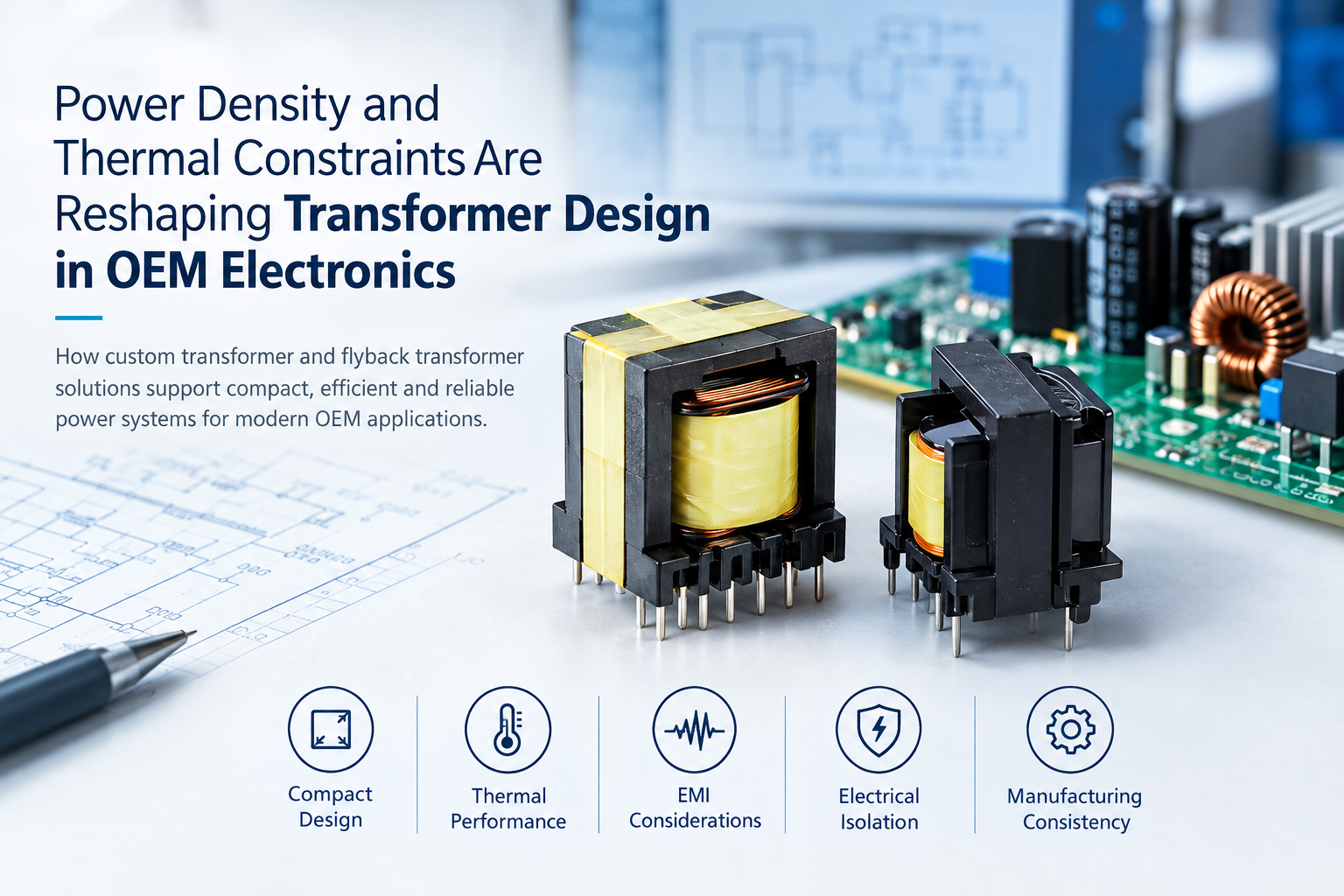
Power Density and Thermal Constraints Are Reshaping Transformer Design in OEM Electronics

As electronic equipment becomes more compact and power requirements become more demanding, OEM manufacturers face increasing pressure to optimize power conversion without sacrificing reliability. Industrial controllers, embedded systems, communications equipment, battery-powered devices, and automated machinery all depend on stable power delivery within defined electrical and mechanical limits.
These requirements are placing greater emphasis on magnetic component design. Transformer selection is no longer simply a matter of matching input and output voltages. Engineers must also consider switching frequency, insulation, thermal performance, electromagnetic interference (EMI), and the physical layout of the finished product.
For original equipment manufacturers (OEMs), these factors make transformer design an important part of product development, particularly in applications that rely on switch-mode power supplies and isolated DC power conversion.
Power Density Is Changing the Requirements for Magnetic Components
Higher power density means delivering the required electrical power within a smaller physical space. This is an important consideration for OEMs developing compact industrial electronics, embedded control boards, and modern power management systems.
However, reducing the size of a power supply introduces several engineering challenges. Smaller components have less available surface area for heat dissipation, while higher switching frequencies can increase the influence of parasitic capacitance, winding losses, and electromagnetic interference.
Transformer design must account for these conditions from the beginning of the development process. Core material, winding arrangement, insulation structure, and operating frequency all influence the final component's performance.
For OEM engineering teams, the objective is to find a workable balance between size, efficiency, temperature rise, electrical isolation, and manufacturing repeatability.
Flyback Transformers in Compact Power Conversion Systems
The flyback topology remains relevant in auxiliary power supplies, low-to-moderate-power isolated converters, control electronics, and other applications where circuit simplicity and multiple output voltages may be important.
A flyback transformer differs from a conventional transformer in its energy-transfer operation. During one portion of the switching cycle, energy is stored in the transformer's magnetic field. During another portion, that stored energy is transferred to the secondary circuit.
This operating principle affects several design requirements, including magnetizing inductance, core air gap, peak current, winding insulation, and saturation margin. The appropriate design depends on the converter topology, input voltage range, output requirements, switching frequency, and expected operating conditions.
OEMs must also evaluate whether the selected design can meet efficiency and thermal targets under both normal and demanding operating conditions. A transformer that performs adequately at a nominal load may behave differently when the input voltage changes or the equipment operates near its maximum rated output.
These considerations make magnetic design and converter-level validation essential parts of power supply development.
Why Custom Transformer Design Matters for OEM Product Development
Standard magnetic components can work well when their electrical ratings and physical dimensions align with the application. However, OEM products sometimes require combinations of specifications that are difficult to accommodate with an off-the-shelf part.
A custom transformer can be developed around the electrical, mechanical, and environmental requirements of a particular product. Relevant design parameters may include:
· Voltage and current requirements: Primary and secondary ratings must align with the converter circuit and its intended operating range.
· Core and winding configuration: Core geometry, winding arrangement, and conductor selection influence losses, inductance, and overall dimensions.
· Thermal limits: Copper losses, core losses, ambient temperature, and cooling conditions affect operating temperature.
· Insulation and isolation: The winding structure and insulation system must satisfy the applicable electrical safety requirements.
· Mechanical integration: Mounting features, terminal positions, package height, and board layout influence compatibility with the OEM's assembly.
· Production consistency: The design must be practical to manufacture repeatedly while maintaining the required electrical characteristics.
Considering these factors early can reduce the need for late-stage circuit modifications and mechanical redesigns. It can also help engineering teams establish realistic performance targets before moving from prototype development to volume manufacturing.
Managing EMI and Thermal Performance Together
Electromagnetic interference is an important consideration in switching power supplies. Fast switching transitions, current loops, parasitic capacitance, and magnetic coupling can contribute to conducted and radiated emissions.
Transformer construction can influence these effects, but the transformer should not be evaluated in isolation. PCB layout, switching devices, grounding, filtering, shielding, and control circuitry also contribute to overall electromagnetic compatibility.
Thermal performance requires similar system-level attention. Core losses generally depend on magnetic material, frequency, flux density, and waveform, while winding losses depend on current, conductor resistance, and frequency-related effects.
As switching frequency increases, skin effect and proximity effect can increase winding losses. A design that reduces component size may therefore require more careful material selection, winding optimization, and thermal testing.
For OEM manufacturers, evaluating EMI and thermal performance together provides a more realistic picture of how a transformer will behave inside the finished equipment.
From Prototype Validation to Repeatable Manufacturing
Transformer performance must be verified under the operating conditions expected in the final product. Electrical characterization can include inductance, turns ratio, winding resistance, leakage inductance, and insulation-related tests, as applicable to the design.
Thermal testing under representative loads helps identify temperature-rise concerns. Converter testing can also reveal interactions between the transformer, switching devices, rectification circuitry, and control loop.
Prototype validation is only one stage of the process. OEMs must also consider manufacturing tolerances, material consistency, winding repeatability, inspection requirements, and production test methods.
A design that performs well in a single prototype is not necessarily ready for high-volume production. Establishing appropriate acceptance criteria and repeatable manufacturing processes helps maintain consistent performance across production batches.
Early communication between electrical engineers, mechanical designers, sourcing teams, and the magnetic component manufacturer can make this transition more predictable.
The Role of Transformer Engineering in Next-Generation OEM Equipment
Compact electronics and increasingly integrated power systems are making magnetic components an important consideration in product architecture. While improvements in semiconductors and control electronics continue to influence converter performance, transformers remain essential wherever voltage conversion, energy transfer, or electrical isolation is required.
Flyback designs continue to serve many compact power conversion applications, while other converter topologies may be more suitable when power levels, efficiency targets, or operating conditions demand a different approach.
For OEM manufacturers, the central engineering task is to select or develop a magnetic component that fits the complete application rather than optimizing a single specification. Electrical performance, mechanical fit, thermal behavior, EMI, safety requirements, and production repeatability must work together.
Treating transformer requirements as an integral part of power electronics development helps OEM teams make better-informed design decisions and build equipment that performs consistently throughout its intended service life.
