

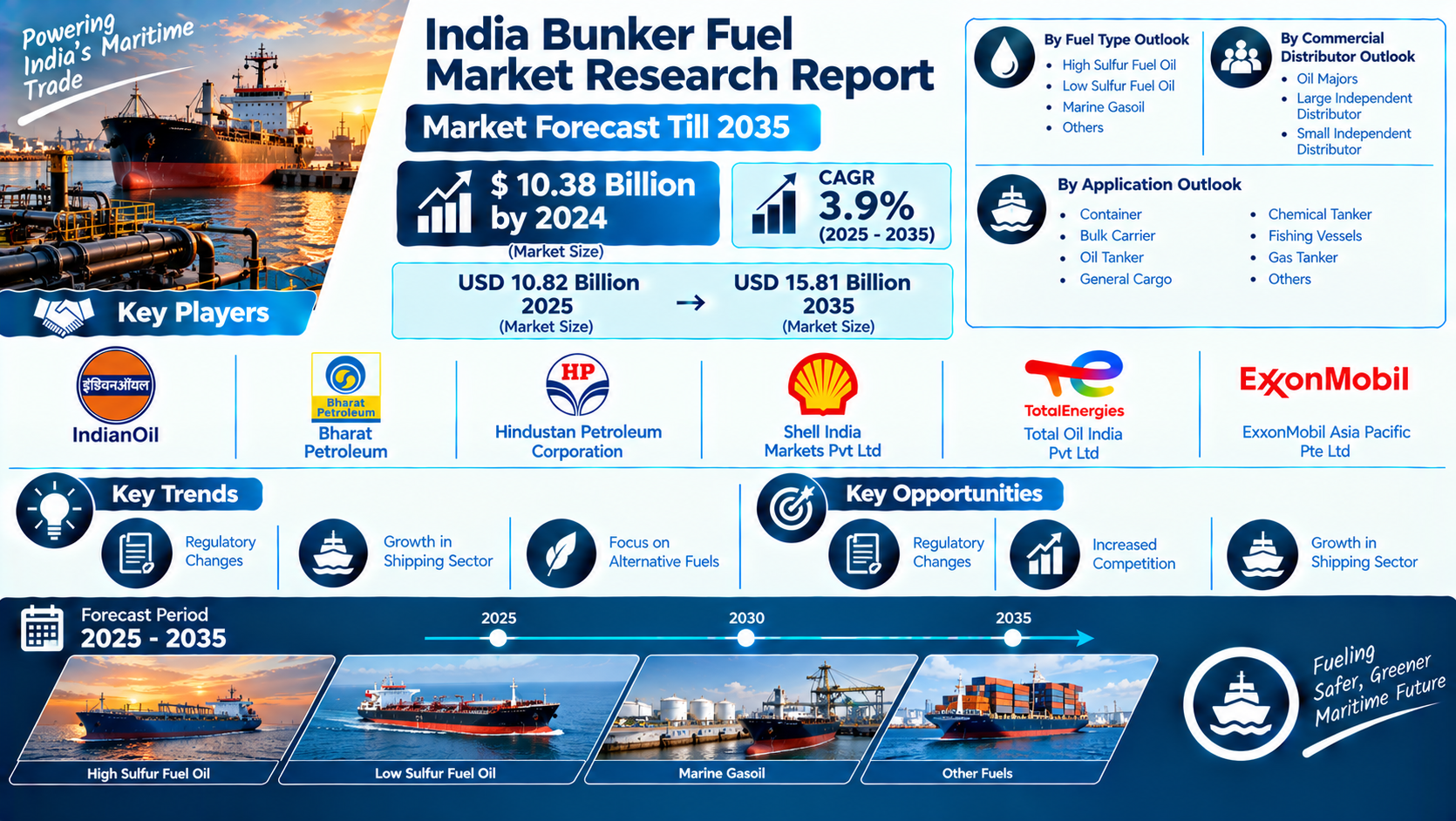

According to Market Research Future® (MRFR), the India Bunker Fuel Market is expected to grow from USD 10.82 billion in 2025 to USD 15.81 billion by 2035, following a valuation of USD 10.38 billion in 2024. The market is forecast to register a CAGR of 3.9% over the 2025–2035 period. Its outlook reflects India's maritime transport requirements, the development of shipping activity, changes in marine fuel regulations, and increasing industry attention to alternative fuels.
Maritime Activity and Fuel Demand
Bunker fuel is central to the operation of commercial shipping because vessels require reliable energy supplies for propulsion and onboard systems. India's maritime network supports domestic cargo movements and international trade, creating demand for marine fuel at ports and other established supply points. The market includes fuel procurement, distribution, storage, and delivery services that help vessels maintain their operating schedules.
Demand is affected by vessel traffic, cargo composition, route length, engine efficiency, and fuel prices. Container ships, bulk carriers, tankers, and general cargo vessels have different operating characteristics, so their fuel requirements vary. Shipping activity can support market growth, although fluctuations in trade, freight rates, and operating costs may influence purchasing patterns.
The forecast growth to USD 15.81 billion by 2035 points to a steadily expanding market. Achieving this outlook will depend on shipping-sector conditions and suppliers' ability to meet customer needs while responding to evolving fuel specifications and environmental expectations.
Regulatory Changes and Fuel Selection
Regulatory changes are among the key trends shaping the bunker fuel industry. Marine fuel requirements influence the sulfur content and other specifications of fuels used by vessels. Shipping operators must select appropriate fuel grades and comply with the rules applicable to their operations. This affects purchasing decisions and creates operational considerations for suppliers that source, store, and deliver marine fuels.
The market's fuel-type categories are high sulfur fuel oil, low sulfur fuel oil, marine gasoil, and others. High sulfur fuel oil may be used where permitted and where the vessel's operating arrangements meet relevant requirements. Low sulfur fuel oil offers an option for operations subject to applicable sulfur limits, while marine gasoil serves particular vessel and operating needs. The selection of a fuel depends on regulatory obligations, engine compatibility, price, availability, and contractual specifications.
Fuel quality management is important throughout the supply chain. Suppliers need appropriate procedures for handling and delivery, while vessel operators must ensure that fuel is suitable for their equipment and operating conditions. Changes in regulation can require adjustments to sourcing strategies and increase the value of distributors that provide consistent, compliant products.
Alternative Fuels and the Transition Ahead
The industry's focus on alternative fuels represents a longer-term market trend. Shipping companies are considering ways to reduce emissions and prepare for changing environmental requirements. Alternative marine energy options may require different storage systems, bunkering infrastructure, safety procedures, and vessel technologies. Their adoption therefore depends on practical availability, investment requirements, operating economics, and compatibility with existing fleets.
Conventional marine fuels remain important to current shipping operations, but suppliers and vessel operators must monitor developments in fuel technology and regulation. The transition is unlikely to proceed uniformly across vessel types or routes. Decisions will depend on the commercial case for individual technologies and the availability of reliable supply infrastructure.
For bunker fuel distributors, flexibility and regulatory awareness may become increasingly important. The ability to support customers using different fuel grades and to respond to changing procurement requirements can help maintain relevance as the maritime industry evolves.
Distributor Structure and Customer Requirements
The India Bunker Fuel Market includes oil majors, large independent distributors, and small independent distributors. Oil majors can draw on established sourcing and distribution capabilities, while independent companies may compete through customer relationships, specialized services, or access to particular locations. Actual capabilities vary by business, and the supplied report information does not provide comparative market shares.
Competition can center on price, product quality, availability, delivery timing, and service dependability. Vessel operators often work within strict port schedules, making timely fuel delivery an important consideration. Distributors must also coordinate procurement and logistics while ensuring that delivered products meet the agreed specifications.
The key companies listed in the report are Indian Oil Corporation, Bharat Petroleum Corporation, Hindustan Petroleum Corporation, Shell India Markets Pvt Ltd, Total Oil India Pvt Ltd, and ExxonMobil Asia Pacific Pte Ltd. These participants form part of the identified competitive landscape, although their individual positions cannot be ranked from the available data.
Vessel Applications and Regional Market Context
Application categories include container vessels, bulk carriers, oil tankers, general cargo vessels, chemical tankers, fishing vessels, gas tankers, and others. Container vessels support trade in manufactured and consumer goods, while bulk carriers transport commodities. Oil and chemical tankers have specialized cargo-handling requirements, and gas tankers operate under specific technical and safety conditions. Fishing vessels and other ship types add further demand across the marine sector.
Fuel consumption varies with vessel size, propulsion systems, route conditions, speed, and time at sea. This variation means that bunker fuel providers need to accommodate different volumes and delivery requirements rather than relying on a single customer profile.
Growth Opportunities and Market Outlook
The report identifies regulatory changes, increased competition, and shipping-sector growth as opportunities. Expanding maritime activity can increase demand for dependable fuel supply, while regulatory developments can encourage distributors to strengthen their compliance capabilities. Competition may lead to improved services and more responsive customer offerings.
The market is projected to rise from USD 10.82 billion in 2025 to USD 15.81 billion in 2035 at a CAGR of 3.9%. Its future performance will be influenced by trade volumes, fuel pricing, environmental requirements, and alternative-fuel adoption. Suppliers that maintain reliable distribution networks, consistent quality, and adaptability to changing vessel requirements may be positioned to serve India's evolving maritime fuel demand.
