

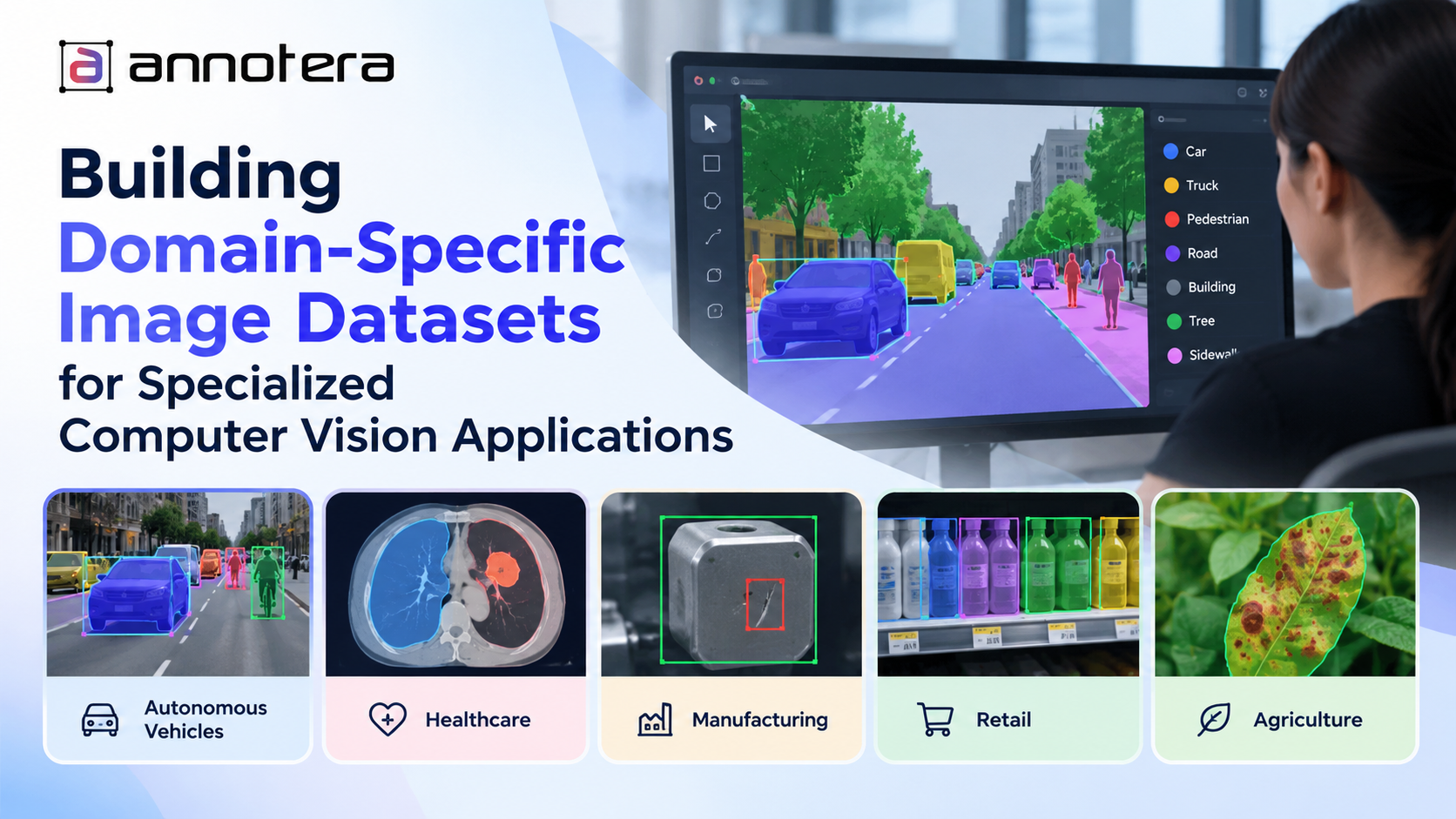
Building Domain-Specific Image Datasets for Specialized Computer Vision Applications

Computer vision is transforming industries by enabling artificial intelligence (AI) systems to interpret images, recognize objects, identify patterns, and make informed decisions. From detecting defects in manufacturing facilities to analyzing medical images and helping autonomous vehicles navigate complex environments, computer vision applications depend on high-quality training data.
However, a model trained on general-purpose images may struggle when deployed in a specialized environment. Industrial machinery, medical scans, agricultural crops, and retail shelves each present unique visual characteristics that require targeted datasets. This is why building domain-specific image datasets has become essential for developing accurate, reliable, and application-ready computer vision models.
Creating these datasets involves more than collecting images. It requires domain-focused data acquisition, consistent annotation guidelines, appropriate labeling techniques, and rigorous quality assurance. With support from an experienced image annotation company, businesses can develop datasets that reflect real-world conditions and address the specific requirements of their AI applications.
What Are Domain-Specific Image Datasets?
Domain-specific image datasets are collections of images designed to train or evaluate computer vision models for a particular industry, task, or operating environment.
Unlike generic datasets, which cover broad categories of everyday objects, specialized datasets focus on the visual patterns, objects, conditions, and edge cases relevant to a defined application.
For example:
-
Healthcare: Medical scans containing anatomical structures, lesions, or other clinically relevant features.
-
Manufacturing: Images of components, equipment, surface defects, and assembly errors.
-
Retail: Shelf images showing products, price labels, packaging variations, and stock availability.
-
Agriculture: Images of crops, weeds, plant diseases, and changing field conditions.
-
Autonomous driving: Road scenes containing vehicles, pedestrians, traffic signs, road boundaries, and unusual weather conditions.
These datasets help models learn the distinctions that matter within a specific domain, improving their ability to perform targeted visual recognition tasks.
Why Specialized Computer Vision Applications Need Custom Datasets
1. Industry-Specific Visual Characteristics
Every industry presents unique visual challenges. A manufacturing inspection model must distinguish between acceptable surface variations and actual product defects. Similarly, an agricultural model must recognize early signs of plant disease despite differences in lighting, crop maturity, and background vegetation.
Generic datasets may not contain sufficient examples of these specialized patterns. Custom datasets provide more relevant visual information, helping models learn features associated with their intended applications.
2. Better Representation of Real-World Conditions
Computer vision systems often operate in environments that differ significantly from controlled training settings. Variations in illumination, camera angles, image resolution, object orientation, and background complexity can affect model performance.
Domain-specific datasets should represent these variations rather than relying exclusively on clean, predictable images. Including challenging scenarios helps teams identify weaknesses and develop models that perform more consistently after deployment.
3. Improved Detection of Rare Events
Some applications require models to recognize uncommon but important events, such as unusual manufacturing defects, damaged infrastructure, or hazardous road situations.
These examples may represent only a small proportion of available images, making them difficult to learn from without targeted data collection. Purposefully incorporating rare cases can improve dataset coverage and help teams evaluate model performance under challenging conditions.
Key Steps in Building Domain-Specific Image Datasets
Step 1: Define the Computer Vision Objective
The first step is to establish what the model must identify, classify, or measure. Different objectives require different dataset structures and annotation methods.
For instance, image classification assigns a category to an entire image, while object detection identifies individual objects and their locations. Semantic segmentation labels pixels according to their corresponding classes, making it useful for applications requiring detailed spatial understanding.
Clearly defined objectives help teams determine the required image types, annotation formats, labeling categories, and evaluation criteria before dataset production begins.
Step 2: Collect Representative and Relevant Images
Data collection should reflect the intended deployment environment. Teams may source images from operational cameras, inspection systems, public datasets, controlled capture environments, or other authorized sources.
The dataset should account for relevant variations, including lighting, environmental conditions, equipment types, image perspectives, and object appearances.
It is equally important to assess image quality, remove unsuitable duplicates, and identify missing scenarios. For sensitive domains such as healthcare, organizations must also follow applicable privacy, consent, and data governance requirements.
Step 3: Develop Domain-Specific Annotation Guidelines
Annotation quality depends on clear and consistent instructions. Guidelines should define object categories, labeling boundaries, edge-case handling, and procedures for resolving ambiguous examples.
For example, an industrial inspection dataset may require annotators to distinguish scratches from cracks. A retail dataset may need separate labels for partially visible products, empty shelf spaces, and packaging variations.
Subject-matter experts can help validate these definitions, ensuring that labels reflect the requirements of the target application rather than subjective interpretations.
Step 4: Select the Appropriate Image Annotation Technique
The annotation technique should match the complexity of the computer vision task.
Common approaches include:
-
Bounding box annotation: Locates objects using rectangular boundaries, supporting detection tasks.
-
Polygon annotation: Traces object outlines for more detailed shape representation.
-
Semantic segmentation: Assigns a class label to each relevant pixel, enabling precise scene and region analysis.
-
Instance segmentation: Separates individual objects, even when multiple objects belong to the same category.
-
Keypoint annotation: Marks important anatomical, structural, or geometric reference points.
For applications involving irregular shapes, overlapping objects, or fine boundaries, the choice of annotation technique can significantly influence the usefulness of the resulting dataset.
Step 5: Implement Quality Assurance
Quality assurance (QA) helps ensure that annotations meet predefined accuracy and consistency standards. Common checks include verifying class assignments, identifying missing labels, reviewing object boundaries, and detecting inconsistencies across annotators.
Teams can combine automated validation tools with manual reviews and expert adjudication. Measuring annotation agreement and tracking recurring errors can also reveal weaknesses in the guidelines or training process.
Regular QA is particularly important for semantic segmentation, where small boundary errors may affect pixel-level evaluation and downstream model predictions.
The Role of Image Annotation Outsourcing Services
Developing specialized datasets can require substantial annotation capacity, technical expertise, and ongoing quality management. For organizations working with large image volumes or multiple computer vision projects, managing every stage internally may create operational bottlenecks.
Professional image annotation outsourcing services can help businesses scale annotation workflows while maintaining consistent labeling standards. Depending on project requirements, an external partner can support data preparation, image labeling, annotation tool configuration, quality checks, and dataset delivery.
When evaluating an image annotation company, organizations should consider its experience with relevant data types, ability to follow domain-specific guidelines, quality assurance procedures, data security practices, and capacity to handle changing project volumes.
A collaborative approach is often most effective. Domain experts define the requirements, annotation teams apply the guidelines, and machine learning engineers evaluate whether the resulting dataset supports model objectives.
Common Challenges and How to Address Them
Building domain-specific datasets involves several challenges that require proactive planning.
Class imbalance: Some categories may have far fewer examples than others. Targeted data collection, carefully designed sampling strategies, and appropriate augmentation can help address this issue.
Inconsistent labels: Differences in annotator interpretation can introduce noise. Detailed guidelines, calibration exercises, and regular quality reviews improve consistency.
Limited coverage of edge cases: A dataset may overlook rare conditions that matter during deployment. Reviewing model errors and collecting additional examples can strengthen coverage.
Changing environments: New equipment, products, environmental conditions, or operating procedures may reduce dataset relevance over time. Periodic dataset reviews and controlled updates help keep training data aligned with real-world requirements.
How Annotera Supports Specialized Computer Vision Projects
At Annotera, we recognize that effective computer vision development depends on training data aligned with specific business objectives. Domain-focused image annotation helps organizations translate complex visual information into structured datasets suitable for machine learning workflows.
From object labeling to semantic segmentation, a carefully managed annotation process can help teams build datasets with greater consistency, detailed visual coverage, and clearly defined labeling standards.
By combining project-specific guidelines, scalable workflows, and quality-focused annotation practices, Annotera supports businesses working to develop computer vision solutions for specialized applications.
Conclusion
Building domain-specific image datasets is a strategic step toward developing computer vision systems that perform reliably in real-world environments. Relevant image collection, precise annotation, representative edge cases, and consistent quality assurance all contribute to stronger training and evaluation datasets.
Whether the objective is identifying manufacturing defects, interpreting medical images, monitoring retail shelves, or improving autonomous navigation, the dataset must reflect the challenges of its intended application.
With the right annotation strategy and experienced image annotation outsourcing services, organizations can build structured, application-focused datasets that support more informed model development. Annotera helps businesses turn specialized visual data into valuable training resources for the next generation of computer vision applications.

