

Directed Energy Weapons Market Outlook 2026-2034: Size, Share, Trends, Demand and Forecast

Market Overview
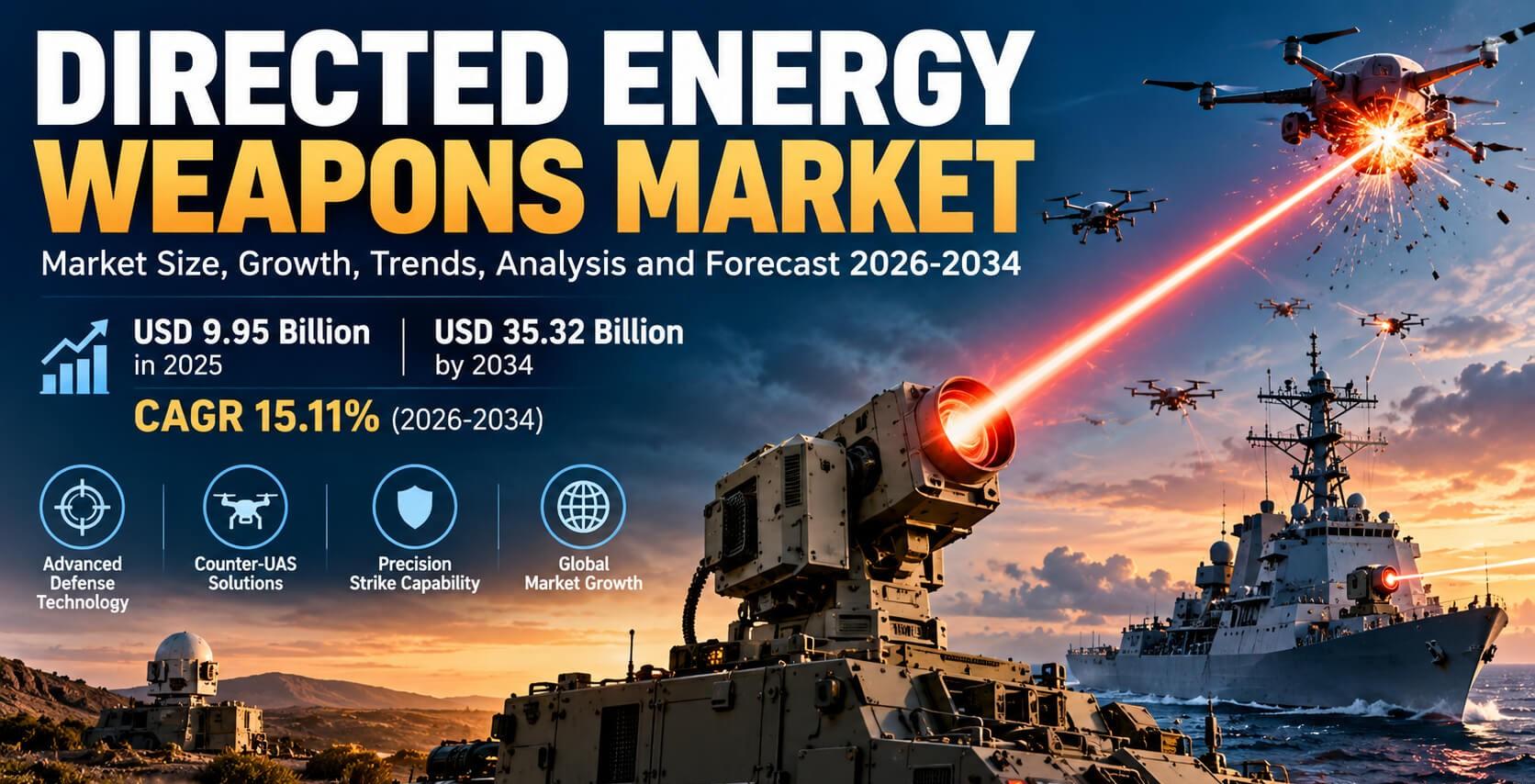
The global directed energy weapons market size is experiencing rapid growth as defense organizations increasingly prioritize advanced military technologies, counter-drone capabilities, precision engagement, and modernized defense systems. The market was valued at USD 9.95 Billion in 2025 and is projected to reach USD 35.32 Billion by 2034, expanding at a CAGR of 15.11% during 2026–2034. North America dominated the market in 2025, accounting for 36.7% of the global market share, while Asia Pacific is emerging as the fastest-growing regional market.
The industry is being influenced by escalating defense budgets, the proliferation of unmanned aerial systems (UAS), technological advancements in high-energy lasers and high-power microwaves, and the increasing need for precision-strike capabilities. Growing investments in counter-unmanned aerial systems (counter-UAS), naval defense modernization, and homeland security applications are creating new opportunities for directed energy weapons manufacturers worldwide.
What Is Driving Directed Energy Weapons Market Growth?
Escalating Defense Budgets and Geopolitical Threats
Rising global defense expenditure and increasing geopolitical tensions are strengthening demand for advanced military technologies. Defense organizations are investing in systems designed to improve operational effectiveness, enhance air defense capabilities, and address emerging threats across land, naval, and airborne environments.
Global defense spending reached USD 2.63 Trillion in 2025, according to the supplied market information. The United States remains a major contributor to directed energy weapons development, supported by defense programs involving the Defense Advanced Research Projects Agency (DARPA), the Missile Defense Agency (MDA), and the military services.
Increasing security concerns in the Indo-Pacific and Eastern Europe are also encouraging governments to modernize defense infrastructure. Directed energy weapons are attracting interest because they can provide alternative engagement options against selected aerial and other military threats.
These developments are encouraging defense contractors to invest in high-energy laser systems, high-power microwave technologies, power management, and beam-control capabilities. As military organizations seek advanced solutions for evolving operational requirements, directed energy weapons are gaining importance in defense modernization strategies.
Proliferation of Drones and Unmanned Aerial Systems
The growing use of unmanned aerial systems (UAS) is creating substantial demand for counter-drone technologies. Commercially available drones can be adapted for surveillance, reconnaissance, and other purposes, while coordinated drone deployments can place significant pressure on conventional air defense systems.
Traditional kinetic interceptors can be expensive when used against comparatively inexpensive aerial threats. Directed energy weapons offer an alternative for certain counter-UAS missions, potentially providing a lower marginal engagement cost when power, maintenance, and operational conditions are favorable.
High-energy laser systems can engage selected aerial targets through concentrated energy, while high-power microwave systems can affect electronic components and may be suitable for countering multiple electronic targets under appropriate conditions.
Military organizations are therefore exploring directed energy technologies for ground-based installations, naval platforms, mobile defense vehicles, and other applications. Growing counter-drone requirements are expected to remain an important factor supporting the directed energy weapons market forecast through 2034.
Precision Engagement and Reduced Collateral Damage Requirements
The demand for precision engagement is another important factor supporting market growth. Defense organizations increasingly seek technologies that can engage specific targets while limiting unintended damage and reducing reliance on conventional ammunition in suitable operational scenarios.
Directed energy weapons can offer rapid engagement and precise energy delivery against certain target types. Their operational effectiveness, however, depends on factors such as atmospheric conditions, available power, target characteristics, system range, and thermal management.
These systems are being evaluated for applications involving aerial threats, selected incoming projectiles, and electronic targets. Their potential use in urban or sensitive environments has also increased interest in capabilities that provide controlled engagement options.
As defense agencies modernize their capabilities, the integration of directed energy systems into broader air defense and multi-domain operational architectures is creating opportunities for manufacturers.
Advancements in High-Energy Laser Technology
Technological progress in high-energy lasers (HEL) is supporting the transition of directed energy weapons from experimental demonstrations toward more mature defense applications.
Developments in solid-state lasers, fiber-coupled laser arrays, adaptive optics, beam quality, and precision tracking are helping improve system performance. Advances in thermal management and power conditioning are also addressing important engineering challenges associated with deploying high-energy systems on military platforms.
High-energy laser technologies are being developed for ground-based defense installations, naval vessels, mobile vehicles, and selected airborne applications. Their ability to deliver concentrated energy without conventional projectile ammunition makes them attractive for specific military missions.
However, operational deployment continues to depend on platform integration, power availability, atmospheric conditions, system reliability, and mission-specific requirements. Continued investment in these areas is expected to influence the market's development over the forecast period.
Request a Sample Report for Detailed Evaluation: https://www.imarcgroup.com/directed-energy-weapons-market/requestsample
Directed Energy Weapons Market Trends to Watch
Several major trends are shaping the future of the global directed energy weapons industry.
Transition from Demonstration Programs to Operational Deployment: Defense organizations are increasingly moving selected directed energy technologies toward field trials, procurement, and operational integration. Improvements in laser power, tracking, and platform compatibility are supporting this transition.
Counter-UAS Specialization: Counter-drone applications are becoming an important area of investment. Ground-based, vehicle-mounted, and shipboard systems are being evaluated to address unmanned aerial threats and improve layered defense capabilities.
Artificial Intelligence and Advanced Targeting: Artificial intelligence and machine learning are attracting interest for target classification, tracking, sensor integration, and fire-control support. These technologies may help operators process information more efficiently and coordinate engagement decisions within established human oversight and operational frameworks.
Naval Platform Integration: Naval forces are exploring directed energy systems as complementary capabilities for shipboard defense. The ability to address selected aerial threats is encouraging investment in high-energy laser integration, power systems, and advanced tracking technologies.
Multi-Domain Defense Architectures: Defense agencies are increasingly exploring combinations of directed energy weapons, electronic warfare, radar, and conventional defense systems. Integrated architectures can provide complementary capabilities across different threat environments and operational requirements.
These developments are creating opportunities for defense contractors, component manufacturers, and specialized technology providers. Continued research into power generation, thermal management, beam control, and system integration will remain important to broader deployment.
Directed Energy Weapons Market Segmentation
The global directed energy weapons market is analyzed by type, application, technology, end use, and region. Each segment reflects different operational requirements, technological capabilities, and procurement priorities.
By Type
-
Lethal
-
Non-Lethal
Lethal directed energy weapons dominated the type segment in 2025, accounting for approximately 59.1% of the market. This leading position reflects demand for systems designed to damage or destroy selected targets using concentrated energy.
High-energy laser platforms are an important part of this segment, with military organizations exploring their use against unmanned aerial systems, selected incoming projectiles, and other military threats. Systems under development or deployment across ground and naval platforms demonstrate the growing interest in directed energy capabilities for air defense.
Lethal systems can offer rapid engagement and reduce dependence on conventional ammunition for certain missions. Nevertheless, their effectiveness varies according to target characteristics, engagement conditions, available power, and environmental factors.
The non-lethal segment accounted for 40.9% of the market in 2025 and is projected to grow at an estimated 15.6% CAGR through 2034, according to the supplied report. Interest in non-lethal directed energy applications is supported by counter-UAS requirements, electronic disruption capabilities, and selected security applications.
By Application
-
Defense
-
Homeland Security
Defense represented the dominant application segment in 2025, accounting for approximately 67.8% of global market revenue. Demand is supported by military modernization, air defense requirements, and investments in technologies designed to address evolving threats.
Defense organizations are evaluating directed energy weapons for ground-based air defense, naval protection, counter-UAS operations, and selected airborne applications. Research and procurement initiatives across military agencies are supporting the development of high-energy lasers, high-power microwave systems, and integrated targeting technologies.
The homeland security segment accounted for 32.2% of the market in 2025. It is gaining attention as government agencies evaluate counter-drone capabilities for critical infrastructure, border protection, airports, and other sensitive locations.
The supplied report identifies homeland security as a fast-growing category, supported by increasing demand for counter-UAS capabilities and infrastructure protection. Deployment in these environments remains subject to applicable regulations, safety requirements, and operational constraints.
By Technology
-
High Energy Laser
-
High-Power Microwave
-
Particle Beam
-
Others
High Energy Laser technology accounted for approximately 50.6% of the market in 2025, making it the leading technology segment in the supplied market assessment.
High-energy laser systems use concentrated optical energy to engage selected targets. Advances in solid-state laser technology, fiber-laser architectures, beam control, and thermal management are supporting the development of more mature platforms for military applications.
High-power microwave systems represent another important technology category. These systems use directed microwave energy to disrupt or damage electronic components under suitable conditions. Their potential application against groups of electronically dependent targets has attracted interest in counter-UAS missions.
Particle beam technologies remain primarily associated with research and experimental development. Their potential future applications depend on substantial scientific and engineering advances before broader operational deployment can be considered.
Additional technologies, including adaptive optics, precision tracking, power conditioning, and advanced fire-control systems, are also important to the performance and integration of directed energy weapons.
By End Use
-
Land Vehicles
-
Naval Platforms
-
Airborne Platforms
-
Fixed Installations
-
Others
The end-use segment reflects the range of military and security platforms on which directed energy systems may be deployed.
Land vehicles and mobile ground-based platforms are being evaluated for counter-UAS missions and short-range air defense. Naval platforms offer opportunities for integrating high-energy laser systems into shipboard defense architectures, while airborne applications involve additional requirements related to weight, power, cooling, and platform integration.
Fixed installations may support the protection of military facilities, critical infrastructure, and selected security sites.
The supplied report identifies land vehicles as a leading end-use category but does not provide a numerical market share for this segment. Across all end-use categories, deployment decisions depend on mission requirements, system maturity, platform compatibility, and the operational environment.
Regional Directed Energy Weapons Market Outlook
North America
North America accounted for 36.7% of the global directed energy weapons market in 2025, making it the leading regional market. Its position is supported by substantial defense expenditure, advanced research capabilities, established defense contractors, and government investment in next-generation military technologies.
The United States is a major contributor to regional demand through research and development programs, military modernization initiatives, and procurement activities involving advanced laser and microwave systems.
Defense contractors such as RTX, Lockheed Martin, Northrop Grumman, and L3Harris Technologies are active in relevant defense technology areas. Their capabilities across photonics, electronics, platform integration, and military systems support the development of directed energy solutions.
Counter-UAS requirements, naval modernization, and the integration of advanced technologies into air defense architectures are creating opportunities for manufacturers. The region also benefits from established defense procurement structures and a strong ecosystem of specialized component suppliers.
Asia Pacific
Asia Pacific accounted for 27.5% of the global directed energy weapons market in 2025 and is projected to be the fastest-growing regional market, with an estimated CAGR of approximately 16.8% during 2026–2034.
Growth is supported by military modernization, rising defense expenditure, regional security concerns, and increasing investment in advanced defense technologies. China, India, Japan, and South Korea are important contributors to regional development.
China's military modernization initiatives and research into advanced laser and microwave systems are influencing the regional technology landscape. India is also pursuing directed energy research through the Defence Research and Development Organisation (DRDO), while Japan and South Korea are expanding their defense capabilities.
The proliferation of unmanned aerial systems and the growing emphasis on air defense are creating additional demand for counter-UAS technologies. These factors are expected to support procurement opportunities and research activity across the region.
Europe
Europe accounted for 22.1% of the global directed energy weapons market in 2025, according to the supplied report. Regional demand is influenced by NATO modernization priorities, security concerns, and investment in advanced defense systems.
The United Kingdom, Germany, and other European countries are supporting research and development in laser technology, electronic warfare, and integrated air defense. Defense organizations are exploring directed energy capabilities that can complement existing conventional systems and respond to emerging aerial threats.
European defense contractors and international technology partners are also contributing to system development, platform integration, and component innovation.
The growing emphasis on counter-UAS capabilities and the modernization of military infrastructure is creating opportunities for directed energy weapons suppliers. However, procurement timelines remain influenced by testing requirements, national defense budgets, technology readiness, and regulatory considerations.
Latin America
Latin America accounted for 7.1% of the global directed energy weapons market in 2025, based on the supplied market data.
Regional opportunities are associated with border security, critical infrastructure protection, naval modernization, and the need to address selected unmanned aerial threats. Brazil and Colombia are among the countries identified in the report as potential contributors to demand.
Government agencies may evaluate directed energy technologies for specific security requirements, particularly where counter-drone capabilities and protection of sensitive facilities are priorities.
However, adoption is likely to depend on defense budgets, procurement priorities, technical support requirements, and the availability of systems suited to regional operational conditions.
Middle East and Africa
The Middle East and Africa accounted for 6.6% of the global directed energy weapons market in 2025, according to the supplied report.
Demand is supported by regional security requirements, critical infrastructure protection, military modernization, and growing interest in counter-drone systems.
Israel is an important participant in directed energy development, while the United Arab Emirates and Saudi Arabia are among the countries investing in broader defense modernization and security capabilities.
The expansion of military infrastructure and the need to protect sensitive facilities are creating opportunities for technologies designed to complement conventional defense systems. Nevertheless, procurement decisions remain dependent on cost, operational suitability, technology maturity, and national defense priorities.
Competitive Landscape
The global directed energy weapons market is characterized by competition among established aerospace and defense contractors, specialized technology developers, and component suppliers. Companies are investing in laser power scaling, beam-control systems, power electronics, thermal management, artificial intelligence, and integrated defense architectures.
Major contractors are pursuing government research programs, development contracts, platform integration projects, and international defense partnerships. These activities help companies strengthen their technological capabilities and position themselves for future procurement opportunities.
The market also depends on specialized suppliers of optical fibers, laser diodes, advanced materials, power-conditioning components, and precision optics. These suppliers play an important role in enabling system performance and supporting the integration of directed energy technologies into deployable platforms.
Major companies identified in the global directed energy weapons market include:
-
RTX Corporation
-
Lockheed Martin Corporation
-
Northrop Grumman Corporation
-
L3Harris Technologies, Inc.
-
BAE Systems
-
Boeing
-
Elbit Systems Ltd.
-
RAFAEL Advanced Defense Systems Ltd.
Key Company Profiles
RTX Corporation
RTX is a major aerospace and defense company with capabilities spanning advanced military systems, sensors, electronics, and defense technologies. Its directed energy-related activities include high-energy laser development, system integration, and technologies supporting ground-based defense and targeting applications.
The company's strategic focus includes improving laser performance, integrating complementary electronic warfare capabilities, and supporting military customers through advanced defense system development.
Lockheed Martin Corporation
Lockheed Martin is a global aerospace and defense company involved in advanced military systems, missile defense, aerospace technologies, and directed energy development.
Its directed energy-related portfolio includes programs such as HELIOS, ATHENA, and ADAM. The company focuses on high-energy laser development, beam-combining technologies, and the integration of directed energy capabilities across land, naval, and airborne platforms.
Northrop Grumman Corporation
Northrop Grumman develops advanced aerospace, defense, autonomous systems, and military technologies. Its relevant directed energy activities include high-energy laser research, advanced targeting, and the integration of laser systems into defense platforms.
The company's strategic priorities include improving laser performance, developing advanced beam-control technologies, and supporting military modernization programs.
L3Harris Technologies, Inc.
L3Harris Technologies provides defense electronics, communications systems, electronic warfare capabilities, and advanced military technologies. Its relevant capabilities include sensor integration and technologies that may support converged electronic warfare and directed energy architectures.
The company is positioned to contribute to defense programs requiring advanced electronics, targeting support, and integrated operational systems.
BAE Systems
BAE Systems is an international defense and aerospace company involved in military platforms, electronic systems, and advanced technology development. Its role in the broader directed energy ecosystem includes research partnerships, platform integration, and technologies supporting next-generation defense capabilities.
Boeing
Boeing develops aerospace and defense systems, including military aircraft, integrated platforms, and advanced defense technologies. Its directed energy-related work has included high-energy laser demonstrations and counter-UAS research.
Elbit Systems Ltd.
Elbit Systems is an international defense technology company that develops military electronics, electro-optical systems, surveillance technologies, and advanced defense solutions. Its capabilities in sensors, optics, and integrated military systems are relevant to the wider directed energy technology landscape.
RAFAEL Advanced Defense Systems Ltd.
RAFAEL is an Israeli defense technology company involved in air defense, missile defense, and advanced military systems. Its Iron Beam high-energy laser program represents an important development in the use of directed energy technologies for selected air defense missions.
Where Are the Biggest Directed Energy Weapons Market Opportunities?
The global directed energy weapons industry presents opportunities across several areas:
-
Counter-UAS and counter-swarm capabilities: Increasing drone proliferation is encouraging investment in technologies that can complement conventional air defense systems.
-
Non-lethal directed energy systems: Selected homeland security and counter-UAS applications are creating demand for systems designed for specific disruption and security missions.
-
Naval platform integration: Shipboard directed energy technologies offer opportunities as military organizations explore additional options for addressing aerial threats.
-
Artificial intelligence and targeting technologies: Advanced sensing, tracking, and fire-control integration are creating opportunities for software and system-integration providers.
-
Asia Pacific defense modernization: Investment in advanced defense technologies across China, India, Japan, and South Korea is supporting regional market development.
-
Critical infrastructure protection: Airports, border installations, and other sensitive facilities may create opportunities for suitable counter-UAS systems.
-
Advanced photonics and power electronics: Specialized components, optical materials, power systems, and thermal-management technologies remain important areas for research and industrial investment.
-
Integrated defense architectures: Combining directed energy systems with radar, electronic warfare, and conventional air defense can create opportunities for advanced platform integration.
These opportunities are particularly relevant as defense organizations seek technologies that can complement existing capabilities and address evolving operational requirements. Companies that strengthen system reliability, improve power efficiency, and demonstrate operational suitability may be better positioned to compete for future defense programs.
Market Challenges and Restraints
Despite the positive growth outlook, the directed energy weapons market faces several technological, financial, and regulatory challenges.
High Development and Integration Costs
Directed energy systems require substantial investment in research, testing, power generation, thermal management, precision optics, and platform integration. These requirements create barriers to entry and can complicate procurement decisions for organizations with limited defense budgets.
Atmospheric and Environmental Limitations
Laser performance can be affected by fog, rain, dust, atmospheric turbulence, and other environmental conditions. These factors may reduce effective range or engagement reliability and require additional engineering solutions.
Power Supply and Energy Storage Constraints
High-power systems require substantial electrical power and effective thermal management. Integrating these capabilities into mobile vehicles, naval vessels, or airborne platforms can increase system complexity, weight, volume, and cost.
Regulatory and Export Control Requirements
Directed energy weapons are subject to national defense regulations, export controls, procurement rules, and applicable international legal frameworks. These requirements can influence development timelines, international cooperation, and market access.
Supply Chain Vulnerabilities
Specialized optical materials, high-power diodes, advanced electronics, and other components require reliable supply chains. Shortages, trade restrictions, and geopolitical tensions may affect manufacturing costs and procurement schedules.
Addressing these challenges through continued research, testing, supply chain diversification, and effective system integration will remain important to the industry's long-term development.
Get Detailed Directed Energy Weapons Market Intelligence
The headline market figures provide an overview of the industry's growth potential, but businesses evaluating market entry, defense procurement, technology investment, competitive positioning, or regional expansion may require more detailed market intelligence.
A comprehensive directed energy weapons market report can provide insights into:
-
Market size and growth forecasts
-
Type-wise market segmentation
-
Application and technology analysis
-
End-use platform assessment
-
Regional and country-level market trends
-
Market drivers and restraints
-
Emerging technologies and innovation trends
-
Competitive landscape and company profiles
-
Defense modernization and procurement developments
-
Counter-UAS and homeland security opportunities
-
Industry value chain and supply chain considerations
-
Future market outlook through 2034
Detailed market intelligence can help industry participants assess emerging opportunities, understand competitive dynamics, and support strategic planning in the evolving directed energy weapons sector.
Request a Sample Report for Detailed Market Insights: https://www.imarcgroup.com/directed-energy-weapons-market/requestsample
Directed Energy Weapons Market FAQs
What is the current size of the global directed energy weapons market?
The global directed energy weapons market was valued at USD 9.95 Billion in 2025 and is projected to reach USD 35.32 Billion by 2034.
What is the expected CAGR of the directed energy weapons market?
The market is projected to expand at a CAGR of 15.11% during 2026–2034, supported by defense modernization, counter-UAS requirements, and advancements in directed energy technologies.
Which region leads the directed energy weapons market?
North America led the market in 2025, accounting for 36.7% of global revenue. Its position is supported by defense expenditure, advanced research capabilities, and established aerospace and defense contractors.
Which region is expected to grow the fastest?
Asia Pacific is projected to be the fastest-growing regional market, with an estimated CAGR of approximately 16.8% during 2026–2034, according to the supplied report.
Which type segment dominates the directed energy weapons market?
The lethal segment dominated the market in 2025, accounting for approximately 59.1% of the market share. Demand is supported by the development and deployment of high-energy laser systems for selected military applications.
Which application segment leads the market?
The defense segment accounted for approximately 67.8% of the global market in 2025, driven by military modernization, air defense requirements, and investment in advanced defense technologies.
What are the major trends in the directed energy weapons market?
Key trends include the transition toward operational deployment, increasing counter-UAS requirements, advances in high-energy lasers and high-power microwaves, artificial intelligence integration, naval platform modernization, and the development of integrated defense architectures.
Who are the major companies in the directed energy weapons market?
Major companies include RTX Corporation, Lockheed Martin Corporation, Northrop Grumman Corporation, L3Harris Technologies, BAE Systems, Boeing, Elbit Systems Ltd., and RAFAEL Advanced Defense Systems Ltd.
Conclusion
The global directed energy weapons market is evolving as defense organizations increasingly prioritize advanced military technologies, counter-drone capabilities, precision engagement, and next-generation defense systems. Valued at USD 9.95 Billion in 2025, the market is projected to reach USD 35.32 Billion by 2034, registering a CAGR of 15.11% during 2026–2034.
Opportunities are emerging across high-energy laser systems, high-power microwave technologies, counter-UAS applications, naval platform integration, homeland security, and advanced targeting systems. North America currently leads the market, while Asia Pacific is expected to experience the fastest growth as regional defense modernization and technological investment continue.
Companies that address power supply constraints, improve system reliability, strengthen component supply chains, and develop technologies suited to evolving defense requirements may be well positioned to participate in the industry's future growth.
About the Author
IMARC Group is a global market research company providing data-driven insights and expert consulting services to businesses seeking to achieve their strategic objectives. With a multidisciplinary team of industry experts, IMARC delivers market intelligence across sectors including aerospace and defense, energy and mining, construction and manufacturing, automotive, chemicals and materials, and more.
Media & Sales Contact
IMARC Group
United States: +1-201-971-6302
India: +91-120-433-0800
United Kingdom: +44-753-714-6104
