

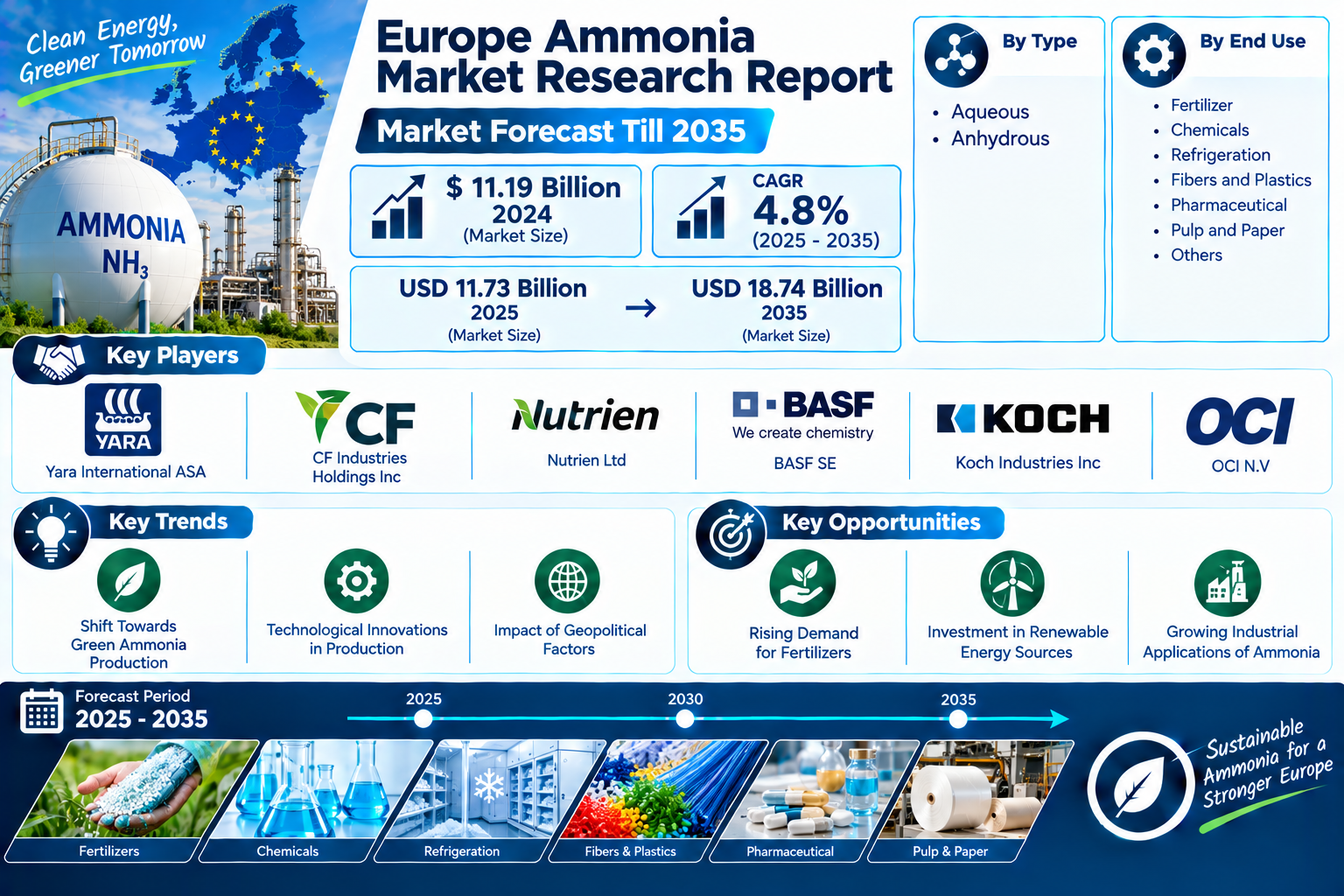

According to Market Research Future® (MRFR), the Europe Ammonia Market is expected to increase from USD 11.19 billion in 2024 to USD 11.73 billion in 2025 and reach USD 18.74 billion by 2035, representing a compound annual growth rate (CAGR) of 4.8% over 2025–2035. The market serves agriculture and a broad range of industrial activities, including chemicals, refrigeration, fibers and plastics, pharmaceuticals, and pulp and paper. Its outlook is being shaped by fertilizer requirements, technological developments, renewable energy investment and the changing economics of ammonia production.
Market Outlook and Strategic Importance
Ammonia occupies a significant position in Europe's agricultural and industrial supply chains. It provides nitrogen for fertilizer production and functions as a feedstock or process input in various industrial applications. As a result, market demand is connected to agricultural production, chemical manufacturing, energy costs and industrial operating conditions.
The market is forecast to expand over the next decade, with reported revenue rising from USD 11.73 billion in 2025 to USD 18.74 billion by 2035. The projected CAGR of 4.8% points to sustained growth across the forecast period. However, the trajectory will depend on more than demand volumes: feedstock prices, electricity costs, logistics, regulatory requirements and investments in production capacity can all affect market performance.
Europe's ammonia industry faces a strategic balancing act. It must maintain supply for established fertilizer and industrial customers while evaluating lower-emission production pathways. This transition involves decisions about infrastructure, technology, financing and access to renewable energy. The timing and scale of adoption will differ according to local conditions and project economics.
The Role of Agriculture and Fertilizer Markets
Fertilizer is a primary end-use category in the report. Ammonia provides a nitrogen source for agricultural nutrient products and is used as an intermediate in the production of other fertilizers. Demand is influenced by crop production requirements, fertilizer application practices, seasonal purchasing cycles and the financial position of farmers.
Affordability is especially important because fertilizer decisions are influenced by both input prices and expected agricultural returns. When ammonia production costs increase, higher prices may affect purchasing volumes, product selection or procurement timing. Conversely, strong agricultural demand can support fertilizer supply requirements, subject to the ability of producers to deliver competitively priced products.
The opportunity identified through rising fertilizer demand depends on maintaining reliable production and distribution. Storage, transportation and inventory planning are important because fertilizer requirements may vary by season and region. Producers must also respond to changing environmental expectations and agricultural practices, which can influence nutrient management and the efficiency with which fertilizers are used.
Aqueous and Anhydrous Product Categories
The report divides the market into aqueous and anhydrous ammonia. These forms differ in composition and handling requirements, which affects their suitability for particular uses. Aqueous ammonia is dissolved in water and can be selected for applications where the solution's concentration and characteristics meet process requirements.
Anhydrous ammonia is supplied without added water and has important uses in fertilizer production and other industrial processes. Its handling requires appropriate containment, transport arrangements and trained personnel because ammonia presents hazards if released or managed incorrectly. Infrastructure and safety procedures therefore form part of the commercial requirements for distribution and use.
Customers select ammonia forms based on application specifications, concentration, storage capacity, transport logistics and operating procedures. Suppliers must maintain consistent product quality and provide information that enables customers to handle and use the product appropriately. The relative size and growth of the two segments are not specified in the supplied market summary.
Industrial Demand and Application Diversity
Beyond agriculture, ammonia serves the chemicals sector and selected industrial processes. Chemical manufacturers use it as a feedstock in downstream production, connecting demand to activity across the broader chemicals value chain. Changes in industrial output, energy costs and the competitiveness of alternative production routes can influence purchasing patterns.
Refrigeration is another application identified in the report. Ammonia is used in certain industrial refrigeration systems, where efficiency, equipment design and safety management influence its adoption. Fibers and plastics, pharmaceuticals, pulp and paper, and other industries contribute additional potential sources of demand. Each sector has distinct technical requirements, purchasing cycles and quality expectations.
This diversity can help broaden the market's demand base, but it also requires suppliers to serve customers with different specifications and delivery needs. Understanding the requirements of each application can help producers plan distribution, technical support and product offerings. The available data do not quantify the share contributed by any one end-use sector.
Green Ammonia and Technology Development
The shift toward green ammonia production is one of the market's defining trends. Green ammonia typically uses hydrogen produced through renewable-powered electrolysis, with the aim of reducing emissions compared with conventional production pathways. Its expansion depends on renewable electricity availability, electrolyzer investment, water and infrastructure requirements, and the economics of producing and transporting the final product.
Technological innovations in production may improve process efficiency and support the development of lower-emission alternatives. However, commercial deployment requires dependable operation and competitive costs. Industrial buyers also need predictable supply and pricing, particularly when ammonia is an essential input for fertilizer or chemical production.
Investment in renewable energy sources creates an opportunity to support low-carbon hydrogen and ammonia projects. Nevertheless, renewable power availability, grid connections, storage and the need to balance electricity supply with industrial demand can influence project feasibility. The transition may therefore involve incremental upgrades and new production facilities rather than a single uniform shift across Europe.
Geopolitical Conditions and Market Resilience
Geopolitical factors can affect ammonia availability through energy prices, trade flows, transportation routes and international supplier relationships. Because production costs are closely linked to energy and feedstock conditions, disruptions can influence the competitiveness of European producers and the cost of imported supplies.
Supply-chain resilience has consequently become an important business consideration. Companies may evaluate supplier diversification, long-term contracts, inventory planning and investment in regional production. These strategies can improve flexibility but may involve higher costs or additional capital requirements. Market participants must balance security of supply with the need to remain competitive.
Competitive Landscape
MRFR identifies Yara International ASA, CF Industries Holdings Inc, Nutrien Ltd, BASF SE, Koch Industries Inc and OCI N.V. among the key players. Competition can reflect production capacity, operating efficiency, distribution networks, customer relationships and investment in emerging technologies. The report summary supplied here does not establish the market shares or rankings of these companies.
Forecast and Industry Prospects
The Europe ammonia market is projected to reach USD 18.74 billion by 2035, with a CAGR of 4.8% over 2025–2035. Fertilizer requirements and industrial applications provide a foundation for demand, while green ammonia production and renewable energy investment offer avenues for transformation. Geopolitical uncertainty, energy costs and infrastructure requirements will remain important factors. Suppliers that combine operational efficiency, reliable distribution and credible transition planning may be better positioned to serve the region's evolving market needs.
