

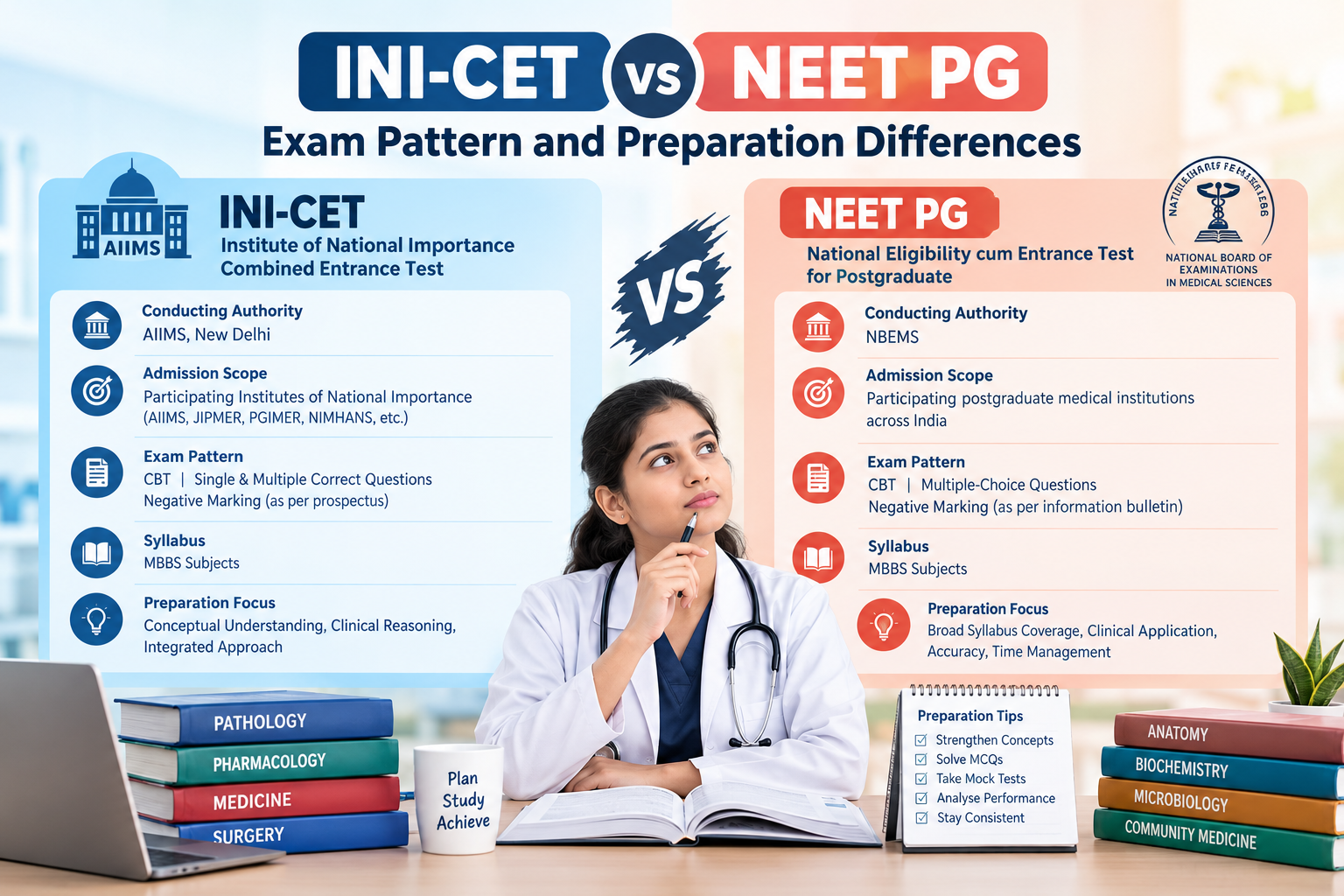

Choosing between preparation strategies for INI-CET and NEET PG an be confusing for medical graduates. Both examinations are important entrance tests for postgraduate medical courses in India, but they differ in their conducting authorities, participating institutions, examination patterns, and approach to preparation.
Understanding the differences between INI-CET and NEET PG helps aspirants build a focused study plan, improve accuracy, and prepare more effectively for their preferred postgraduate seats.
What Is INI-CET?
The Institute of National Importance Combined Entrance Test (INI-CET) is conducted by the All India Institute of Medical Sciences (AIIMS), New Delhi. It is used for admission to postgraduate medical courses, including MD, MS, DM (six years), MCh (six years), and MDS, at participating Institutes of National Importance, subject to the applicable admission rules.
Institutions participating in INI-CET include AIIMS campuses, JIPMER, PGIMER Chandigarh, and NIMHANS, among others, depending on the course and admission session.
INI-CET assesses a candidate's knowledge of medical subjects, conceptual understanding, clinical reasoning, and ability to apply information to examination questions.
What Is NEET PG?
The National Eligibility cum Entrance Test for Postgraduate (NEET PG) is conducted by the National Board of Examinations in Medical Sciences (NBEMS). It is the principal entrance examination for admission to MD, MS, and PG Diploma courses in participating medical institutions across India, subject to applicable eligibility and counselling rules.
NEET PG provides access to postgraduate seats in government medical colleges, private medical colleges, and other participating institutions. Admission to specific institutions and courses depends on the applicable counselling process and eligibility requirements.
The examination tests knowledge across the MBBS curriculum, including preclinical, paraclinical, and clinical subjects.
INI-CET vs NEET PG: Exam Pattern Differences
Although both examinations cover MBBS subjects, their formats and question-solving demands can differ.
| Feature | INI-CET | NEET PG |
|---|---|---|
| Conducting authority | AIIMS, New Delhi | NBEMS |
| Main admission scope | Participating Institutes of National Importance | Participating postgraduate medical institutions across India |
| Examination mode | Computer-based test | Computer-based test |
| Question format | Objective-type questions, including single-correct and multiple-correct formats as applicable | Multiple-choice questions |
| Negative marking | Applicable; check the current prospectus for exact rules | Applicable; check the current information bulletin for exact rules |
| Syllabus | MBBS subjects | MBBS subjects |
| Main preparation focus | Conceptual understanding, clinical reasoning, and careful interpretation | Broad syllabus coverage, clinical application, accuracy, and time management |
Important: The exact number of questions, examination duration, marking scheme, and other rules may change between sessions. Candidates should check the latest official AIIMS INI-CET prospectus and NBEMS NEET PG information bulletin before finalising their exam strategy.
Key Differences in Preparation Strategy
1. Build Strong Concepts for INI-CET
INI-CET preparation requires more than memorising facts. Candidates should focus on understanding mechanisms, clinical presentations, diagnostic findings, and the connections between different subjects.
For example, a question involving a clinical case may require knowledge of pathology, pharmacology, and medicine at the same time. Practising integrated questions can help develop this skill.
Revise high-yield concepts regularly and maintain short notes for topics that you frequently get wrong.
2. Maintain Broad Coverage for NEET PG
NEET PG preparation requires consistent coverage of the entire MBBS syllabus. While high-yield topics deserve priority, ignoring smaller subjects or less frequently tested areas can leave gaps in your preparation.
Create a subject-wise timetable covering Anatomy, Physiology, Biochemistry, Pathology, Pharmacology, Microbiology, Forensic Medicine, Community Medicine, and clinical subjects.
Combine video lectures, revision notes, previous-year questions, and question banks to reinforce important concepts.
3. Practise MCQs and Clinical Questions
For both examinations, solving questions regularly is essential. However, your practice should include different question styles and levels of difficulty.
For INI-CET, practise clinical vignettes, image-based questions, integrated concepts, and multiple-correct questions where relevant.
For NEET PG, focus on clinical application, factual recall, image-based questions, and maintaining accuracy across a broad syllabus.
After each practice session, review incorrect answers and understand why the correct option is appropriate.
4. Understand Negative Marking
Negative marking makes accuracy an important part of preparation. Avoid guessing without evaluating the available options.
Practise eliminating clearly incorrect answers and distinguish between questions you can solve confidently and those where your knowledge is incomplete.
During mock tests, record how many marks you lose through incorrect answers, rushed decisions, and avoidable mistakes. Use this analysis to improve your approach.
5. Use Mock Tests Strategically
Mock tests help you assess preparation, speed, and accuracy under examination conditions.
For NEET PG, use full-length mock tests to assess broad subject coverage and identify weak areas. For INI-CET, combine full-length tests with practice focused on complex clinical and integrated questions.
After every mock test, review:
-
Incorrect answers and their underlying concepts.
-
Questions answered correctly through guessing.
-
Time spent on difficult questions.
-
Topics requiring repeated revision.
-
Accuracy across individual subjects.
Mock-test analysis is often more useful than simply increasing the number of tests attempted.
Can You Prepare for INI-CET and NEET PG Together?
Yes. Since both examinations cover the MBBS curriculum, a large part of the preparation can be shared. You do not necessarily need two completely separate study plans.
Start with common subjects and core concepts, revise them regularly, and solve previous-year questions for both examinations. As the exam approaches, adjust your practice according to the relevant pattern, question styles, and official instructions.
For example, allocate dedicated sessions for INI-CET-style integrated questions while continuing broad syllabus revision and NEET PG mock tests. Keep separate records of performance in each examination to identify specific weaknesses.
Conclusion
INI-CET and NEET PG share a common medical foundation, but their admission scope, question formats, and preparation demands are not identical. INI-CET preparation benefits from strong conceptual understanding and integrated clinical reasoning, while NEET PG preparation requires broad syllabus coverage, regular revision, and consistent accuracy.
The most effective approach is to build a common foundation, practise questions for both examinations, analyse mock-test performance, and adapt your final revision to the latest official guidelines.
With a realistic timetable and consistent practice, medical graduates can prepare for both examinations without unnecessarily duplicating their efforts.
