

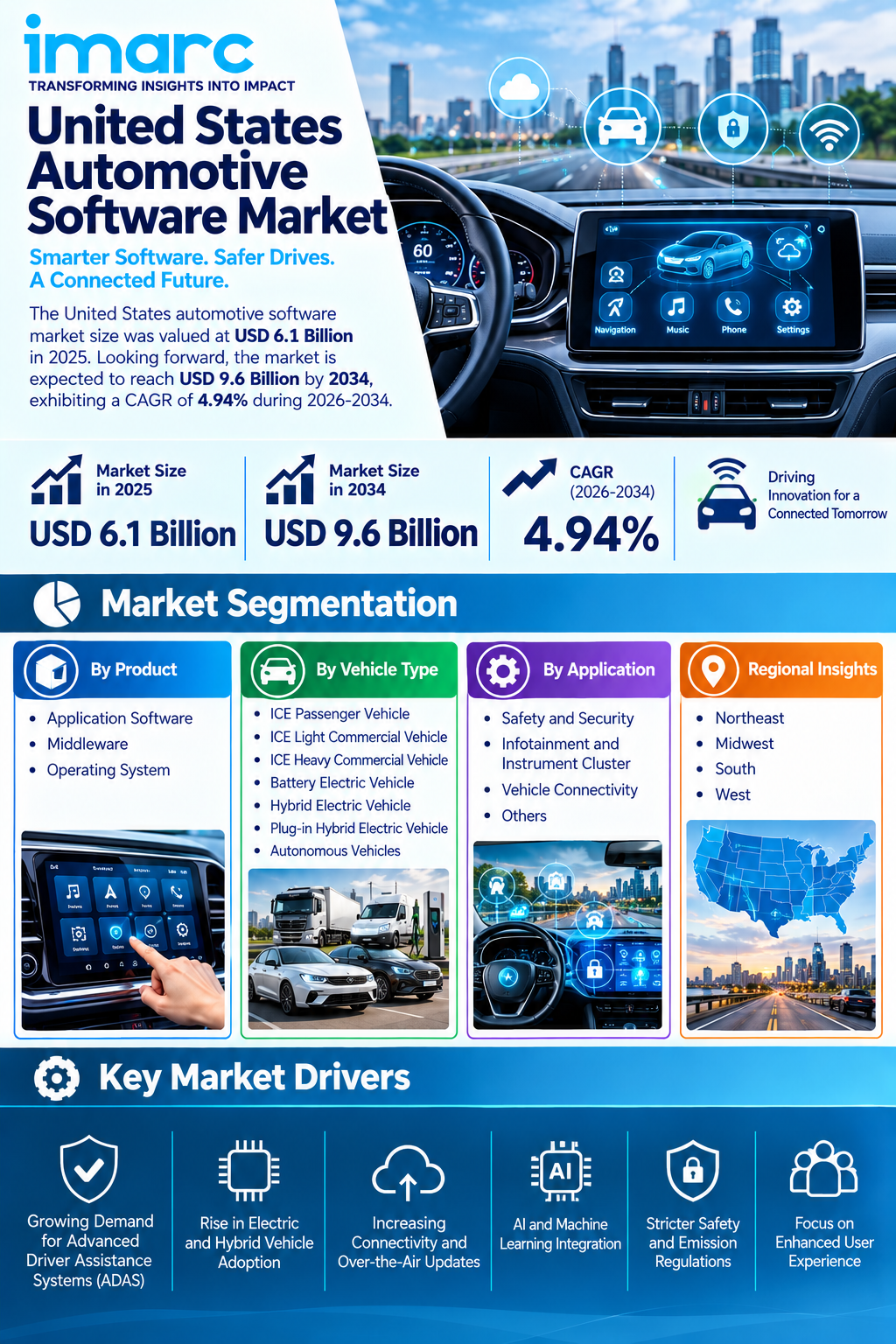
United States Automotive Software Market Size Projected to Reach USD 9.6 Billion by 2034 with a CAGR of 4.94%

IMARC Group has recently released a new research study titled “United States Automotive Software Market Report by Product, Vehicle Type, Application, and Region, 2026-2034,” that offers a detailed analysis of the market drivers, segmentation, growth opportunities, trends and competitive landscape to understand the current and future market scenarios.
United States Automotive Software Market Size, Growth, and Forecast (2026-2034)
The united states automotive software market size reached USD 6.1 Billion in 2025 and is projected to reach USD 9.6 Billion by 2034, growing at a CAGR of 4.94% during 2026-2034. Rising demand for connected cars, innovation in autonomous driving technologies, and growing consumer expectations for in-car digital experiences are the primary factors driving the united states automotive software market.
Automotive software refers to the operating systems, middleware, and applications that run vehicle functions, from navigation and infotainment to driver assistance, telematics, and safety systems. It has moved from handling simple functions to sitting at the center of vehicle design, operation, and user experience.
The spread of electric and hybrid vehicles is also lifting software development, particularly in battery monitoring and energy optimization. Government policies encouraging vehicle safety and emission control, along with partnerships between automakers and technology companies, are accelerating innovation in real-time data analytics, artificial intelligence (AI), and security across the us automotive software market.
Explore Growth Opportunities in the United States Automotive Software Market - Grab Your Sample Report for Evaluation: https://www.imarcgroup.com/united-states-automotive-software-market/requestsample
Key Trends Driving the United States Automotive Software Market
- Software as a core driver of safety and user interfaces: Software now powers interactive dashboards, real-time navigation, voice commands, and safety features such as collision alerts, lane departure warnings, blind spot detection, and automatic emergency braking. As consumers and regulators both push to reduce accidents, automakers are investing heavily in these capabilities.
- Shift toward connected and intelligent vehicles: Drivers increasingly expect smartphone integration, real-time updates, and personalized experiences from their vehicles, prompting automakers to embed more advanced software platforms. Collaborations with cloud service providers and data analytics companies are shaping long-term connected ecosystems in the us automotive software market.
- Smart mobility and digitized transportation: Smart traffic systems, electric vehicle charging infrastructure, and mobility-as-a-service platforms all depend on real-time data and integrated software. Automotive software enables vehicle-to-everything (V2X) communication, remote diagnostics, and ride optimization, extending its role well beyond the vehicle itself.
United States Automotive Software Market Report Segmentation:
The United States Automotive Software Market report provides a detailed segmentation analysis to help businesses identify key growth segments and evolving industry dynamics. The market is categorized based on product, vehicle type, and application, with regional forecasts, offering comprehensive insights across the united states automotive software market.
Product Insights:
- Application Software: Application software covers navigation, infotainment, driver assistance functions, and telematics, delivering the safety, comfort, and convenience features that drivers interact with directly.
- Middleware: Middleware bridges the operating system and application software, enabling data transfer and system integration between sensors, control units, and cloud platforms, and supporting over-the-air updates.
- Operating System: Operating systems form the base for all automotive software functions, with platforms such as Android Automotive and QNX supporting infotainment, safety features, and vehicle control.
Vehicle Type Insights:
- ICE Passenger, Light Commercial, and Heavy Commercial Vehicles: Internal combustion engine vehicles use software for infotainment, diagnostics, driver aids, fleet management, route planning, emissions management, and predictive maintenance.
- Battery Electric, Hybrid Electric, and Plug-in Hybrid Electric Vehicles: Electrified vehicles depend heavily on software to manage battery performance, charging, energy use, regenerative braking, and switching between power sources.
- Autonomous Vehicles: Self-driving vehicles are at the center of software development, relying on sensor fusion, perception, mapping, and AI-driven decision-making.
Application Insights:
- Safety and Security: Safety and security software spans advanced driver assistance, collision avoidance, emergency braking, and cybersecurity technologies that protect vehicles and occupants.
- Infotainment and Instrument Cluster: This segment powers touchscreens, navigation, multimedia, smartphone integration, and digital instrument clusters with customizable layouts and voice controls.
- Vehicle Connectivity: Connected vehicle software enables telematics, over-the-air updates, remote diagnostics, and real-time traffic information between the vehicle, cloud services, and infrastructure.
- Others: Other applications include additional vehicle control and support functions that rely on embedded software.
Regional Insights:
- Northeast: The Northeast prioritizes software for urban mobility, safety, and emissions compliance, supported by regional tech centers and public-private collaboration.
- Midwest: The Midwest, home to the US automotive manufacturing belt, leads R&D on embedded systems in states such as Michigan and Ohio, backed by strong OEM and supplier bases.
- South: The South is an emerging automotive center, with Texas, Georgia, and Tennessee attracting automakers and software engineers focused on telematics, infotainment, and fleet management.
- West: The West, led by California, is a hotbed for autonomous vehicle software, electric mobility platforms, and digital in-car experiences, supported by many technology companies and startups.
United States Automotive Software Market: Recent News and Developments
- July 2025: QNX and Vector announced a partnership to develop a Foundational Vehicle Software Platform that combines safe middleware and certified operating systems to simplify software-defined vehicle development, with an official release scheduled for late 2026.
- June 2025: Plus Automation and Churchill IX merged to form PlusAI, focused on its AI-powered SuperDrive virtual driver software for autonomous trucking, which has been trialed with DSV and IVECO.
Challenges Impacting the United States Automotive Software Market
Growing software complexity and connectivity raise cybersecurity and data protection demands, requiring continuous investment to keep vehicles and user data secure.
Integrating new software platforms with existing vehicle architectures, along with high development and validation costs, can slow rollouts and strain automaker and supplier budgets.
Investment Opportunities in the United States Automotive Software Market
The united states automotive software market presents compelling investment opportunities supported by its projected growth from USD 6.1 Billion in 2025 to USD 9.6 Billion by 2034. ADAS, autonomous driving, and over-the-air update platforms represent high-value areas as vehicles become increasingly software-defined.
Cybersecurity, AI-based diagnostics, and cloud-connected analytics are a growing investment frontier, supported by collaborations between automakers and technology companies. Firms that combine secure, updatable software with strong partnerships can build strong competitive positions in the us automotive software market.
Outlook of the United States Automotive Software Market (2026-2034)
The outlook for the united states automotive software market is positive, supported by connected car demand, autonomous driving innovation, and the rise of electric and hybrid vehicles. The market is projected to grow from USD 6.1 Billion in 2025 to USD 9.6 Billion by 2034 at a CAGR of 4.94%.
Continued growth in software-defined vehicles, expanding 5G connectivity, and rising demand for safety and in-car digital experiences will be the defining trends shaping the united states automotive software market through 2034.
Key Players in the United States Automotive Software Market
The united states automotive software market is served by a mix of established software providers, automakers, and technology companies competing on innovation, vehicle intelligence, and partnerships. Key companies include Airbiquity Inc., BlackBerry Limited, Intellectual Technology Inc., and RisingMax Inc.
BlackBerry Limited: Through its QNX business, BlackBerry supplies operating systems used in infotainment, safety, and vehicle control. In July 2025, QNX and Vector announced a partnership to develop a Foundational Vehicle Software Platform for software-defined vehicles.
Airbiquity Inc.: Airbiquity is a connected vehicle software and services provider, known for supporting over-the-air updates and vehicle data management that help automakers keep vehicles current after sale.
Frequently Asked Questions (FAQs): United States Automotive Software Market
- What is the current united states automotive software market size?
The united states automotive software market size reached USD 6.1 Billion in 2025 and is projected to reach USD 9.6 Billion by 2034, growing at a CAGR of 4.94% during 2026-2034.
- What is automotive software?
Automotive software includes the operating systems, middleware, and applications that run vehicle functions such as navigation, infotainment, driver assistance, telematics, and safety systems.
- What are the key drivers of the united states automotive software market?
Key drivers include rising demand for connected vehicles, advances in autonomous driving, the growth of electric and hybrid vehicles, consumer preference for safety and infotainment features, and collaboration between automakers and technology companies.
- How is the us automotive software market segmented?
The us automotive software market is segmented by product (application software, middleware, and operating system), vehicle type (ICE, electric, hybrid, plug-in hybrid, and autonomous vehicles), application (safety and security, infotainment and instrument cluster, vehicle connectivity, and others), and region.
- Who are the key players in the united states automotive software market?
Key players in the united states automotive software market include Airbiquity Inc., BlackBerry Limited, Intellectual Technology Inc., and RisingMax Inc., alongside automakers and technology companies investing in software-defined vehicles.
Author IMARC Group
IMARC Group is a global management consulting firm that helps the world's most ambitious changemakers to create a lasting impact. The company provide a comprehensive suite of market entry and expansion services. IMARC offerings include thorough market assessment, feasibility studies, company incorporation assistance, factory setup support, regulatory approvals and licensing navigation, branding, marketing and sales strategies, competitive landscape and benchmarking analyses, pricing and cost research, and procurement research.
Contact Us
IMARC Group,
134 N 4th St. Brooklyn, NY 11249, USA,
Email: [email protected],
United States: +1-201971-6302
