

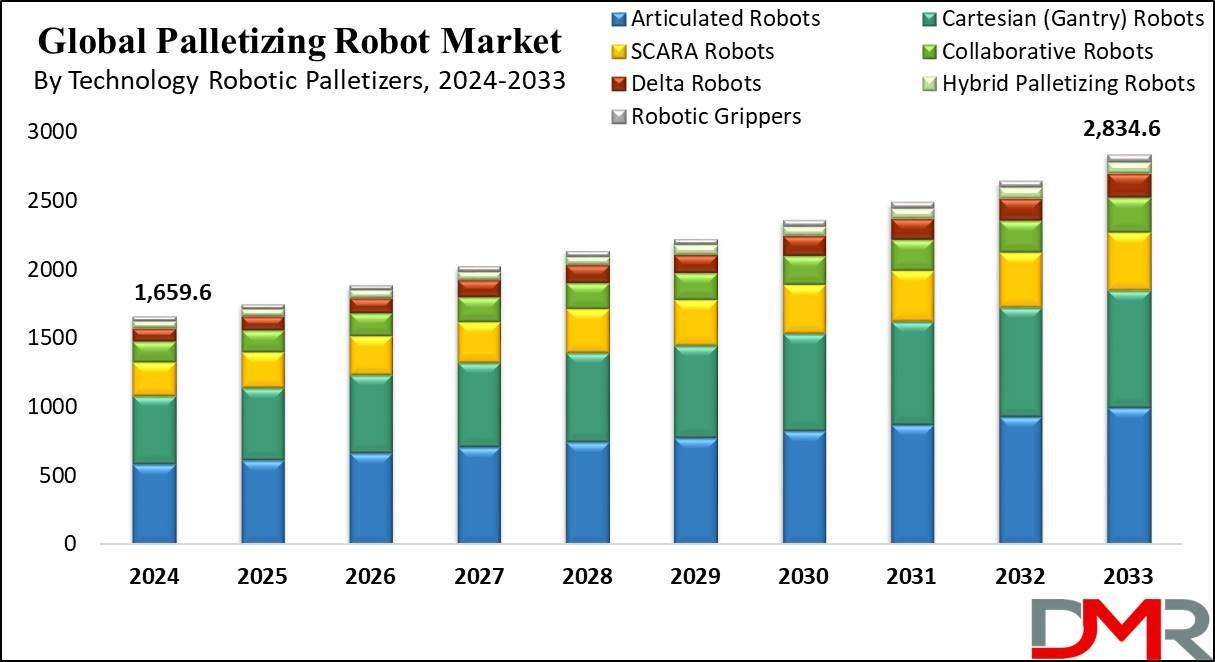

The global Palletizing Robot Market is becoming an important part of industrial automation as manufacturers and logistics operators prioritize faster packaging, efficient material handling, and reduced dependence on repetitive manual processes. According to Dimension Market Research, the market was valued at USD 1,659.6 million in 2024 and is projected to reach USD 2,834.6 million by 2033, expanding at a CAGR of 6.1%.
Increasing adoption of robotic technologies across food and beverages, pharmaceuticals, consumer goods, manufacturing, and e-commerce is reshaping how businesses manage packaging and distribution operations. Organizations are investing in intelligent palletizing solutions to improve productivity, maintain stacking accuracy, and support increasingly complex supply chains.
Advancements in artificial intelligence, machine learning, robotic vision, and collaborative automation are also transforming conventional palletizing equipment into flexible systems capable of handling diverse product sizes, weights, and packaging configurations.
What Is the Palletizing Robot Market?
The Palletizing Robot Market comprises automated robotic systems designed to arrange, stack, and organize packaged products onto pallets for storage, transportation, and distribution. These systems typically integrate robotic arms, end-of-arm tooling, control software, sensors, and supporting automation equipment.
Unlike conventional manual palletizing, robotic systems perform repetitive material handling operations with greater consistency and precision. They can process cartons, bags, bottles, drums, and other packaged goods while supporting different production speeds and pallet arrangements.
Their growing relevance extends beyond large manufacturing facilities to warehouses, distribution centers, and smaller industrial operations seeking scalable automation.
Why Is the Palletizing Robot Market Growing?
Industrial automation is becoming increasingly important as businesses respond to labor shortages, rising operating costs, and growing pressure to improve supply chain performance.
E-commerce and retail distribution are particularly significant demand drivers. High order volumes and changing packaging requirements create operational challenges that robotic palletizing systems can help address.
The principal growth factors include:
● Increasing investment in warehouse and packaging automation.
● Rising demand for efficient e-commerce fulfillment.
● Growing adoption of collaborative robotic solutions.
● Greater emphasis on worker safety and productivity.
● Advancements in AI-enabled material handling systems.
Palletizing automation also helps manufacturers maintain consistency across high-volume production lines. By minimizing repetitive lifting and stacking activities, businesses can redirect workers toward supervision, quality control, and other operational responsibilities.
Get a Free Sample of the Palletizing Robot Market Report
Explore detailed market segmentation, technology developments, regional opportunities, competitive positioning, and growth drivers through Dimension Market Research's comprehensive industry assessment. The sample provides an introduction to the research framework and market outlook.
https://dimensionmarketresearch.com/request-sample/palletizing-robot-market/
Palletizing Robot Market Size, Share and Growth Statistics
The published market analysis identifies the following industry benchmarks:
● 2024 Market Size: USD 1,659.6 million
● 2033 Market Forecast: USD 2,834.6 million
● Forecast CAGR: 6.1%
● Leading Region: North America, 39.2% share in 2024
● Leading Component: Robotic arms, 37.1% share in 2024
● Leading Technology: Articulated robots, 35.0% share in 2024
● US Market Size: USD 547.1 million in 2024
These figures highlight the established role of robotic automation in packaging operations and the opportunities associated with continued industrial modernization.
How Are AI and Collaborative Robots Transforming Palletizing?
Artificial intelligence and machine learning are improving the adaptability of robotic palletizing systems. Intelligent software enables robots to recognize product variations, adjust stacking patterns, and respond to changing packaging requirements.
Machine vision technology supports product identification and positioning, making robotic systems increasingly suitable for mixed-product palletizing applications.
Collaborative robots, commonly called cobots, represent another important development. These systems are designed to work alongside human operators under appropriate safety conditions and can offer flexible automation options for smaller production environments.
Modular robotic systems are also gaining attention because they allow manufacturers to adjust automation capacity without replacing entire production lines.
Palletizing Robot Market Segmentation and Applications
Robotic arms lead the component segment because they provide the flexibility, precision, and movement capabilities required for automated stacking operations.
Within technology segmentation, articulated robots maintain a prominent position because their multi-axis movement supports complex palletizing patterns and different payload requirements.
Medium-payload systems, covering 101 to 500 kilograms, are identified in the report as particularly versatile across industrial applications.
Case palletizing remains an important application because manufacturers frequently transport products in standardized cartons and boxes. The pharmaceutical industry is identified as a leading end-user segment, supported by its requirements for precise, hygienic, and consistent product handling.
Other important applications include bag palletizing, bottle palletizing, and drum palletizing across industrial packaging operations.
Regional Outlook: North America Leads Industrial Automation Adoption
North America held the leading position in the global market, accounting for approximately 39.2% in 2024. Its advanced manufacturing infrastructure, established logistics networks, and widespread industrial automation adoption support demand for robotic palletizing solutions.
The United States represents a major market, driven by automated warehousing, food processing, pharmaceutical manufacturing, and distribution activities.
Europe also maintains a significant presence, supported by industrial robotics adoption across established manufacturing economies.
Meanwhile, Asia Pacific offers substantial growth opportunities as China, India, and other emerging industrial markets increase investments in manufacturing modernization and automated logistics.
Competitive Landscape and Industry Opportunities
Competition in the Palletizing Robot Market centers on robotic performance, automation flexibility, payload capacity, integration capabilities, and cost efficiency.
Prominent companies identified in the report include FANUC Corporation, Yaskawa Electric Corporation, Kawasaki Heavy Industries, Mitsubishi Electric Corporation, ABB Ltd., KUKA AG, and Columbia/Okura LLC.
Market participants are developing intelligent robotic systems, customized end-of-arm tooling, collaborative automation platforms, and modular palletizing solutions.
Despite growing demand, high initial investment, technical integration difficulties, and specialized maintenance requirements remain important adoption barriers, particularly for smaller manufacturers.
Future opportunities are increasingly connected to affordable robotic deployment, intelligent software, and adaptable systems capable of supporting changing packaging requirements.
Explore the Complete Palletizing Robot Market Analysis
Dimension Market Research provides detailed market intelligence covering component demand, robotic technologies, payload classifications, applications, regional performance, and competitive developments. The complete study supports manufacturers, automation suppliers, investors, and strategic planners evaluating industrial robotics opportunities.
https://dimensionmarketresearch.com/checkout/palletizing-robot-market/
Frequently Asked Questions
1. What is the global Palletizing Robot Market size?
The global market was valued at USD 1,659.6 million in 2024 and is projected to reach USD 2,834.6 million by 2033.
2. What is the expected CAGR of the Palletizing Robot Market?
The market is projected to expand at a CAGR of 6.1% during the 2024 to 2033 forecast period.
3. Which technology segment leads the Palletizing Robot Market?
Articulated robots lead the technology segment, accounting for approximately 35.0% of the global market in 2024.
4. Which region dominates the Palletizing Robot Market?
North America leads with approximately 39.2% market share in 2024, supported by advanced manufacturing and logistics automation.
5. What is the future outlook for the Palletizing Robot Market?
The market is expected to benefit from AI integration, collaborative robotics, warehouse automation, and rising industrial demand for efficient material handling.
Conclusion
The Palletizing Robot Market is evolving as intelligent automation becomes increasingly important to modern manufacturing and distribution. Growing adoption of AI-enabled robotics, collaborative systems, and flexible palletizing technologies is creating opportunities for automation providers and industrial operators.
As businesses prioritize productivity, packaging accuracy, and supply chain resilience, robotic palletizing systems are positioned to play a greater role in industrial operations through 2033.
Related Robotics and Industrial Automation Market Insights
The Advanced Robotics Market Size was projected at USD 47.5 billion in 2024 and is forecast to reach USD 260.9 billion by 2033, expanding at a CAGR of 20.8%. Growth is supported by artificial intelligence, machine learning, advanced sensors, and increasing robotics adoption across manufacturing, healthcare, and logistics.
The Robotic Palletizer Market Share reflects increasing adoption of automated stacking and packaging technologies. This related market was projected at USD 2.0 billion in 2024 and is expected to reach USD 3.7 billion by 2033, registering a CAGR of 7.0%, supported by warehouse modernization and industrial automation.
The The US Palletizing Robot Market Growth outlook highlights increasing investment in automated material handling across American manufacturing and distribution facilities. The US market is projected to expand from USD 580.4 million in 2025 to USD 974.1 million by 2034 at a CAGR of 5.9%, driven by labor constraints, e-commerce fulfillment, and intelligent warehouse operations.
