

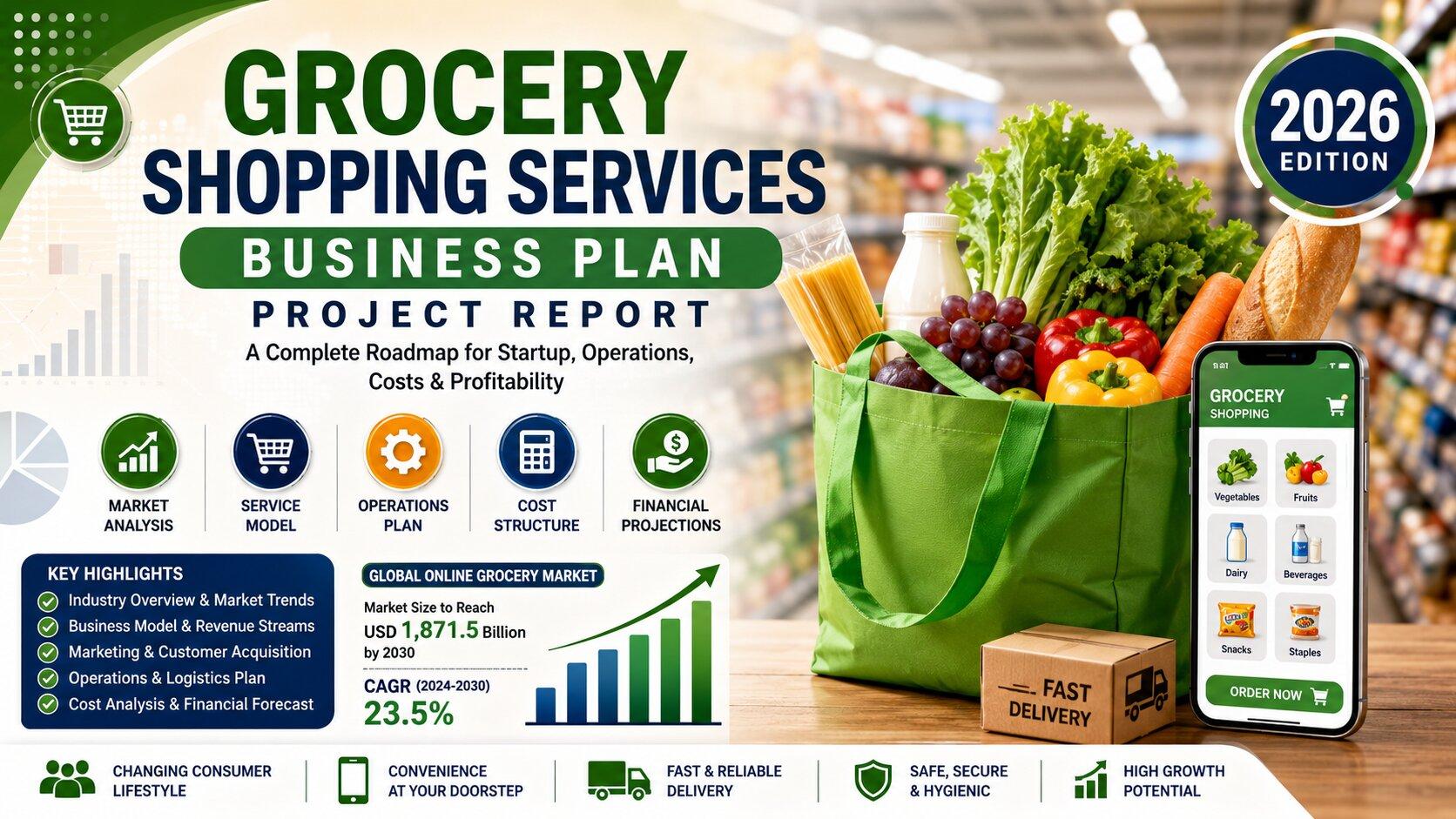

IMARC Group's "Grocery Shopping Services Business Plan and Project Report 2026: Industry Trends, Business Setup, Revenue Model, Investment Opportunities, Income, Expenses, and Profitability," provides a complete roadmap for setting up a grocery shopping services facility. The critical areas, including market trends, investment opportunities, revenue models, and financial forecasts, are discussed in this in-depth report and are therefore useful resources to entrepreneurs, consultants and investors. Whether evaluating the viability of a new venture or streamlining an existing one, the report gives an in-depth analysis of all the ingredients that make it successful, starting with business formation and profitability over time.
What is Grocery Shopping Services?
Grocery shopping services provide customers with a convenient way to purchase and receive groceries and household essentials without visiting physical stores. These services cover the entire shopping process, from receiving orders through websites, mobile applications, or phone calls to selecting products, checking freshness, managing substitutions, processing payments, and arranging delivery or pickup. Efficient operations depend on product knowledge, food safety practices, inventory management, customer communication, and delivery route planning. Personal shoppers, order pickers, delivery personnel, and customer support teams work together to ensure accurate orders and a satisfactory customer experience. The adoption of digital shopping platforms, real-time inventory systems, AI-powered product recommendations, automated substitutions, and temperature-controlled delivery solutions is further improving convenience, order accuracy, and service efficiency.
What is Driving the Grocery Shopping Services Market?
The grocery shopping services market is expanding as busy lifestyles, the growing number of dual-income households, and increasing preference for home delivery encourage consumers to seek convenient shopping alternatives. The growth of e-commerce, digital payment solutions, and last-mile delivery networks is making these services more accessible. Demand is also supported by working professionals, older consumers, and health-conscious individuals seeking personalized assistance and access to organic, fresh, and specialty dietary products. Partnerships with supermarkets, local farmers, organic food suppliers, and meal-kit providers are helping service operators diversify their offerings. Furthermore, mobile applications, subscription-based memberships, contactless delivery options, and flexible delivery schedules are strengthening customer engagement. Investments in shopper training, product quality control, refrigerated transportation, and advanced fulfillment technologies are enabling providers to improve service reliability, retain customers, and expand their market presence.
Request for a Sample Report: https://www.imarcgroup.com/grocery-shopping-services-business-plan-project-report/requestsample
Report Coverage
The Grocery Shopping Services Business Plan and Project Report includes the following areas of focus:
- Business Model & Operations Plan
- Technical Feasibility
- Financial Feasibility
- Market Analysis
- Marketing & Sales Strategy
- Risk Assessment & Mitigation
- Licensing & Certification Requirements
The comprehensive nature of this report ensures that all aspects of the business are covered, from market trends and risk mitigation to regulatory requirements and customer-focused acquisition strategies.
Key Elements of Grocery Shopping Services Business Setup
Business Model & Operations Plan
A solid business model is crucial to a successful venture. The report covers:
- Service Overview: A breakdown of full-service grocery shopping and delivery, curbside pickup and click-and-collect services, subscription-based recurring grocery delivery, specialty diet and organic product shopping (vegan, gluten-free, keto), personal shopper consultation and meal planning assistance, same-day and scheduled delivery options, bulk shopping for events and gatherings, elderly and mobility-impaired shopping assistance, gift basket and special occasion shopping, and customer support and order modification services offered
- Service Workflow: How each customer registration and preference profiling, shopping list creation or cart building, product availability verification, personal shopper assignment and store navigation, item selection and quality inspection, substitution approval and customer communication, checkout and secure payment processing, and packaging, delivery or pickup coordination process is managed
- Revenue Model: An exploration of the mechanisms driving revenue across multiple grocery shopping service tiers and value-added convenience offerings
- SOPs & Service Standards: Guidelines for consistent order accuracy, food safety and handling protocols, product freshness and quality standards, delivery timeliness requirements, and customer satisfaction
This section ensures that all operational and grocery fulfillment aspects are clearly defined, making it easier to scale and maintain service quality.
Technical Feasibility
Setting up a successful business requires proper operational infrastructure and service capability planning. The report includes:
- Location Selection Criteria: Key factors to consider when establishing fulfillment centers, partnership with grocery retailers, and service coverage areas
- Space & Costs: Estimations for required office and dispatch space, temporary storage and staging areas, refrigerated holding facilities, packing stations, and associated costs
- Equipment & Systems: Identifying essential mobile shopping applications and platforms, order management and fulfillment software, payment processing systems, inventory tracking tools, insulated delivery bags and coolers, temperature monitoring devices, delivery vehicles or fleet access, and customer communication systems
- Facility & Infrastructure Setup: Guidelines for creating efficient fulfillment and packing operations, climate-controlled storage areas, and organized dispatch facilities
- Utility Requirements & Costs: Understanding the refrigeration and climate control systems, internet connectivity for order management, vehicle fuel or charging infrastructure, facility utilities, and operational necessities to run grocery shopping operations
- Human Resources & Wages: Estimating staffing needs, roles, and compensation for personal shoppers and order fulfillment staff, delivery drivers, customer service representatives, quality control inspectors, operations coordinators, marketing and partnership managers, and administrative support personnel
This section provides practical, actionable insights into the operational infrastructure needed for setting up your business, ensuring fulfillment efficiency and grocery shopping service delivery capability.
Financial Feasibility
The Grocery Shopping Services Business Plan and Project Report provides a detailed analysis of the financial landscape, including:
- Capital Investments & Operating Costs: Breakdown of initial and ongoing investments
- Revenue & Expenditure Projections: Projected income and cost estimates for the first five years
- Profit & Loss Analysis: A clear picture of expected financial outcomes
- Taxation & Depreciation: Understanding tax obligations and equipment depreciation
- ROI, NPV & Sensitivity Analysis: Comprehensive financial evaluations to assess profitability
This in-depth financial analysis supports effective decision-making and helps secure funding, making it an essential tool for evaluating the business's potential.
Request For Customization: https://www.imarcgroup.com/request?type=report&id=43841&flag=E
Market Insights & Strategy
Market Analysis
A deep dive into the grocery shopping services market, including:
- Industry Trends & Segmentation: Identifying emerging trends and key market segments across urban professional convenience shopping, elderly and senior citizen assistance services, busy family grocery delivery, specialty diet and organic product shopping, subscription-based recurring grocery services, same-day and express delivery segments, and corporate office pantry and snack delivery solutions
- Regional Demand & Cost Structure: Regional variations in adoption rates and cost factors affecting service operations
- Competitive Landscape: An analysis of the competitive environment including major grocery retailer delivery services, dedicated grocery delivery platforms, gig economy shopping services, meal kit and grocery hybrid companies, and independent personal shopping businesses
Profiles of Key Players
The report provides detailed profiles of leading players in the industry, offering a valuable benchmark for new businesses. It highlights their strategies, service models, technology platforms, retail partnerships, geographic coverage, and market positioning, helping you identify strategic opportunities and areas for differentiation.
Capital & Operational Expenditure Breakdown
The report includes a comprehensive breakdown of both capital and operational costs, helping you plan for financial success. The detailed estimates for technology development, equipment acquisition, and operating costs ensure you're well-prepared for both initial investments and ongoing expenses.
- Capital Expenditure (CapEx): Focused on mobile app and platform development or licensing, office and fulfillment center setup, refrigerated storage equipment purchase, insulated delivery bags and temperature control containers, delivery vehicle fleet acquisition or partnerships, payment processing system setup, initial marketing and brand launch, and technology infrastructure investment
- Operational Expenditure (OpEx): Covers ongoing costs like shopper and delivery staff salaries and wages, vehicle fuel and maintenance expenses, app and software subscription fees, payment processing transaction fees, insurance coverage (liability, vehicle, product), facility rent and utilities, refrigeration and climate control costs, marketing and customer acquisition expenses, customer service operations, and quality assurance programs
Financial projections ensure you're prepared for cost fluctuations, including adjustments for seasonal demand variations, fuel and transportation cost changes, labor market wage pressures, technology platform upgrades, and competitive market pressures over time.
Profitability Projections
The report outlines a detailed profitability analysis over the first five years of operations, including projections for:
- Total revenue from per-order service and delivery fees, subscription and membership programs, retail partnership commissions, premium and express delivery charges, specialty shopping service premiums, and tips and gratuities, expenditure breakdown, gross profit, and net profit
- Profit margins for each service tier and year of operation
- Revenue per customer and average order value projections and market penetration growth estimates
These projections offer a clear picture of the expected financial performance and profitability of the business, allowing for better planning and informed decision-making.
About Us
IMARC Group is a leading global market research and management consulting firm. We specialize in helping organizations identify opportunities, mitigate risks, and create impactful business strategies.
Our expertise includes:
- Market Entry and Expansion Strategy
- Feasibility Studies and Business Planning
- Company Incorporation and Service Business Setup Support
- Regulatory and Licensing Navigation
- Competitive Analysis and Benchmarking
- Industry Partnership Development
- Branding, Marketing, and Consumer-Focused Customer Strategy
Contact Us:
IMARC Group
134 N 4th St. Brooklyn, NY 11249, USA
Email: [email protected]
Tel No:(D) +91 120 433 0800
United States: (+1-201971-6302)
