

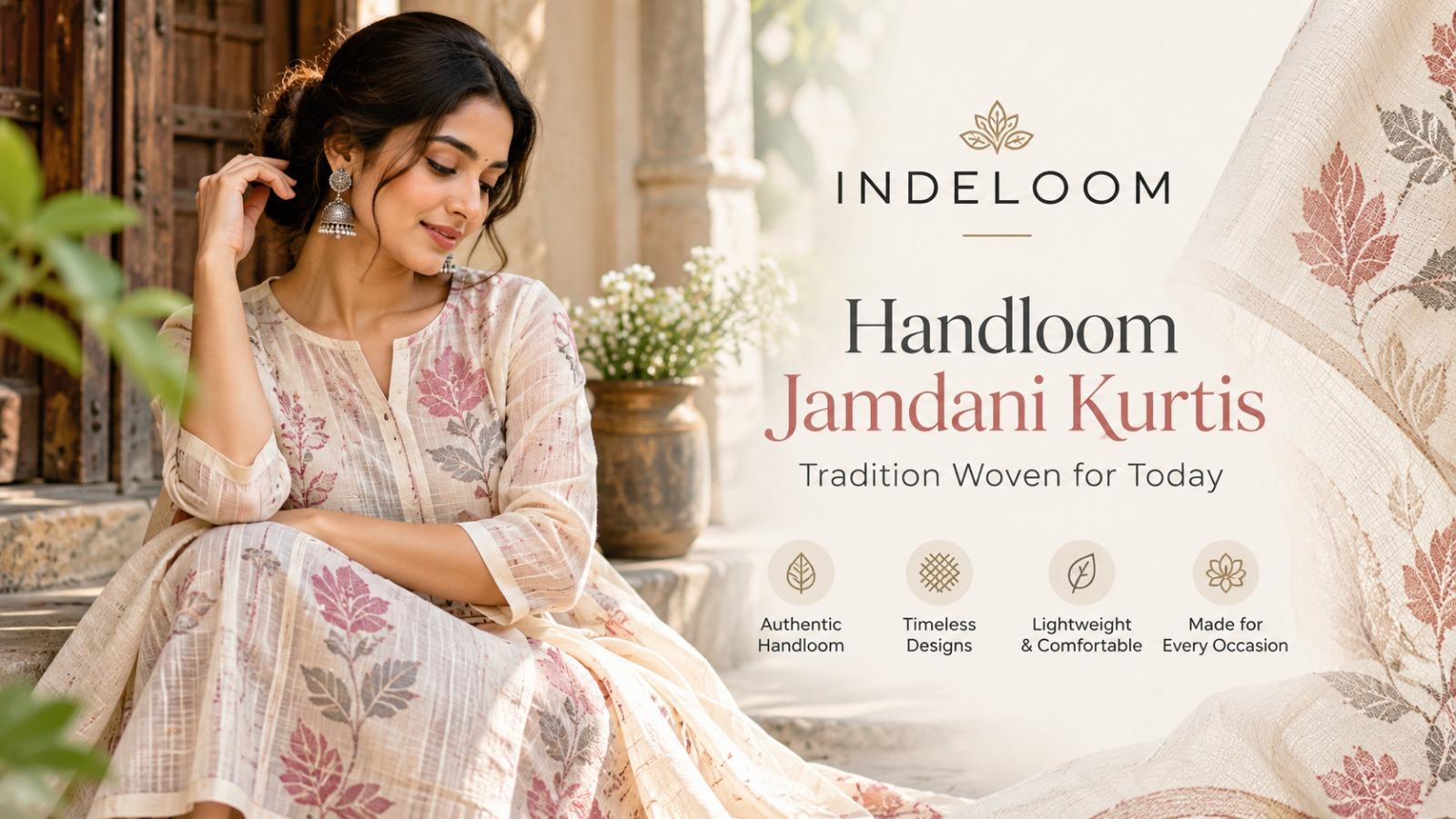

When shopping for ethnic wear, you may notice that some kurtis feature delicate motifs that appear to float across the fabric, while others display regular stripes, checks, or repeating woven patterns. These differences often come from the weaving technique, the type of yarn used, and the craftsmanship behind the textile. Jamdani kurtis stand out because of their intricate motifs and the detailed work involved in creating them.
Understanding Jamdani kurti features can help you distinguish these garments from other woven kurtis and choose a design that suits your style, comfort preferences, and budget. While many woven textiles have their own beauty and cultural significance, Jamdani is particularly admired for its fine patterns and traditional weaving heritage.
What Is a Jamdani Kurti?
A Jamdani kurti is a garment made from Jamdani-patterned fabric, a textile tradition associated with fine weaving and decorative motifs. Historically, Jamdani is closely connected with Bengal's weaving heritage, particularly the renowned muslin textiles of the region. The tradition is also practised in Bangladesh, where Jamdani weaving remains an important part of textile culture.
Unlike fabrics that rely mainly on printed designs, Jamdani traditionally incorporates motifs into the fabric during weaving. Artisans use supplementary weft threads to create decorative patterns alongside the base weave. This process requires precision, patience, and considerable skill.
Modern Jamdani kurtis are available in different silhouettes, colours, and fabric compositions. Depending on the garment, the material may use cotton or other fibres, so checking the product description is important before buying.
1. Jamdani Weaving Technique Creates Distinctive Motifs
One of the most important differences between Jamdani and many other woven textiles is how its decorative patterns are produced.
Motifs Woven Into the Fabric
In traditional Jamdani weaving, artisans introduce additional threads to create individual motifs within the fabric. These motifs are built into the textile rather than simply applied to its surface after weaving.
Common design elements include flowers, leaves, geometric shapes, vines, and other decorative forms. Their appearance depends on the weaving tradition, the design, and the artisan's interpretation.
This technique gives Jamdani its distinctive visual character. The motifs can appear delicate and slightly raised or textured against the background, creating a subtle contrast between the pattern and the base fabric.
Why the Technique Matters to Buyers
The Jamdani weaving technique can influence the fabric's appearance, texture, and price. Creating detailed motifs requires time and skilled labour, particularly when the design contains many small elements.
However, a complicated pattern does not automatically mean that every garment is handmade or of superior quality. Buyers should check whether the product is handwoven, powerloom-produced, or made using another construction method. Clear product descriptions and trustworthy seller information are valuable when assessing authenticity.
2. How Jamdani Patterns Differ from Other Woven Textile Patterns
Not all woven kurtis use the same method to create designs. Comparing their patterns can help you understand what makes Jamdani distinctive.
Jamdani Versus Striped and Checked Fabrics
Many woven cotton kurtis feature stripes, checks, or grids formed by arranging coloured warp and weft yarns. These patterns often repeat consistently across the fabric.
Jamdani can also contain geometric elements, but its decorative motifs are traditionally created through supplementary weft work. This allows artisans to produce more individualised shapes and intricate arrangements.
For example, a striped kurti may display continuous parallel lines, while a Jamdani kurti may feature small flowers or leaf-like motifs distributed across the fabric.
Jamdani Versus Jacquard Fabrics
Jacquard weaving uses a specialised mechanism to control individual warp threads and produce complex woven patterns. It can create elaborate floral designs, ornamental borders, and repeating motifs.
Jamdani and jacquard fabrics may look similar at first glance because both can feature designs woven into the textile. However, traditional Jamdani is distinguished by its supplementary-weft motif technique and its specific regional craftsmanship.
The appearance alone may not reveal the production method. If the distinction matters to you, look for information about the weaving process rather than relying only on the product's name.
Jamdani Versus Printed Kurtis
Printed kurtis receive their designs through a printing process in which colour or pigment is applied to the fabric. Woven designs, by contrast, are formed through the arrangement of yarns.
A printed kurti can still be attractive, durable, and well-made. The difference is primarily in construction and surface appearance. On a traditional Jamdani textile, the motifs are part of the woven structure rather than simply printed onto the surface.
3. Traditional Craftsmanship and Attention to Detail
Traditional craftsmanship is central to Jamdani's identity. Creating detailed motifs requires an understanding of thread placement, pattern spacing, and the relationship between the design and the base fabric.
Artisans must maintain consistency while working with small decorative elements. Even a relatively simple motif can require careful attention to keep its shape and placement balanced.
Design Complexity
Some Jamdani fabrics feature sparse motifs with plenty of open space, while others display dense patterns across much of the textile. Both approaches can be beautiful, but they create different visual effects.
Minimal motifs are often suitable for everyday kurtis and understated outfits. More elaborate designs can work well for festive occasions, family gatherings, and cultural events.
Why Handmade Pieces May Differ
In handwoven textiles, small variations can occur because the work involves human skill and manual processes. These variations are not automatically defects.
However, uneven construction, loose threads, damaged areas, or poorly finished seams should not be dismissed as signs of authenticity. A well-made garment should have a sound overall structure, even when its handmade details are not perfectly identical.
4. Fabric Texture, Weight, and Comfort
Jamdani kurtis are often appreciated for their fine appearance, but comfort depends on more than the weaving tradition alone.
The base yarn, fabric density, finishing, lining, and garment construction all affect how a kurti feels against the skin.
Is Every Jamdani Kurti Lightweight?
No. Some Jamdani fabrics are fine and lightweight, while others may feel firmer depending on the yarn, weave, and decorative density. A heavily patterned fabric may also feel different from one with sparse motifs.
When shopping online, check the stated fabric composition and any available information about weight or transparency. If the details are missing, ask the seller before placing an order.
Choosing a Comfortable Kurti
For warm weather, many buyers prefer breathable cotton-based fabrics and relaxed silhouettes. For longer wear, pay attention to the lining, sleeve construction, neckline, and ease of movement.
A beautiful woven fabric will not necessarily feel comfortable if the garment is too tight or poorly finished. Consider the complete kurti rather than judging it by the fabric pattern alone.
5. Design Variety and Styling Possibilities
Another appealing feature of Jamdani kurtis is the variety of patterns and garment styles available. The same textile tradition can produce very different looks depending on colour, motif placement, and silhouette.
Minimalist Jamdani Kurtis
Kurtis with small, widely spaced motifs are suitable for buyers who prefer understated ethnic wear. They pair easily with straight trousers, leggings, or simple cotton pants.
Neutral shades and soft colours can create a relaxed daytime outfit, while darker colours offer a more defined appearance.
Statement Jamdani Kurtis
Designs with denser motifs, contrasting colours, or decorative borders can create a stronger visual impression. These kurtis may be suitable for celebrations and occasions when you want your clothing to feature noticeable textile details.
Pair them with relatively simple bottoms and accessories to avoid competing with the woven design.
Contemporary Silhouettes
Jamdani fabric can be used for straight-cut kurtis, A-line styles, shorter designs, and longer silhouettes. The cut influences how the motifs appear on the finished garment.
Before buying, consider where the pattern falls in relation to the neckline, sleeves, side seams, and hem. Thoughtful placement can make the garment look balanced and well-designed.
6. How to Identify a Well-Made Jamdani Kurti Before Buying
Understanding the differences between woven textiles is useful, but practical quality checks are equally important.
Use the following checklist when shopping online or in a store:
- Check the product description: Look for the fabric composition, weaving method, and whether the garment is handwoven or machine-produced.
- Examine the motifs: Zoom in on product images to assess pattern clarity, spacing, and visible weaving details.
- Inspect the finishing: Check seams, hems, sleeve edges, and neckline construction for neatness.
- Ask about transparency: Fine fabrics may require a lining or suitable innerwear. Confirm whether lining is included.
- Review the size chart: Compare garment measurements with a kurti you already own rather than relying only on a general size label.
- Understand care requirements: Follow the recommended washing and drying instructions to help preserve the fabric and its decorative details.
- Check return policies: Confirm whether returns or exchanges are available if the garment does not match its description.
If you are specifically seeking traditional handwoven Jamdani, ask the seller for clear information about the textile's origin and production method. A product title alone is not sufficient proof of handloom authenticity.
7. Is a Jamdani Kurti Worth Choosing Over Other Woven Kurtis?
The right choice depends on your priorities. Jamdani may appeal to buyers who value intricate motifs, textile heritage, and visible craftsmanship. Other woven kurtis may be more suitable if you prefer regular stripes, bold geometric patterns, heavier textures, or a particular price range.
|
Feature |
Jamdani kurti |
Other woven kurtis |
|
Pattern style |
Often features intricate, supplementary-weft motifs |
May feature stripes, checks, jacquard patterns, or other designs |
|
Craft tradition |
Strong association with Bengal's weaving heritage |
Depends on the textile and regional tradition |
|
Visual character |
Can look delicate, detailed, and artistic |
Ranges from simple to highly decorative |
|
Price |
Varies with materials, labour, and production method |
Varies with materials, construction, and craftsmanship |
|
Best selection factor |
Motif quality and verified weaving details |
Fabric type, design, construction, and intended use |
Neither category is automatically better in every situation. The best garment is one that meets your needs for comfort, design, quality, and value.
Conclusion
Jamdani kurtis stand out because of their distinctive motifs, traditional supplementary-weft weaving technique, and association with skilled textile craftsmanship. While other woven kurtis can also feature beautiful patterns and complex construction, understanding how their designs are made helps buyers appreciate the differences.
When choosing a Jamdani kurti, look beyond its appearance. Check the fabric composition, production method, motif quality, stitching, fit, and care requirements. These details will help you select a garment that reflects your style while offering the comfort and quality you expect from a carefully chosen piece of ethnic wear.
