

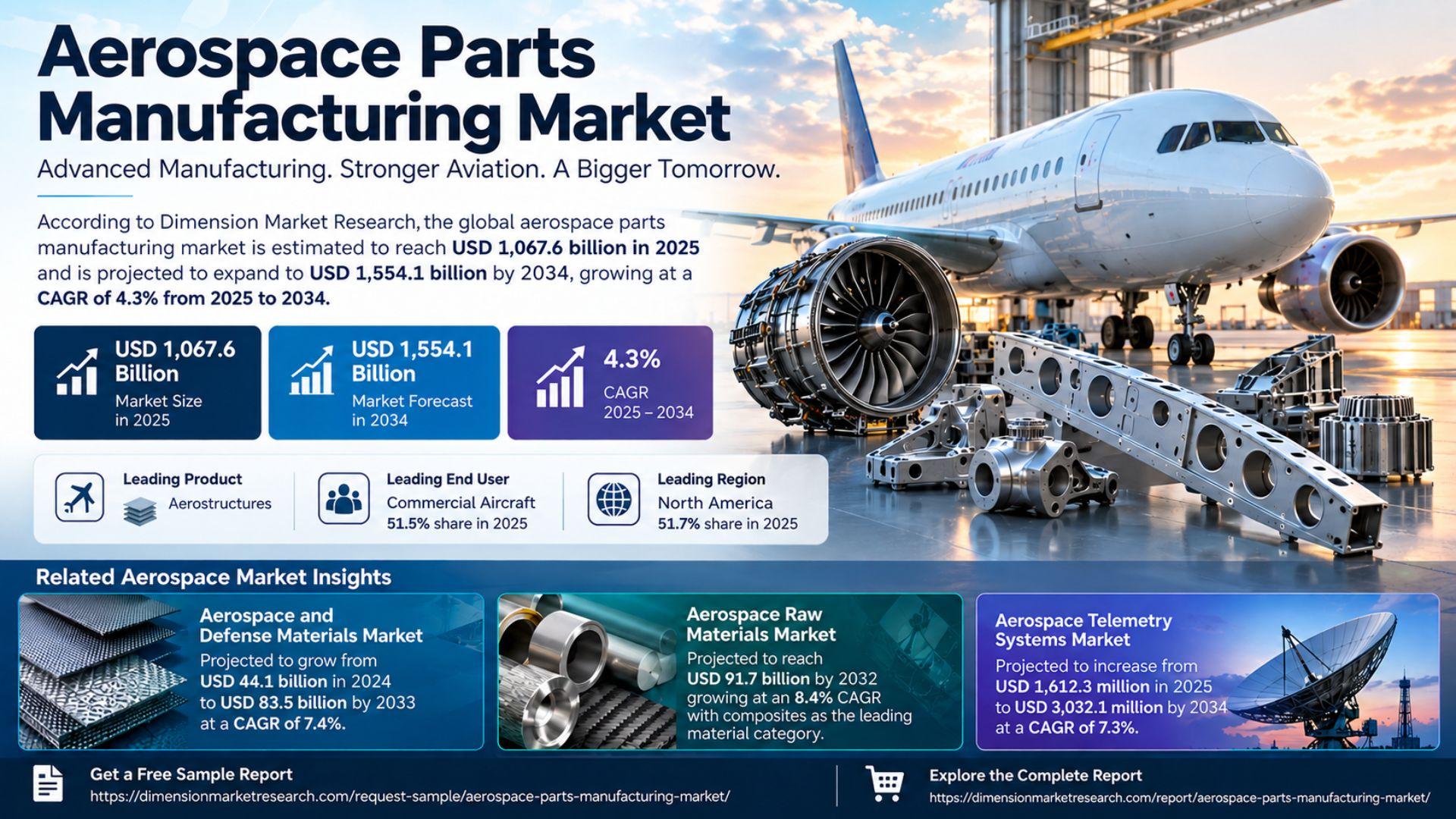

The global aviation industry is changing not only how aircraft operate but also how their essential components are designed, manufactured, and supplied. The Aerospace Parts Manufacturing Market is benefiting from this transition as aircraft producers prioritize structural efficiency, advanced engineering, and improved production capabilities. According to Dimension Market Research, the industry is estimated to reach USD 1,067.6 billion in 2025 and is forecast to achieve USD 1,554.1 billion by 2034, expanding at a CAGR of 4.3% during 2025–2034.
Behind this expansion lies a fundamental shift in aerospace procurement. Airlines are replacing aging aircraft, defense organizations are modernizing aviation platforms, and manufacturers are introducing more sophisticated technologies into production facilities.
Consequently, aerospace component suppliers must increasingly balance precision, material performance, regulatory compliance, and manufacturing economics to remain competitive.
What Is the Aerospace Parts Manufacturing Market?
The Aerospace Parts Manufacturing Market encompasses companies producing critical systems and individual components for commercial, military, business, and other aircraft.
Its scope extends from major structural assemblies to intricate electronic equipment, engine components, interior systems, and specialized insulation products. Each component contributes to aircraft safety, operational reliability, or overall performance.
Unlike conventional industrial production, aerospace manufacturing operates under demanding qualification procedures, extensive testing requirements, and strict quality controls.
Manufacturers must ensure that materials, designs, and finished components can perform consistently under demanding flight conditions while meeting customer and regulatory expectations.
Why Aircraft Modernization Is Creating New Manufacturing Opportunities
Aircraft replacement represents an important source of long-term component demand.
Older fleets can impose higher operating and maintenance requirements, encouraging airlines to invest in aircraft with improved fuel efficiency and operational capabilities. These purchasing decisions influence demand throughout the aerospace supply chain.
Commercial aviation expansion also supports aircraft production as passenger transportation, cargo movements, and international connectivity develop.
Meanwhile, defense modernization programs create additional opportunities for manufacturers supplying aircraft structures, propulsion components, electronic systems, and specialized equipment.
The industry's principal growth influences include:
● Replacement of aging commercial aircraft fleets
● Expansion of passenger and cargo aviation
● Investment in military aircraft modernization
● Adoption of precision manufacturing technologies
● Development of lightweight aerospace components
For suppliers, these developments reinforce the importance of aligning production capacity with aircraft manufacturers' evolving technical and operational requirements.
Get a Free Sample of the Aerospace Parts Manufacturing Market Report
Understanding aerospace component demand requires more than monitoring aircraft deliveries. Manufacturers, investors, and procurement teams also need to evaluate product categories, geographic demand, competitive positioning, and technological developments.
Request a free sample to review the report's coverage and determine how its findings relate to your business priorities.
https://dimensionmarketresearch.com/request-sample/aerospace-parts-manufacturing-market/
Aerospace Parts Manufacturing Market: Key Industry Statistics
● 2025 Global Market Value: USD 1,067.6 Billion
● 2034 Global Market Forecast: USD 1,554.1 Billion
● Forecast CAGR: 4.3% from 2025 to 2034
● Leading Product Category: Aerostructures
● Commercial Aircraft Share: 51.5% in 2025
● North America Market Share: 51.7% in 2025
● 2025 United States Market: USD 464.2 Billion
These indicators demonstrate the substantial role of commercial aircraft manufacturing and North American production capabilities within the global aerospace supply chain.
Why Aerostructures Remain Central to Aircraft Manufacturing
Aerostructures occupy a prominent position in aerospace component production because they form the physical foundation of aircraft.
The segment includes fuselage sections, wings, structural frames, doors, and related assemblies. The report identifies aerostructures as the leading product category, accounting for 54.3% of the market in its 2024 segmentation analysis.
Aircraft manufacturers increasingly require components that combine structural strength with lower weight, creating demand for specialized materials and advanced fabrication methods.
These requirements also influence supplier selection. Companies must demonstrate manufacturing precision, consistent product quality, and the ability to meet complex technical specifications.
Engine manufacturing represents another significant area because propulsion performance, durability, and operational efficiency depend on precisely manufactured components.
Avionics, cabin interiors, and equipment systems further contribute to the industry's diverse manufacturing requirements.
Commercial Aviation Remains the Largest End-User Segment
Commercial aircraft are projected to account for 51.5% of total market revenue in 2025.
This position reflects demand generated by passenger airlines, cargo operators, fleet replacement programs, and the expansion of aviation services.
Commercial aircraft production requires extensive networks of manufacturers supplying structural assemblies, engines, electronic systems, and interior components.
Business aviation creates additional demand for specialized aircraft and associated equipment, while military programs require components designed for demanding operational environments.
For market participants, the different requirements of these customer groups influence product development, manufacturing investment, and commercial strategy.
How Digital Manufacturing Is Changing Aerospace Component Production
Aerospace production is moving toward greater integration of digital technologies and automated processes.
Additive manufacturing allows engineers to produce intricate geometries and can reduce material waste when compared with certain conventional production methods. It also supports rapid prototyping and greater flexibility in component design.
Automation improves repeatability and supports the precision required for complex aerospace assemblies.
Digital twin technology introduces another capability by enabling virtual representations of physical equipment and systems. These models can support simulation, performance monitoring, and maintenance planning.
The report highlights Boeing's May 2024 investment in digital twin technology as an example of increased attention to digitally supported aerospace operations.
However, technological progress does not eliminate manufacturing challenges. Certification requirements, development expenditure, supply chain constraints, and production qualification processes continue to influence operating decisions.
Regional Outlook: North America's Established Aerospace Advantage
North America is projected to retain the largest regional position, representing 51.7% of global market revenue in 2025.
Its strength reflects an established aerospace manufacturing ecosystem, technical expertise, research capabilities, and investment in advanced production processes.
The United States is particularly important, with its aerospace parts manufacturing market estimated at USD 464.2 billion in 2025 and projected to reach USD 663.0 billion by 2034.
Europe represents another important manufacturing region, supported by aircraft production capabilities, engineering expertise, and specialized component suppliers.
Asia-Pacific offers opportunities linked to aviation expansion and aerospace industrial development, particularly across China, India, Japan, and South Korea.
For companies considering geographic expansion, manufacturing infrastructure, customer access, regulatory compliance, and technical capabilities remain important evaluation criteria.
Competitive Landscape and Strategic Industry Priorities
The aerospace parts manufacturing industry brings together established engineering specialists and diversified aerospace technology companies.
Organizations identified in the report include GE Aviation, Rolls-Royce plc, Pratt & Whitney, Lockheed Martin, Honeywell International, Collins Aerospace, MTU Aero Engines AG, Safran Group, Lufthansa Technik AG, Spirit AeroSystems, and Parker-Hannifin Corporation.
Competition extends beyond component pricing. Aerospace manufacturers must demonstrate reliable production, technical expertise, product quality, and the capacity to support demanding aircraft programs.
Strategic partnerships and joint ventures can also help distribute development expenses and strengthen manufacturing capabilities for complex systems.
Aerospace Parts Manufacturing Market Outlook Through 2034
The industry's projected expansion reflects the combined influence of aircraft modernization, sustained aviation activity, technological improvement, and defense-related requirements.
Component manufacturers that strengthen precision engineering, production efficiency, and advanced material capabilities may discover opportunities across aircraft platforms and specialized applications.
At the same time, long qualification cycles and manufacturing complexity mean that commercial opportunities require careful evaluation.
For investors and suppliers, the key question is not simply where aircraft demand is growing, but which manufacturing capabilities will be most relevant to future programs.
Explore the Complete Aerospace Parts Manufacturing Market Analysis
The complete market research report examines product and end-user segmentation, regional market conditions, industry dynamics, competitive participants, and forecast developments.
Explore its findings to support manufacturing investment, competitive assessment, supplier strategy, and regional opportunity evaluation.
View report and proceed to checkout:
https://dimensionmarketresearch.com/checkout/aerospace-parts-manufacturing-market/
Frequently Asked Questions
1. What is the projected size of the Aerospace Parts Manufacturing Market?
The global market is estimated at USD 1,067.6 billion in 2025 and is forecast to reach USD 1,554.1 billion by 2034.
2. What is the expected market growth rate?
The Aerospace Parts Manufacturing Market is projected to register a CAGR of 4.3% during 2025–2034.
3. Which product category has the largest market share?
Aerostructures lead the product category, supported by their essential role in aircraft frames, fuselages, wings, and other structural assemblies.
4. Which region dominates aerospace parts manufacturing?
North America leads the global market, with a projected revenue share of 51.7% in 2025.
5. What factors are influencing aerospace parts manufacturing demand?
Commercial aviation growth, fleet replacement, defense modernization, advanced manufacturing technologies, and demand for efficient aircraft components are major influences.
Conclusion
The Aerospace Parts Manufacturing Market is evolving as aircraft producers respond to changing operational requirements and technological possibilities.
Commercial aircraft production remains a major demand source, while aerostructures and specialized components continue to play important roles in manufacturing activity.
Through 2034, developments in digital production, lightweight materials, and aircraft modernization are expected to shape opportunities for manufacturers, engineering companies, and aerospace suppliers.
Understanding these shifts will help businesses identify where manufacturing capabilities and market demand are becoming more closely aligned.
Related Aerospace Industry Market Insights
The Aerospace and Defense Materials Market Size reflects growing requirements for high-performance materials capable of meeting aerospace and military operating conditions. The market is projected to increase from USD 44.1 billion in 2024 to USD 83.5 billion by 2033, at a CAGR of 7.4%. Developments in composites, titanium, aluminum, and specialized alloys are influencing material selection for demanding aerospace applications.
The Aerospace Raw Materials Market Share analysis illustrates the increasing importance of advanced materials in aircraft structures and propulsion components. Valued at USD 44.3 billion in 2023, the market is projected to reach USD 91.7 billion by 2032, registering an 8.4% CAGR. Composites represent the leading material segment in the report's 2023 analysis, highlighting the industry's continued emphasis on improved strength-to-weight performance.
The Aerospace Telemetry Systems Market Growth outlook provides insight into the growing importance of real-time monitoring, aircraft communications, and mission-critical data transmission. This market is projected to rise from USD 1,612.3 million in 2025 to USD 3,032.1 million by 2034, expanding at a CAGR of 7.3%. Increasing demand for connected aerospace systems, satellite communications, and aircraft health monitoring supports this development.
