

Europe BtM BESS Market Outlook: Emerging Trends Shaping Industrial Energy Storage

Europe Behind-the-Meter BESS Market Report: Strategic Insights for Energy Businesses
European companies are reassessing how they manage electricity systems. Electrification, rooftop solar, charging infrastructure, and exposure to volatile power prices are creating new operational challenges. Behind-the-meter battery energy storage systems offer a way to coordinate these changes by storing electricity for later use, managing demand peaks, and improving the use of locally generated power.
A useful Europe Behind-the-Meter (BtM) BESS Market Report should distinguish technical potential from commercially viable demand. Battery deployment is shaped by electricity tariffs, consumption profiles, grid conditions, financing access, policy design, and the maturity of energy management services. These variables differ across European markets, so regional growth can conceal national differences.
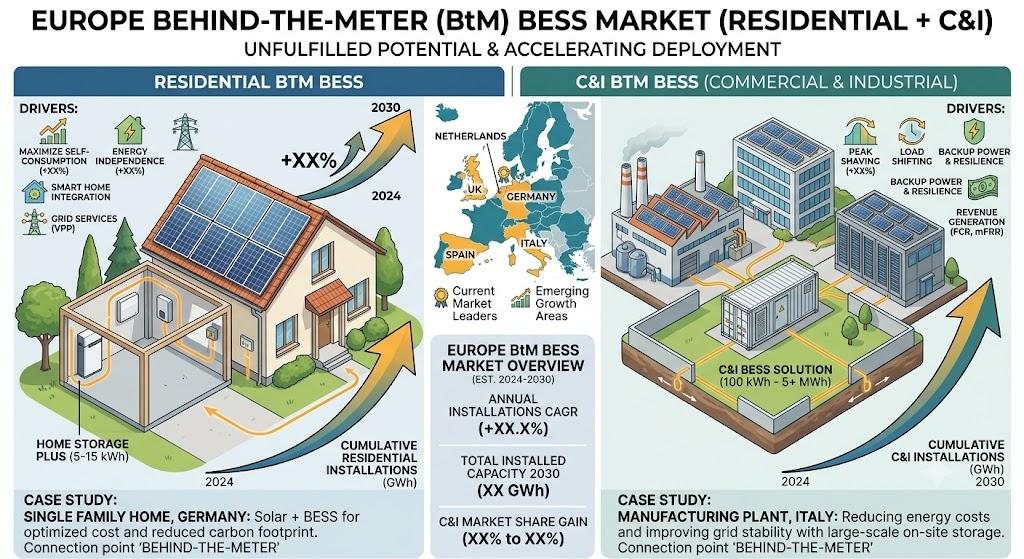
The principal customer groups include manufacturing plants, commercial property owners, retail chains, logistics facilities, hospitality operators, public buildings, and businesses with substantial electric vehicle charging demand. Each group has a different load profile. A manufacturer may need to limit short, expensive peaks caused by machinery starting simultaneously. A retail site may have daytime solar output and evening refrigeration loads. A fleet depot may need to control charging demand without exceeding its grid connection capacity.
Peak shaving is one of the most familiar applications. A control system discharges the battery when site demand approaches a defined threshold, potentially reducing demand-related charges or helping the facility stay within an agreed import limit. Success depends on the duration and frequency of peaks, available battery power, usable energy, and the rules used by the network or electricity supplier. A short battery may not manage a long peak unless its dispatch is carefully planned.
Energy arbitrage offers another potential source of value. The system charges when electricity is less expensive and discharges when prices rise. The relevant spread must cover round-trip losses, degradation, operating expenses, and financing costs. Dynamic tariffs can create opportunities, but volatile prices also increase uncertainty. Automated controls should follow site priorities and battery limits rather than reacting to prices without considering production needs.
Solar-plus-storage can increase the share of renewable electricity consumed on site. Instead of exporting all surplus midday generation, a business can store part of it for use during later demand periods. The benefit is strongest where exported electricity earns less than avoided grid purchases. Project models should include seasonal solar variation, consumption forecasts, system efficiency, and the possibility that future tariffs change the value of exports.
System design affects lifetime economics. Battery chemistry, power rating, energy capacity, inverter configuration, thermal controls, fire-safety measures, and software all influence performance. Buyers should assess usable rather than headline capacity, warranty limits, expected degradation, service response times, and replacement assumptions. Integration with existing solar inverters, building management systems, and charging software can reduce operational complexity when responsibilities are clearly defined.
Commercial delivery models include direct purchase, leasing, shared-savings agreements, and energy-as-a-service contracts. Each affects the customer’s capital requirements and exposure to operational risk. Agreements should state who controls dispatch, who benefits from savings, how performance is verified, and what happens when a site changes its operating schedule. Businesses should not rely solely on vendor payback estimates without independently checking the assumptions.
For developers and investors, the value chain includes batteries, inverters, installation, software, optimization, financing, maintenance, and recycling. Competitive advantage may increasingly depend on delivering dependable outcomes rather than low equipment prices alone. Strong service networks and transparent reporting can help customers understand whether a system is delivering expected value.
The market’s future will be determined by project economics and execution. Better metering data, improved control software, standardized contracting, and experienced integrators can reduce uncertainty. Businesses that define measurable goals, compare alternatives, and monitor results are better positioned to use storage as a durable energy-management asset.
