

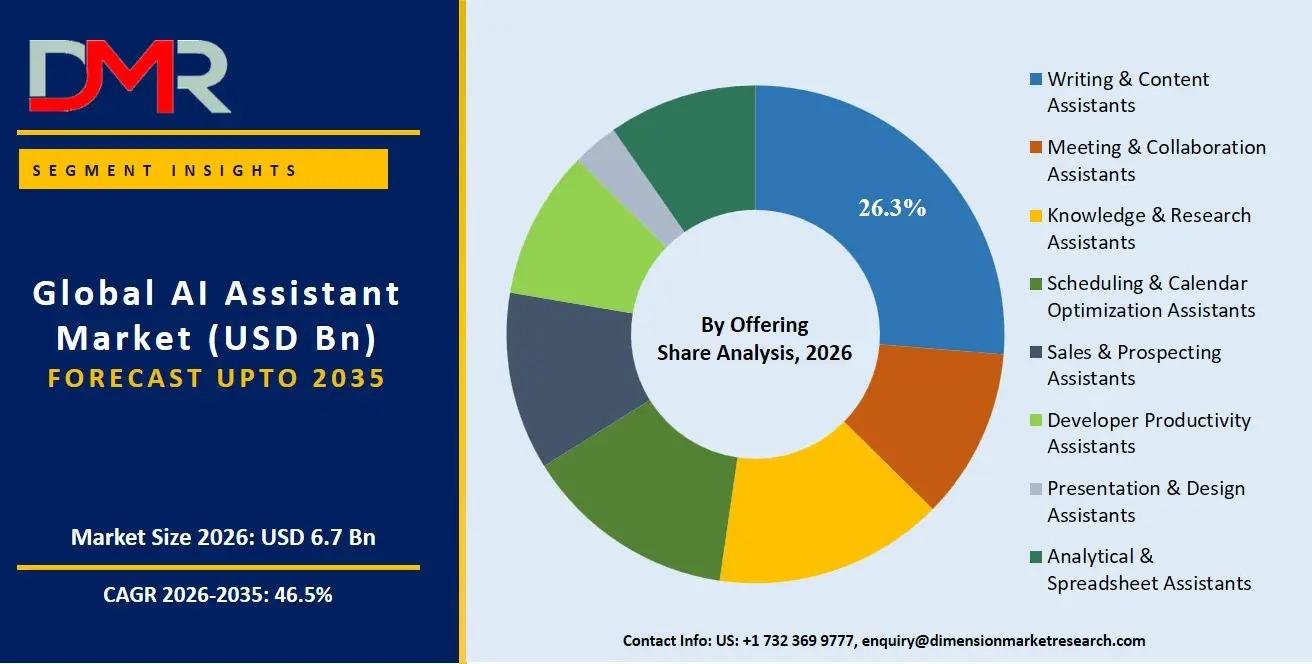

The global AI Assistant Market is experiencing rapid transformation as businesses incorporate generative artificial intelligence into everyday operations. From content creation and software development to research and customer engagement, intelligent assistants are becoming important tools for improving workplace productivity and automating knowledge-intensive activities.
According to Dimension Market Research, the global market is projected to reach USD 6.7 billion in 2026 and expand to USD 207.6 billion by 2035, registering a CAGR of 46.5% during 2026 to 2035.
Increasing demand for intelligent workflow automation, advancements in large language models, and integration with enterprise software platforms are supporting market expansion. Organizations are moving beyond experimental AI applications toward specialized assistants capable of handling practical business functions.
What Is the AI Assistant Market?
The AI Assistant Market encompasses intelligent software applications that use natural language processing, machine learning, and generative AI to support professional and personal activities.
These solutions help users draft documents, summarize meetings, retrieve information, manage schedules, analyze spreadsheets, develop software, and automate repetitive tasks.
Unlike conventional automation software, modern AI assistants can interpret conversational instructions, understand contextual information, and generate responses suited to particular activities. Their integration with cloud platforms, business applications, and collaborative workspaces is expanding their usefulness across industries.
Why Is the AI Assistant Market Growing?
One of the strongest growth drivers is the increasing need to automate knowledge-based work. Organizations generate considerable volumes of information, creating demand for systems that can simplify research, documentation, communication, and analysis.
Generative AI is accelerating adoption by allowing assistants to understand complex instructions and produce relevant content. Enterprises are increasingly integrating these capabilities into customer relationship management, software development, communication, and productivity applications.
The expansion of cloud computing and Software-as-a-Service platforms is another important factor. Cloud-based assistants offer flexible deployment, regular model updates, and integration with existing business systems.
Get a Free Sample of the AI Assistant Market Report
Explore detailed market forecasts, offering segmentation, technology adoption, regional opportunities, and competitive insights through the latest Dimension Market Research analysis.
https://dimensionmarketresearch.com/request-sample/ai-assistant-market/
AI Assistant Market Size and Key Statistics
● 2026 Market Size: USD 6.7 Billion
● 2035 Market Forecast: USD 207.6 Billion
● Forecast CAGR: 46.5%
● Leading Region: North America, 43.2% share in 2026
● Leading Offering: Writing & Content Assistants
● Leading Deployment: Cloud-Based
● Leading Technology: Generative AI
● Leading End User: Large Enterprises
These projections reflect growing enterprise spending on AI-powered productivity solutions and increasing interest in specialized digital assistants.
AI Assistant Market Segmentation and Leading Applications
Writing and content assistants are expected to dominate the offering category, supported by demand for automated document creation, email drafting, marketing content, and multilingual communication.
Meeting and collaboration assistants are also gaining relevance as organizations automate transcription, summarize discussions, and identify follow-up activities.
Knowledge and research assistants help enterprises retrieve information from internal repositories, while developer productivity assistants support code completion, software reviews, and application modernization.
Cloud-based deployment is projected to lead because of scalability, accessibility, and integration capabilities. SaaS-native assistants are also expected to dominate the integration category as AI becomes embedded within existing workplace applications.
Large enterprises represent the leading end-user segment, reflecting investments in operational automation, digital transformation, and enterprise data management.
How Generative AI Is Transforming the AI Assistant Market
Generative AI is reshaping assistant capabilities by enabling more sophisticated conversations, contextual understanding, and intelligent content generation.
Multimodal AI represents an important technology trend. These assistants can process multiple information formats, including text, voice, images, documents, and video, enabling more flexible interactions.
Industry-specific assistants are another emerging opportunity. Healthcare organizations are exploring AI-supported documentation and research, while financial institutions are adopting tools for knowledge retrieval and software modernization.
However, data privacy, cybersecurity, inaccurate outputs, and integration complexity remain significant adoption challenges. These concerns are particularly relevant for regulated industries managing confidential information.
Regional Outlook and Growth Opportunities
North America is projected to lead the AI Assistant Market with a 43.2% share in 2026. Strong enterprise technology investment, established AI research capabilities, and widespread software modernization support the region's position.
The United States is forecast to generate USD 2.4 billion in market revenue in 2026 and reach USD 62.8 billion by 2035.
Europe is also expanding through enterprise adoption of intelligent automation and increasing emphasis on secure AI deployment and data governance.
Asia-Pacific is expected to be the fastest-growing regional market. Digital transformation initiatives across China, India, Japan, and Southeast Asia are creating opportunities for scheduling, analytics, and productivity assistants.
Competitive Landscape of the AI Assistant Market
Competition includes major technology companies, enterprise software providers, and specialized AI developers.
Prominent companies identified in the DMR report include OpenAI, Microsoft, Google, Amazon Web Services, Anthropic, Meta Platforms, IBM, Salesforce, Adobe, Grammarly, Zoom, and Notion.
Competitive differentiation increasingly depends on model capabilities, enterprise integrations, data security, contextual accuracy, and industry-specific functionality.
Companies are also emphasizing partnerships, application integration, and specialized AI development to address changing enterprise requirements.
Explore the Complete AI Assistant Market Analysis
Access detailed forecasts through 2035, competitive positioning, deployment analysis, regional assessments, and market opportunities to support investment and business planning.
https://dimensionmarketresearch.com/checkout/ai-assistant-market/
Frequently Asked Questions About the AI Assistant Market
1. What is the global AI Assistant Market size in 2026?
The global AI Assistant Market is projected to reach USD 6.7 billion in 2026.
2. What is the expected CAGR of the AI Assistant Market?
The market is forecast to grow at a CAGR of 46.5% from 2026 to 2035, reaching USD 207.6 billion.
3. Which segment dominates the AI Assistant Market?
Writing and content assistants are expected to lead the offering segment, supported by increasing adoption of AI-powered content generation and business communication tools.
4. Which region leads the global AI Assistant Market?
North America is projected to account for 43.2% of global market revenue in 2026, making it the leading region.
5. What is the future outlook for the AI Assistant Market?
The market outlook remains strongly growth-oriented as enterprises adopt generative AI, multimodal assistants, cloud-based deployment, and specialized workflow automation solutions.
Conclusion
The global AI Assistant Market is moving toward broader enterprise adoption as organizations integrate intelligent automation into business operations.
Generative AI development, demand for productivity improvements, and integration with existing software ecosystems are central to this transformation. Although security, accuracy, and implementation challenges remain, specialized and context-aware assistants present substantial opportunities through 2035.
Related Artificial Intelligence Market Insights
Intelligent Virtual Assistant Market Size
The global Intelligent Virtual Assistant Market is projected to grow from USD 3.3 billion in 2023 to USD 24.7 billion by 2032, registering a CAGR of 25.2%. Increasing adoption of conversational AI, chatbots, voice assistants, and automated customer interactions supports expansion. North America accounted for 30.2% of the market in 2023.
Artificial Intelligence (AI) Writing Assistant Software Market Share
The global Artificial Intelligence (AI) Writing Assistant Software Market is projected to reach USD 15.3 billion by 2033, expanding at a CAGR of 27.9% from its USD 1.7 billion valuation in 2024. Cloud-based solutions accounted for 76.8% of the market in 2024, reflecting demand for accessible and scalable writing applications.
Healthcare Virtual Assistants Market Growth
The global Healthcare Virtual Assistants Market is forecast to increase from USD 969.1 million in 2023 to USD 14,419.2 million by 2032, growing at a CAGR of 35.0%. Healthcare digitization, patient engagement, appointment automation, and AI-powered administrative support are contributing to expansion.
