

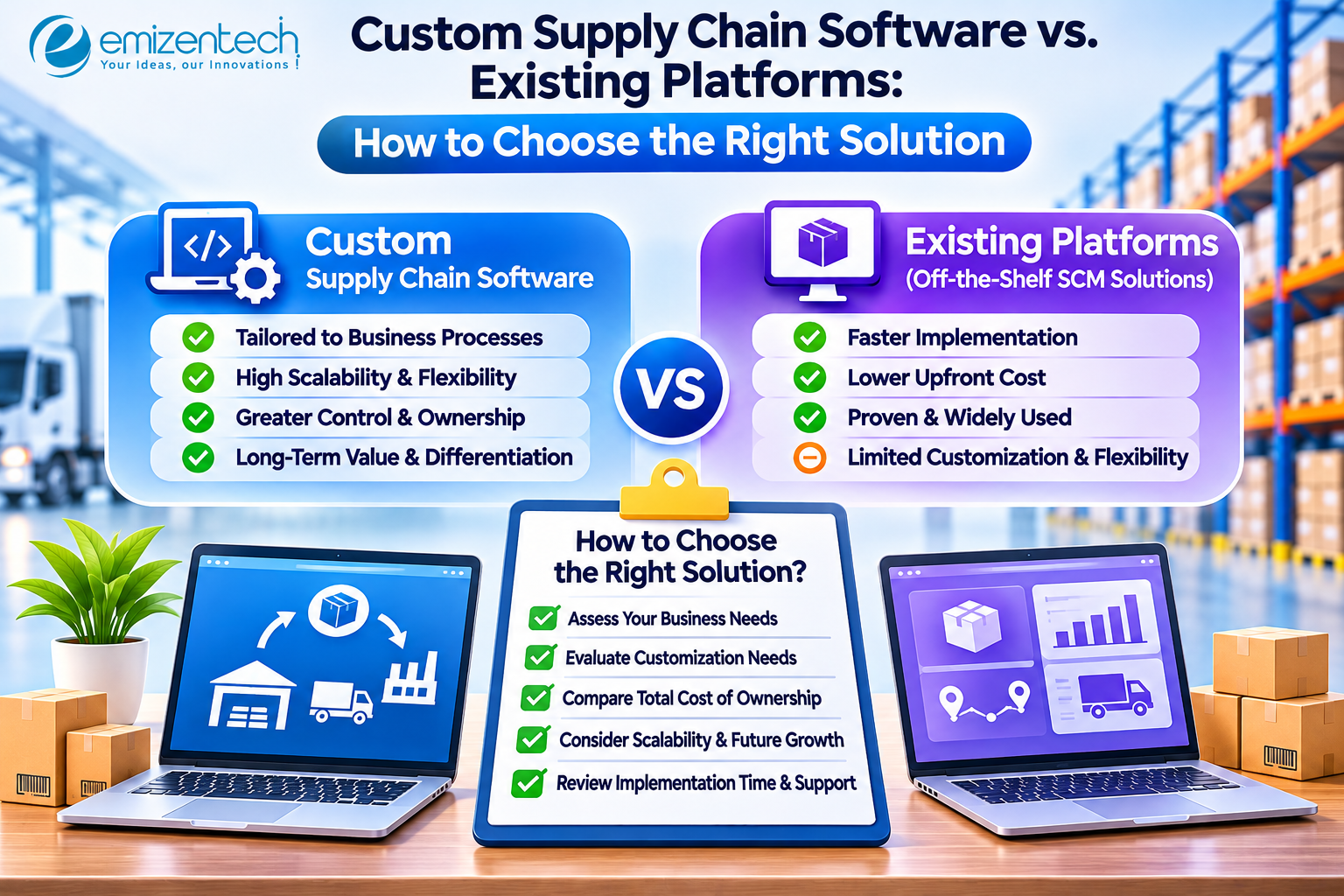
Custom Supply Chain Software vs. Existing Platforms: How to Choose the Right Solution

Supply chain operations involve multiple processes, including procurement, inventory management, warehousing, and order fulfillment. As businesses expand, managing these activities through disconnected systems or manual processes can create delays, increase costs, and reduce operational visibility.
Businesses evaluating Supply Chain Management Software often need to decide whether an existing platform can meet their requirements or whether a custom solution would provide better long-term value.
The decision depends on operational complexity, integration needs, available resources, and the level of control businesses require over their technology.
What Are the Main Differences Between Custom and Existing Supply Chain Systems?
Custom software is developed around a business's specific requirements, while existing platforms provide predefined functionality for common supply chain operations.
Custom development allows businesses to determine how the system works, which features it includes, and how it connects with other applications.
Existing platforms offer established features that businesses can implement without developing an entire application.
The main differences involve implementation time, customization, ownership, maintenance, and cost. Understanding these factors helps businesses evaluate which approach best supports their operational objectives.
What Are the Benefits of Custom Supply Chain Software?
Custom development can provide greater flexibility for businesses with specialized operational requirements. Custom Supply Chain Management Software allows businesses to build features around their workflows, integration needs, and long-term operational goals.
Supports Business-Specific Workflows
Every supply chain has different processes for managing inventory, coordinating suppliers, and fulfilling orders.
Custom software allows businesses to develop workflows that reflect their operational requirements rather than adapting processes to predefined features.
For example, a manufacturer may require specialized inventory allocation rules based on production schedules and material availability.
Enables Tailored System Integrations
Businesses often use multiple applications to manage different aspects of their operations.
Custom development can connect ERP systems, warehouse applications, accounting software, and eCommerce platforms according to specific integration requirements.
This can reduce manual data entry and improve information consistency across departments.
Provides Greater Control Over Future Changes
Businesses can modify features, introduce new workflows, and expand functionality as operational requirements change.
However, these changes require proper planning, technical expertise, and ongoing maintenance.
What Are the Advantages of Existing Supply Chain Platforms?
Existing software platforms can be a practical choice for businesses that need established functionality and faster implementation.
Faster Deployment
Ready-made platforms include features for common supply chain activities, allowing businesses to begin implementation without developing the entire system from scratch.
This can reduce the time required to introduce inventory management, procurement, and order processing capabilities.
Lower Initial Investment
Businesses generally pay subscription or licensing fees instead of funding the complete development of a new application.
This makes existing platforms suitable for businesses with limited development budgets or straightforward operational requirements.
Vendor-Managed Updates
Software vendors typically manage product updates, security patches, and platform maintenance.
This reduces the technical responsibilities of internal teams, although businesses should review the vendor's support commitments and pricing structure.
When Should Businesses Consider Custom Development?
Custom development becomes more valuable when existing platforms cannot support essential operational requirements.
Businesses may consider building a tailored solution when they:
-
Manage complex warehouse or distribution workflows.
-
Require specialized inventory tracking or forecasting.
-
Need integrations unavailable through existing platforms.
-
Experience recurring inefficiencies caused by software limitations.
-
Expect significant changes in operational requirements.
For example, a distributor managing multiple warehouses may require custom inventory allocation rules that account for stock availability, delivery schedules, and regional demand.
In such cases, a tailored system can provide functionality that standard platforms may not offer.
When Is an Existing Platform the Better Option?
Existing software is often more suitable when business processes follow standard operational practices.
Businesses with conventional inventory, procurement, and order management requirements may find that available platforms already provide the necessary functionality.
Buying is particularly practical when:
-
Implementation speed is a priority.
-
Development resources are limited.
-
The business requires standard features.
-
Existing integrations meet operational needs.
-
Vendor-managed maintenance is preferred.
If a platform already addresses the business's essential requirements, custom development may introduce unnecessary costs and technical complexity.
How Should Businesses Compare the Total Cost of Ownership?
The initial purchase price or development estimate does not represent the complete financial commitment.
Businesses should compare the total cost of ownership over several years, including implementation, maintenance, integrations, training, and ongoing support.
Custom development may require a higher initial investment but can reduce dependence on recurring licensing fees or expensive workarounds.
Existing platforms generally involve lower initial costs, but subscription fees, additional modules, and customization expenses may increase over time.
Businesses should also consider operational savings, such as reduced manual work, improved inventory accuracy, and faster order processing.
A solution that costs less initially may not provide the best long-term financial value.
Can a Hybrid Approach Provide Better Flexibility?
Businesses can combine an existing supply chain platform with custom functionality instead of choosing one approach exclusively.
For example, a business may purchase an established inventory management system while developing custom integrations for its eCommerce platform, logistics applications, or internal reporting tools.
This approach can reduce development time while addressing specialized requirements.
However, businesses should evaluate integration complexity, maintenance responsibilities, and compatibility between the systems.
A hybrid solution works best when the responsibilities of each application are clearly defined.
How Can Businesses Select the Right Approach?
Before making a decision, businesses should identify their operational priorities and evaluate how each solution addresses them.
Consider the following factors:
-
Operational requirements: Identify essential workflows and functionality.
-
Budget: Compare initial costs with long-term expenses.
-
Implementation timeline: Determine how quickly the system must become operational.
-
Integration needs: Evaluate compatibility with existing applications.
-
Scalability: Assess whether the solution can support future growth.
-
Maintenance: Understand the technical responsibilities of each approach.
Businesses should also request demonstrations, review vendor agreements, and involve operational and technical stakeholders in the evaluation process.
Conclusion
Custom and existing supply chain systems offer different advantages depending on business requirements. Existing platforms provide faster implementation, while custom development supports specialized workflows and greater flexibility.
EmizenTech offers custom Supply Chain Management Software development services to help businesses address operational challenges, integrate existing applications, and develop solutions aligned with their business objectives.
The right approach is the one that meets current operational needs while providing sustainable value and supporting future growth.
