

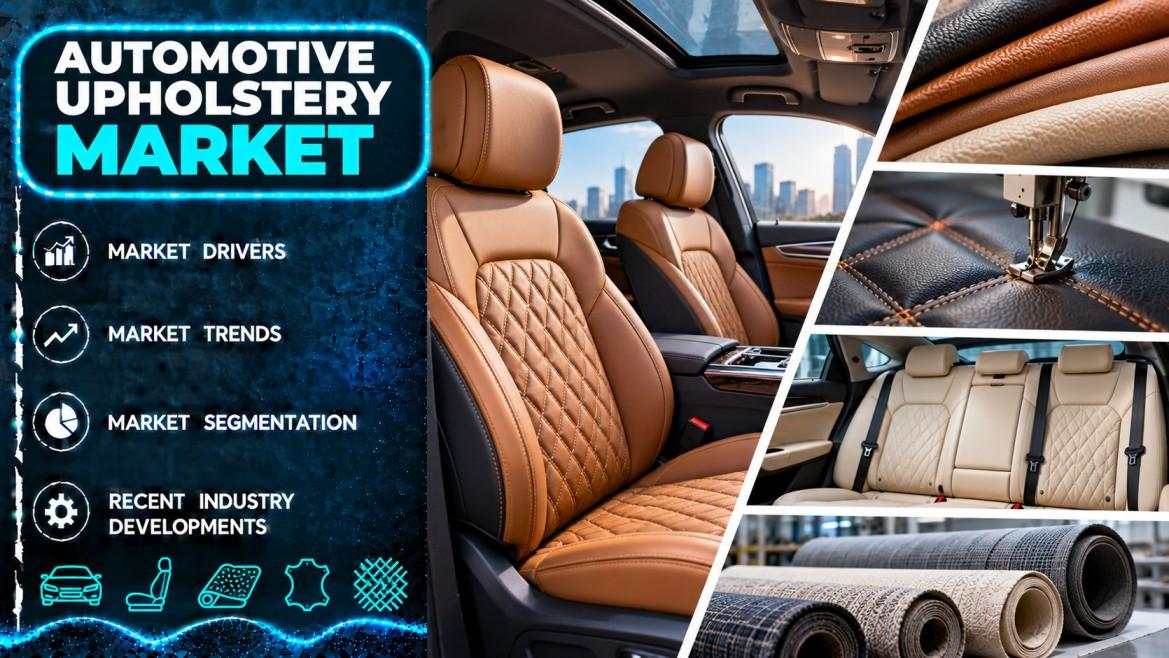
Automotive Upholstery Market Size, Analysis, Growth Trends & Regional Outlook 2034

IMARC Group, a leading global market research and management consulting firm, has published its latest market intelligence report on the automotive upholstery market. The global automotive upholstery market size was valued at USD 7.8 Billion in 2025 and is projected to reach USD 11.4 Billion by 2034, exhibiting a CAGR of 4.15% during the forecast period 2026-2034., driven by expanding vehicle production volumes, rising consumer preference for premium and customized vehicle interiors, growing adoption of sustainable and lightweight materials, and the rapid integration of smart fabrics across passenger and commercial vehicles worldwide.
The market is witnessing steady expansion as automakers treat the cabin as a key point of brand differentiation. Global vehicle output remains above 92 million units annually, and every one of those vehicles needs seat covers, door trims, headliners, and floor and console finishes. Electric vehicles are adding to this demand. IMARC notes that interior content value per electric vehicle can run 15% to 25% above comparable combustion models, because buyers expect a premium, tech-forward cabin. In China alone, annual vehicle production is around 31.3 million units, which anchors Asia Pacific demand for upholstery materials.
How AI is Reshaping the Future of the Automotive Upholstery Market
- AI-Powered Demand Forecasting and Material Planning: Machine learning platforms help tier-1 suppliers analyze OEM build schedules, trim-level mix, and raw material price movements. This supports better purchasing of polymers, hides, and fibers, which matters when input costs swing with oil prices and hide supply.
- Computer Vision for Quality Control on Cutting and Stitching Lines: Vision systems inspect fabric defects, pattern alignment, seam quality, and color consistency in real time. This reduces scrap on expensive materials such as leather and synthetic leather, and cuts warranty claims tied to interior appearance.
- Generative Design and Consumer Analytics for Interior Personalization: AI tools mine configurator data and customer preferences to guide trim, color, and texture choices. This is useful because IMARC notes that some premium brands are seeing customization take rates of 30% to 40%, and AI helps suppliers shorten development cycles for new materials.
Grab a sample PDF of this report: https://www.imarcgroup.com/automotive-upholstery-market/requestsample
Automotive Upholstery Market Trends and Drivers:
The global automotive upholstery market is experiencing strong growth momentum, fueled by premiumization, electrification, and a visible shift toward sustainable materials. Vehicle buyers now judge a car by its cabin as much as by its powertrain, and OEMs are responding with richer textures, ambient features, and personalized trims. Luxury vehicle volumes are growing at roughly 6% to 8% annually, and these segments carry the highest upholstery spend per vehicle. Heated seats are a clear example of rising content. Penetration is about 65% in Europe and 45% in North America, and suppliers are moving toward ventilated and sensor-equipped seat fabrics that raise value per vehicle.
Sustainability is now a purchasing criterion for automakers, backed by regulation. In the European Union, the End-of-Life Vehicles Regulation took effect in August 2026 and sets the first binding recycled plastic quotas for new vehicles, starting at 15% and rising to 25% in phases. It also introduces producer responsibility for collection and treatment, and requires clearer dismantling instructions. The Commission estimates that 10 to 12 million vehicles reach end of life in Europe each year. Individual OEMs are setting their own goals too. Volkswagen has targeted 40% recycled materials in new models, and Toyota Boshoku has set a goal of 30% bio-based and recycled content. Plant-based leathers, recycled polyester, and animal-free interiors are moving from concept cars into production programs. IMARC notes that bio-based and recycled materials still carry a 15% to 40% price premium, which is the main cost hurdle suppliers must solve.
Lightweighting and smart textiles are opening another growth path. Non-woven and thermoplastic materials help offset battery weight and extend electric vehicle range, and they already hold a majority of the fabric segment. Smart fabrics with heating, ventilation, and biometric sensing are the fastest-growing material group, although development cycles of 24 to 36 months slow commercialization. Lear has set an ambition of more than USD 1 Billion in smart seating revenue, and leading players invest USD 200 Million to USD 500 Million each year in R&D. The aftermarket adds further upside through customization and commercial fleet upgrades, with IMARC pointing to a segment worth above USD 3.5 Billion.
Ask an analyst for customized report: https://www.imarcgroup.com/request?type=report&id=6211&flag=E
Automotive Upholstery Industry Segmentation:
The report has segmented the market into the following categories:
Breakup By Material:
- Plastics
- Leather
- Synthetic Leather
- Automotive Textiles
- Thermoplastic Polymers
- Smart Fabrics
Plastics account for the largest material share at 42.2%, followed by leather at 22.7% and synthetic leather at 14.3%. Plastics lead because of their durability, low weight, and cost efficiency in high-volume programs. Smart fabrics hold 3.8% today but are the fastest-growing material group, while synthetic leather is also gaining ground as automakers pursue premium looks with animal-free credentials.
Breakup By Fabric Type:
- Non-Woven
- Woven
Non-woven fabrics dominate with a 64.5% share, supported by their lighter weight, design flexibility, and lower production cost compared with woven alternatives.
Breakup By Sales Channel:
- OEM
- Aftermarket
OEM sales lead with a 66.7% share, driven by factory-fitted interiors across passenger and commercial vehicle platforms. The aftermarket holds the remaining share and benefits from demand for custom leather, seat covers, and refurbishment.
Breakup By Application:
- Seat Covers
- Other Interior Applications
Seat covers account for the largest application share at 31.4%, because seats are the largest and most touched interior surface and the main place where comfort and brand identity meet.
Breakup By Region:
- North America
- Asia Pacific
- Europe
- Latin America
- Middle East and Africa
Asia Pacific dominates the global automotive upholstery market with a 49.8% share and is also the fastest-growing region. Its lead rests on large-scale vehicle manufacturing in China, India, Japan, and South Korea, rising electric vehicle adoption, and a deep local supply base. Europe follows with 22.4%, shaped by premium automakers and strict recycling rules, and North America holds 17.3%. Latin America accounts for 6.1% and the Middle East and Africa for 4.4%.
Competitive Landscape:
The report provides a comprehensive analysis of the competitive landscape in the automotive upholstery market, with detailed profiles of all major companies, including:
- Adient
- Lear Corporation
- Toyota Boshoku
- Faurecia (Forvia)
- Grupo Antolin
- Borgers SE
- Sage Automotive Interiors
- Katzkin Leather
- Seiren Co.
- The Haartz Corporation
The top four tier-1 suppliers hold roughly 40% to 50% of revenue, while the materials and component layers remain fragmented, with more than 200 regional suppliers.
What Does The Full Report Cover?
If you are tracking the automotive upholstery market for investment decisions, market entry planning, competitive benchmarking, or strategic advisory, IMARC Group’s report gives you everything in one place:
- Complete market sizing with revenue projections covering the full forecast period
- Quantified growth driver analysis across material, fabric type, sales channel, application, and regional markets
- Sub-segment breakdowns for plastics, leather, synthetic leather, automotive textiles, thermoplastic polymers, and smart fabrics, with individual share data
- Competitive profiles of leading companies with strategic landscape assessment
- Porter’s Five Forces, value chain analysis, and pricing intelligence
- Latest innovation trends covering bio-based materials, smart fabrics, lightweight non-wovens, and circular economy programs shaping competition across key regional markets
Recent News and Developments in Automotive Upholstery Market
- August: The European Union’s End-of-Life Vehicles Regulation took effect, setting the first binding recycled plastic content targets for new vehicles, along with producer responsibility rules and tighter dismantling requirements. This directly affects interior material choices, including trims, foams, and fabrics.
- April: Adient acquired a seating foam production plant in Romulus, Michigan, from Woodbridge. The plant supplies foam for seats to several automaker customers and adds to Adient’s network of 10 foam plants in the Americas, out of 30 worldwide.
- February: Lear was reported to be building a new seating plant in Orion Township, Michigan, after winning the work tied to General Motors’ assembly plant program. This strengthens local seat and upholstery supply capacity in North America.
- September: Grupo Antolin and Spanish startup PersiSKIN introduced PersiSkin Auto, a plant-based interior covering made largely from persimmon fruit waste, with up to 80% biological content. It targets seats, door panels, instrument panels, and consoles as an alternative to animal leather and synthetic covers.
Note: If you require specific details, data, or insights that are not currently included in the scope of this report, we are happy to accommodate your request. As part of our customization service, we will gather and provide the additional information you need, tailored to your specific requirements. Please let us know your exact needs, and we will ensure the report is updated accordingly to meet your expectations.
Key Questions This Report Answers
- What is the current global automotive upholstery market size and what is its projected value?
- Which material segment holds the largest share in the global automotive upholstery market?
- What are the key drivers of global automotive upholstery market growth?
- Which region dominates the global automotive upholstery market and why?
- How are electrification, sustainability regulation, and smart fabric innovation reshaping product development and competitive strategies in the automotive upholstery industry?
- Who are the top companies in the global automotive upholstery market and what are their competitive strategies?
- What are the investment and market entry opportunities across bio-based materials, smart fabrics, OEM programs, and aftermarket customization?
About Us:
IMARC Group is a global management consulting firm that helps the world’s most ambitious changemakers to create a lasting impact. The company provides a comprehensive suite of market entry and expansion services. IMARC offerings include thorough market assessment, feasibility studies, company incorporation assistance, factory setup support, regulatory approvals and licensing navigation, branding, marketing and sales strategies, competitive landscape and benchmarking analyses, pricing and cost research, and procurement research.
Media and Sales Contact
IMARC Group
Email: [email protected]
United States: +1-201-971-6302
India: +91-120-433-0800
United Kingdom: +44-753-714-6104
