


IMARC Group has recently released a new research study titled "Data Governance Market Size, Share, and Trends by Component, Deployment Mode, Organization Size, Business Function, Application, End Use Industry, and Region 2026-2034", offering a detailed analysis of the market drivers, segmentation, growth opportunities, trends, and competitive landscape to understand the current and future market scenarios.
Data Governance Market Size & Share 2026-2034
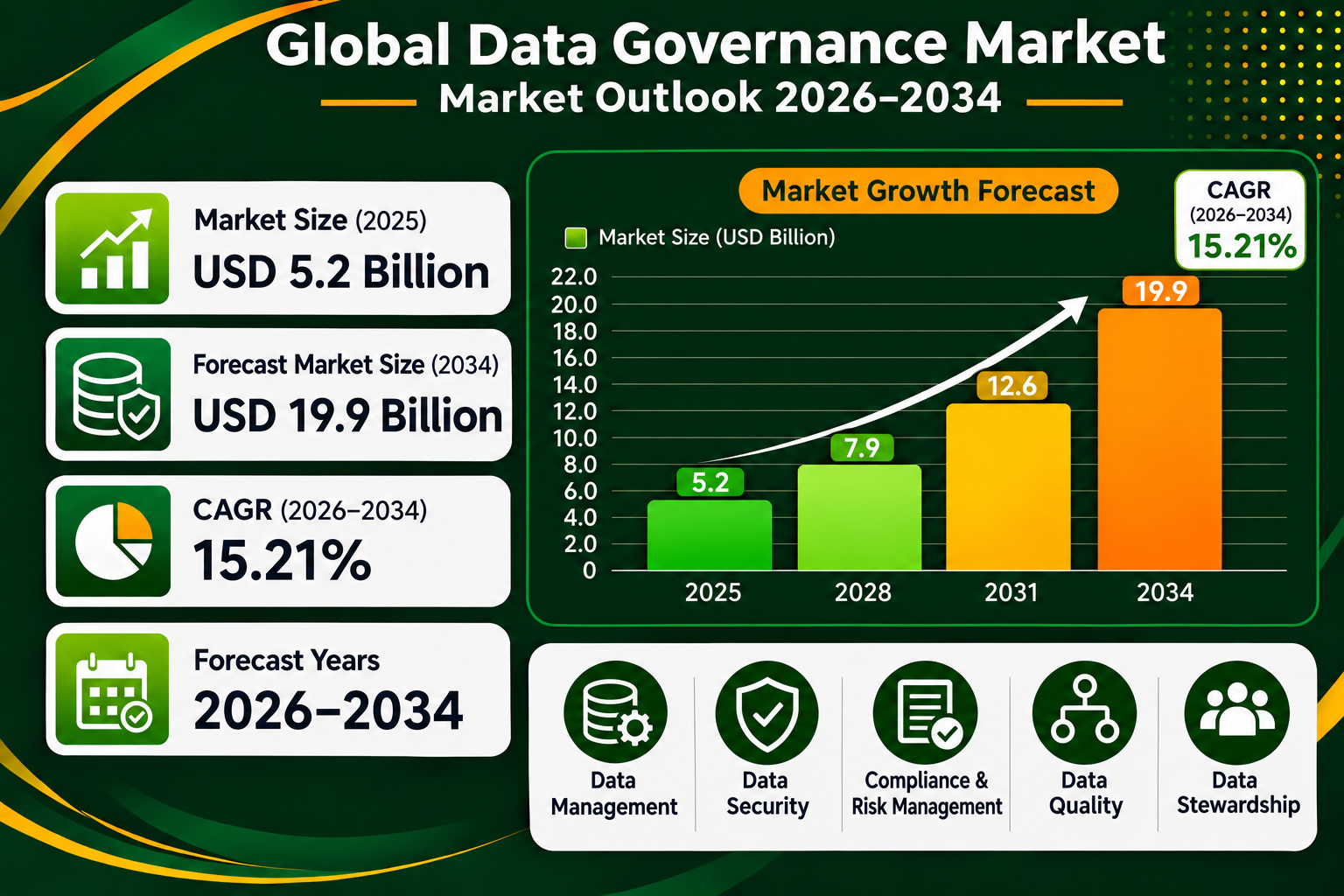
The global data governance market size was valued at USD 5.2 Billion in 2025 and is projected to reach USD 19.9 Billion by 2034, expanding at a CAGR of 15.21% during 2026-2034, according to IMARC Group. North America held the largest regional share at 35.3% in 2025. Software was the leading component with a 63.5% share, cloud-based deployment led with 56.1%, large enterprises held 65.5%, and BFSI was the largest end use industry with a 24.4% share.
Momentum in 2026 is being shaped by regulatory compliance and data privacy requirements and, increasingly, by artificial intelligence. Vendors have used 2026 launches to extend governance from data catalogs to AI models and agents, with real-time monitoring and policy enforcement, and the market has seen major consolidation, including Proofpoint's agreement in October 2026 to acquire Varonis for about USD 6.3 Billion. These dynamics are expected to strengthen the data governance market share of platform vendors throughout the forecast period.
Key Market Statistics at a Glance
- Base Year: 2025
- Historical Years: 2020-2025
- Forecast Period: 2026-2034
- Market Size (2025): USD 5.2 Billion
- Projected Market Size (2034): USD 19.9 Billion
- Growth Rate: CAGR of 15.21% (2026-2034)
Explore Opportunities in the Data Governance Market: Download the IMARC Sample Report: https://www.imarcgroup.com/data-governance-market/requestsample
Key Growth Drivers and Trends in the Data Governance Market
Growth in the data governance market is driven primarily by the need to comply with stringent data protection regulations. Governments worldwide are imposing stricter rules, such as the General Data Protection Regulation (GDPR) in Europe and the California Consumer Privacy Act (CCPA) in the United States, which compel organizations to adopt stronger governance frameworks and avoid heavy penalties and reputational damage. Industries that handle sensitive personal information, including healthcare, finance and telecommunications, face particularly close scrutiny. Rising data volumes add to the pressure: industry reports indicate that around 90% of global data has been produced in the past two years and that stored data doubles roughly every four years.
One of the leading data governance market trends is the rising need for data quality and operational efficiency. Businesses want accurate, consistent and accessible data to improve decision-making, customer service and operations, and a recent survey found that 64% of organizations list data quality as a top challenge. In the United States, 94% of organizations believe customers would avoid them without proper data protection, while 86% of Americans report growing concern about data privacy and 72% support more government regulation.
Another key trend is the integration of big data, artificial intelligence (AI), machine learning and cloud computing into governance frameworks. Industry studies show that 40% of businesses use big data analytics and 75% expect significant improvements in decision-making from combining AI-driven technologies with big data. These technologies automate data management tasks, enable real-time processing and strengthen data security, which makes automated governance essential for scaling operations.
A third trend is the extension of governance to AI itself. OneTrust's 2026 AI-Ready Governance Report found that 86% of surveyed organizations experienced an AI-related incident in the past year, yet only 27% slowed or paused deployment. A Grant Thornton 2026 survey of 950 C-suite leaders found that 78% lack strong confidence they could pass an independent AI governance audit within 90 days. In response, vendors including Collibra, OneTrust and Alation launched AI governance products in 2026 that inventory models and agents and enforce policies at runtime, and Gartner published a 2026 Magic Quadrant for AI Governance Platforms.
Speak to an Analyst: https://www.imarcgroup.com/request?type=report&id=4854&flag=C
Data Governance Industry Segmentation Insights
Breakup by Component:
- Software: The largest segment, with a 63.5% share in 2025. Integrated, scalable software helps organizations manage data quality, privacy, security and compliance, and automates the enforcement of governance policies. Demand is supported by data-driven decision-making and regulations such as GDPR.
- Services: Includes consulting, implementation, integration and managed services that help organizations design governance programs and operate them over time.
Breakup by Deployment Mode:
- Cloud-based: The largest segment, with a 56.1% share in 2025. Businesses migrating to cloud platforms value scalability, flexibility and cost efficiency, centralized policy management across distributed environments, and the ability to streamline compliance across multiple jurisdictions.
- On-premises: Preferred by organizations that need to keep governance infrastructure and sensitive data under direct internal control.
Breakup by Organization Size:
- Large Enterprises: The largest segment, with a 65.5% share in 2025. They manage vast data estates across departments, regions and systems, face complex regulatory requirements and breach risks, and have the budgets to invest in enterprise-wide governance, risk and compliance solutions.
- Small and Medium-sized Enterprises (SMEs): A growing segment that increasingly adopts cloud-based governance tools to meet regulatory requirements without large in-house data teams.
Breakup by Business Function:
- Finance: The largest function, with a share of over 35.3% in 2025. Financial organizations handle highly sensitive data under regulations such as the Sarbanes-Oxley Act and the Dodd-Frank Act, and need strong security, privacy and auditability.
- Operation and IT: IT and operations teams that manage data infrastructure, access controls and data lifecycle processes.
- Legal: Legal and compliance teams responsible for interpreting regulations and demonstrating adherence.
- Sales and Marketing: Teams that use customer data and need consent, privacy and data quality controls.
- Others: Includes human resources, procurement and other business functions.
Breakup by Application:
- Risk and Compliance Management: The largest application, with a share of over 47.5% in 2025. Stricter regulations and harsher penalties push organizations to automate compliance processes, improve data security protocols and maintain transparency in data handling under laws such as GDPR and HIPAA.
- Incident Management: Tools to detect, track and resolve data-related incidents such as breaches and policy violations.
- Process Management: Workflows that define and enforce how data is created, approved, shared and retired.
- Audit Management: Capabilities for audit trails, evidence collection and regulatory reporting.
- Data Quality and Security Management: Tools to validate, cleanse and protect data so that it is accurate, consistent and secure.
- Others: Includes metadata management, data lineage and master data governance.
Breakup by End Use Industry:
- BFSI: The largest industry, with a 24.4% share in 2025. Banks and insurers manage vast amounts of sensitive customer and financial data and must meet standards such as Anti-Money Laundering (AML) and Know Your Customer (KYC), while relying on analytics for decision-making and risk management.
- IT and Telecom: Technology and telecom operators governing large volumes of customer and network data.
- Healthcare: Providers and life-science firms protecting patient data under regulations such as HIPAA.
- Retail: Retailers managing customer, transaction and loyalty data across online and physical channels.
- Defense: Defense and government bodies safeguarding sensitive and classified information.
- Others: Includes manufacturing, energy, media and education.
Breakup by Region:
- North America: The largest regional market, with a 35.3% share in 2025, supported by strong technological infrastructure, innovation in governance tooling, and regulations such as CCPA and HIPAA. The United States accounted for 88.60% of the North American market in 2025. Includes the United States and Canada.
- Asia Pacific: Includes China, Japan, India, South Korea, Australia, Indonesia and others. National data protection laws in India, Japan and Australia, digitalization of public services, smart city investment and fintech expansion are driving demand.
- Europe: Includes Germany, France, the United Kingdom, Italy, Spain, Russia and others. Enforcement of GDPR and similar laws, cross-border data flows, rising cyberattacks and hybrid and multi-cloud adoption are driving demand.
- Latin America: Includes Brazil, Mexico and others. Laws such as Brazil's LGPD, growth in digital financial services and e-commerce, and an emphasis on data localization and sovereignty are supporting adoption.
- Middle East and Africa: National digital transformation agendas, growing cloud adoption, smart city projects in the UAE and Saudi Arabia, and stronger personal data regulation are driving demand.
Key Challenges and Growth Opportunities in the Data Governance Market
The market must contend with the difficulty of aligning policies across multi-cloud environments and jurisdictions, persistent data quality problems, unclear data ownership and stewardship, a shortage of skilled data governance professionals, and the cost and effort of integrating governance tools with existing data platforms. Unstructured data and AI agents add new complexity, because traditional, manual and point-in-time governance cannot keep up with the pace and scale of AI use.
The opportunities are considerable. AI model and agent governance, automated policy enforcement, data products and semantic layers that give AI trusted context, and cloud-based governance are all expected to expand the addressable market. New privacy laws in emerging markets, demand from regulated industries such as BFSI and healthcare, and the adoption of managed and cloud-delivered offerings by small and medium-sized enterprises are likely to support long-term growth.
Competitive Landscape
The IMARC report provides a comprehensive analysis of the competitive landscape of the Global Data Governance Market, with detailed profiles of all major companies. Companies are using advanced software and automation to turn raw data into reliable insights, refining how governance tools integrate across data collection, management and security stages, and strengthening real-time monitoring to maintain data quality and compliance. Partnerships and acquisitions are helping vendors broaden platforms, particularly around AI governance and data security.
Key Players in the Global Data Governance Market:
- Adobe Inc.: Provides data governance, privacy and consent controls within Adobe Experience Platform for customer data management.
- Alation Inc.: Data catalog pioneer repositioned as an agentic knowledge layer. In 2026 it released Curation Automation, Alation AI Governance and the AIOS platform.
- Ataccama: Provider of the Ataccama ONE agentic data trust platform, combining data quality, observability, lineage and governance. In 2026 it launched Agentic Data Observability and data products.
- Collibra: Provider of unified governance for data and AI, named a Leader in the Gartner Magic Quadrant for Data and Analytics Governance Platforms for the second consecutive year in January 2026. It launched the AI Command Center in May 2026 and acquired trail ML in October 2026.
- world, Inc.: Cloud-native data catalog and governance platform acquired by ServiceNow, with the deal completed in July 2025, and being integrated into ServiceNow's AI platform.
- OneTrust, LLC: Provider of the AI-Ready Governance Platform covering privacy, data governance, risk and AI governance. In March 2026 it added real-time AI monitoring and enforcement, and in June 2026 it was named a Visionary in the Gartner Magic Quadrant for AI Governance Platforms.
Recent Developments in the Global Data Governance Market
- October 2026: Proofpoint agreed to acquire Varonis in an all-cash deal valued at about USD 6.3 Billion (USD 49.75 per share), described as the largest cybersecurity acquisition announced so far in 2026. Collibra also announced its acquisition of Munich-based trail ML to add agent-powered automation and runtime enforcement for AI governance policies.
- September 2026: Collibra launched Collibra Maestro, Live Map and Guardian Agents to reduce the cost of scaling AI governance, Alation expanded its AIOS platform with six products for AI governance, enterprise context and agent management, and OneTrust unveiled the evolution of its platform at TrustWeek 2026, combining CORIE, an AI Control Plane and a Governance Command Center.
- July 2026: Alation launched AIOS, connecting its catalog, lineage, data quality, semantic context, AI Governance and Agent Studio in one architecture.
- May 2026: Collibra launched the AI Command Center for real-time control of agentic AI, and Alation introduced Alation AI Governance, a system of record for enterprise AI compliance, at the Gartner Data & Analytics Summit in London.
Author IMARC Group
IMARC Group is a leading global market research company providing data-driven insights and expert consulting services to businesses seeking to achieve their strategic objectives. With a multidisciplinary team of industry experts, IMARC delivers reliable market intelligence across sectors including Chemicals and Materials, Healthcare, Technology, Agriculture, and Retail.
Contact Us:
IMARC Group
Email: [email protected]
United States: +1-201-971-6302
