

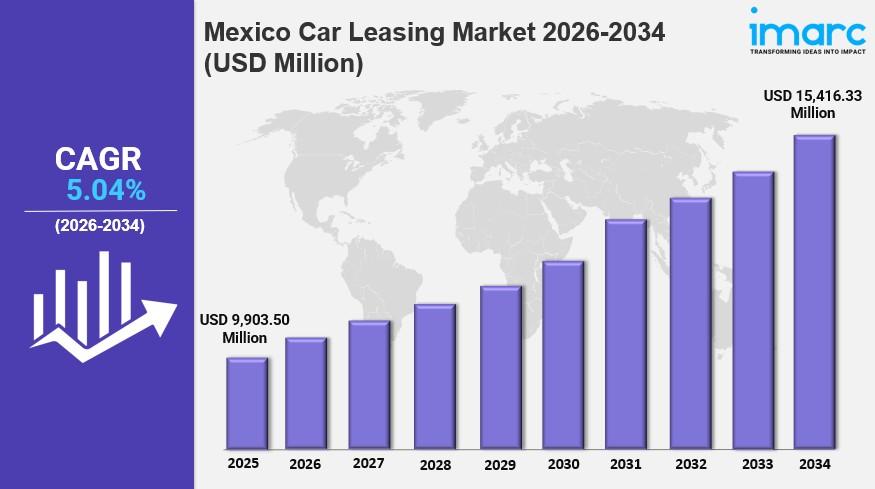
Mexico Car Leasing Market Size to Hit USD 15,416.33 Million in 2034 | Grow CAGR by 5.04%

IMARC Group has recently released a new research study titled "Mexico Car Leasing Market Size, Share, Trends and Forecast by Type, Lease Type, Service Provider Type, Tenure, and Region, 2026-2034", offering a detailed analysis of the market drivers, segmentation, growth opportunities, trends, and competitive landscape to understand the current and future market scenarios.
Mexico Car Leasing Market Size & Share 2026-2034
The Mexico car leasing market size was valued at USD 9,903.50 Million in 2025 and is projected to reach USD 15,416.33 Million by 2034, expanding at a CAGR of 5.04% during 2026-2034, according to IMARC Group. Growth is driven mainly by corporate demand for fleet management solutions, individual preference for flexible vehicle access without the burdens of ownership, and the spread of digital and fintech-enabled leasing platforms.
Momentum in 2026 reflects a market that is still growing in fleet size but moderating in new purchases. The Mexican Association of Vehicle Leasing Companies (AMAVe) reported that its members managed more than 400,000 vehicles at the end of the second quarter of 2026, up 16.7% from a year earlier, even though leasing companies' purchases of new light vehicles fell 16.3% in the first quarter after an exceptionally strong 2025. At the same time, lessors' purchases of hybrid and electric vehicles rose 65.2%, and 50% import tariffs on vehicles from China and other countries without a free trade agreement, in force since January 2026, are reshaping vehicle supply. These dynamics are expected to support the Mexico car leasing market demand of business, close ended, bank-affiliated and long-term contracts throughout the forecast period.
Key Market Statistics at a Glance
- Base Year: 2025
- Historical Years: 2020-2025
- Forecast Period: 2026-2034
- Market Size (2025): USD 9,903.50 Million
- Projected Market Size (2034): USD 15,416.33 Million
- Growth Rate: CAGR of 5.04% (2026-2034)
Explore Opportunities in the Mexico Car Leasing Market: Download the IMARC Sample Report: https://www.imarcgroup.com/mexico-car-leasing-market/requestsample
Key Growth Drivers and Trends in the Mexico Car Leasing Market
Growth in the Mexico car leasing market is driven primarily by corporate fleet optimization. Companies in pharmaceuticals, retail, logistics, last-mile delivery and government increasingly lease vehicles to preserve capital for core operations, budget around predictable monthly payments and avoid managing depreciation. Tax treatment adds to the appeal: according to IMARC, lease payments are more favorably deductible for businesses than the write-off available on purchased cars, and policies increasingly extend deductibility to electric and hybrid vehicles. Credit is already mainstream, with roughly 60% of light vehicles in Mexico financed, and higher interest rates have made conventional purchases less attractive. Scale is also visible in the data: AMAVe members buy about 8% of the light vehicles sold in Mexico.
One of the leading Mexico car leasing market trends is the digital transformation of leasing operations. Providers are deploying cloud-based platforms for contract management and customer engagement, and major banks now offer fully digital financing simulations and applications that remove the need for branch visits. Telematics, real-time vehicle monitoring and automated maintenance scheduling improve fleet utilization, while artificial intelligence and data analytics are being applied to personalized lease structuring and risk assessment. Fintech entrants are using new credit-assessment methods to reach segments such as gig-economy workers that conventional financing has often excluded.
Another key trend is the rise of subscription-based mobility. Subscription models bundle the monthly payment with insurance, maintenance and roadside assistance, appealing to urban professionals and younger consumers who want flexibility without long-term commitments. The shift is also visible in how the industry describes its role: AMAVe says the task is no longer simply acquiring vehicles but managing them well. Short-term and daily rental remain important in tourism corridors, where more than 20,000 units serve travelers in Cancun, Playa del Carmen and Tulum, equal to 20-25% of the daily rental fleet in Mexico, according to AMAVe 2025 data.
A third trend is the expansion of electric and hybrid vehicle leasing. Leasing suits electrified vehicles because it addresses concerns about battery technology and depreciation through predictable costs and upgrade flexibility. In the first quarter of 2026, leasing companies bought 3.2% of the 44,183 hybrid and electric light vehicles sold in Mexico, a 65.2% increase over the same period of 2025, and hybrids and electrics represent about 4% of the fleet managed by AMAVe members. Financing is following: banks are building dedicated electric-vehicle products with preferential rates, and the International Finance Corporation (IFC) has committed US$100 million to Element Fleet Management for electric and hybrid fleet acquisitions in Mexico.
Speak to an Analyst: https://www.imarcgroup.com/request?type=report&id=34926&flag=C
Mexico Car Leasing Industry Segmentation Insights
Breakup by Type:
- Business Lease: The largest segment, with a 62.07% share in 2025. Companies lease fleets to preserve capital, deduct lease expenses and avoid depreciation risk, typically with maintenance, insurance and roadside assistance bundled in. Pharmaceutical, consumer goods, logistics and government users, along with multinationals entering Mexico, drive demand.
- Private Lease: Serves individuals, accounting for the remaining 37.93% of the market in 2025. Appeals to consumers who prefer fixed monthly payments and lower upfront costs than a purchase, and is supported by subscription-style offers and electric-vehicle leasing aimed at urban professionals and younger drivers.
Breakup by Lease Type:
- Close Ended Lease: The leading structure, with a 75.03% share in 2025. The lessee returns the vehicle at the end of the term with no obligation for residual value differences, which gives predictable payments and a clear exit, and places depreciation risk on the lessor.
- Option to Buy Lease: Gives the lessee the right to purchase the vehicle at the end of the term at a pre-agreed price. Suits customers who want the flexibility of leasing while keeping a path to ownership.
- Sub-Vented Lease: A structure in which a manufacturer or dealer subsidizes part of the financing cost or residual value, lowering the monthly payment. Commonly used in promotional programs to move new models.
- Others: Includes other lease structures and customized contracts offered by lessors.
Breakup by Service Provider Type:
- Original Equipment Manufacturer (OEM): Captive finance and leasing arms of automakers. They offer preferred access to the manufacturer's vehicles, brand-aligned products and promotional lease programs.
- Bank Affiliated: The largest segment, with a 58.06% share in 2025. Banks combine low-cost funding, existing customer relationships, branch networks and faster credit assessment. IMARC cites BBVA Mexico as the automotive financing leader, with about a 25% share and a portfolio above 50 billion pesos.
- Nonbank Financial Companies (NBFCs): Independent lessors, fleet managers and fintech platforms. They compete on flexible products, specialized services and alternative risk assessment that reaches customers outside traditional bank criteria.
Breakup by Tenure:
- Short-Term: Accounts for the remaining 33.98% of the market in 2025. Covers daily, weekly and monthly rentals and flexible subscriptions, used for tourism, event-driven demand, project work and customers avoiding long commitments.
- Long-Term: The leading segment, with a 66.02% share in 2025. Contracts of roughly 36 to 60 months offer lower monthly payments, bundled maintenance and price protection, and align with corporate fleet replacement cycles and multi-year budgets.
Breakup by Region:
- Northern Mexico: An industrial and manufacturing base with strong automotive, logistics and cross-border trade activity, generating demand for corporate and commercial fleets.
- Central Mexico: The largest region, with a 35% share in 2025. The Mexico City metropolitan area concentrates corporate headquarters, banks, multinationals and higher-income consumers, and the valley around the capital holds about a quarter of the national population.
- Southern Mexico: Demand is shaped by tourism destinations such as Cancun, Playa del Carmen and Tulum, which sustain a large daily rental fleet, alongside growing commercial and logistics needs. Electric-vehicle charging infrastructure remains thinner outside major metropolitan areas.
- Others: Includes the remaining regions of the country not covered above.
Key Challenges and Growth Opportunities in the Mexico Car Leasing Market
The market must contend with cyclical pressure on fleet purchasing. After a record 2025, AMAVe members bought 13,842 new light vehicles in the first quarter of 2026, down 16.3%, and 602 heavy vehicles, down 49.9%, as companies postponed fleet renewals and became more cautious about investment. The FIFA World Cup lifted rental occupancy to only about 63%, against the 75-80% the industry had projected. Trade uncertainty adds risk: about 70% of vehicles sold in Mexico are imported, China has become one of the main suppliers, and the 50% tariff on vehicles from non-FTA countries and the review of the USMCA leave pricing and supply less certain. Interest rate volatility affects affordability and has pushed some financing terms out to as long as 72 months, which adds risk for lessees and lessors. Limited electric-vehicle charging outside major cities and a cultural preference for owning a vehicle, with most consumers taking out fewer than two car loans in a lifetime, also slow adoption.
The opportunities are considerable. AMAVe said in mid-2026 that the sector had reached its low point and that it would seek inclusion in the Plan Mexico to encourage heavy-vehicle fleet renewal, while its managed fleet continues to grow. Electric and hybrid leasing is expanding with preferential bank rates, multilateral funding and specialist partners. Subscription models, digital origination and fintech-led credit assessment open new customer groups, including gig-economy drivers and small businesses, and bundled maintenance, insurance and telematics services deepen relationships with fleet clients. Chinese brands are widening the range of available models, although AMAVe cautions that new entrants will have to earn a place in the commercial leasing market. Lessors that combine competitive funding, a broad lease product range and strong digital and electrification offers are likely to be best placed for long-term growth.
Competitive Landscape
The IMARC report provides a comprehensive analysis of the competitive landscape of the Mexico Car Leasing Market, with detailed profiles of all major companies. Competition spans bank-affiliated institutions, OEM financing arms, independent lessors and fleet managers, and emerging fintech platforms. Banks lean on branch networks, low funding costs and integrated services, while OEM-affiliated lessors benefit from manufacturer relationships. Independent lessors compete on full-service packages that bundle maintenance, insurance and fleet administration, and fintech entrants target underserved segments. AMAVe counts 38 member companies, and the core of their portfolio is pure (operating) leasing, complemented by financial leasing, daily rental and management of customer-owned vehicles. Investment in digital platforms, electrification and partnerships with automakers is the main means of differentiation.
Key Players in the Mexico Car Leasing Market:
- BBVA Mexico: Leader in bank-affiliated automotive financing, with about a 25% market share and a portfolio above 50 billion pesos, according to IMARC. Directs monthly financing volume toward hybrid and electric vehicles and works with Chinese automakers such as BYD.
- Santander (Mexico): Partnered with electromobility company VEMO to offer leasing solutions for customers with fleets of more than 100 vehicles, combining VEMO's electric-vehicle expertise with Santander's sustainable financing.
- TIP Mexico: Lessor and fleet manager with more than three decades of experience, operating the country's largest haulage fleet and one of its main light-vehicle leasing portfolios. Works with VEMO on fleet electrification and joined the Electro Movilidad Asociacion in 2025.
- Element Fleet Management (Element Mexico): Global fleet manager with Mexican operations. In 2025 it secured a US$100 million sustainability-linked IFC loan, the first tranche of a package of up to US$600 million, to fund electric and hybrid vehicles and charging infrastructure for its clients.
- Ayvens (formerly ALD Automotive): International leasing company active in Mexico's organized fleet-leasing market. Has worked with VEMO on its transition to full-service electric-vehicle leasing in the country.
- VEMO: Mexican electromobility company combining electric-vehicle leasing, charging infrastructure and fleet management software. Raised about US$63.7 million to expand its fleet and charging network and its VEMO Impulso leasing program for ride-hailing drivers.
- Independent Mexican lessors: A broad base of regional and national operators offering pure (operating) leasing, including Casanova Rent, Vanrenta, Firma CAR Leasing and C&S Leasing.
Recent Developments in the Mexico Car Leasing Market
- September 2026: AMAVe reported that at the end of the second quarter its members managed more than 400,000 vehicles, up 16.7% year over year, made up of about 360,000 light and 35,000 heavy units, with 38 member companies. It said members buy about 8% of light vehicles sold in Mexico, noted that around 70% of vehicles sold in the country are imported, and scheduled its 10th-anniversary forum for October 6 in Mexico City.
- July 2026: AMAVe said the sector had reached its low point after the first-quarter slowdown and that it would seek inclusion in the Plan Mexico to encourage renewal of heavy-vehicle fleets. It reported a managed fleet approaching 400,000 units, about 4% of them hybrid or electric.
- June 2026: The AMAVe-AMDA report for the first quarter showed lessors buying 13,842 of 381,653 new light vehicles (down 16.3%) and 602 of 7,277 heavy vehicles (down 49.9%). Purchases of hybrid and electric light vehicles rose 65.2% to 3.2% of the 44,183 sold. AMAVe said World Cup rental occupancy reached about 63% versus the 75-80% expected, with Mexico City stronger than Cancun.
- May 2026: TIP Mexico took part in the Global Fleet Summit 2026 in Cascais, Portugal (May 5-6), where its director general joined a panel on global leasing alliances and presented Mexico as a strategic market for corporate mobility and fleet electrification.
- January 2026: Mexico's 50% import tariff on light vehicles from China and other non-FTA countries took effect on January 1, up from 20% for Chinese cars. Registrations of Chinese brands kept rising in the first half of the year, as inventory stockpiling delayed the impact. IMARC published its Mexico car leasing market report the same month.
- June 2025: TIP Mexico and VEMO announced a partnership to advise companies on moving to electric fleets, covering vehicle selection, charging infrastructure and technology.
- May 2025: IFC committed US$100 million to Element Fleet Management as the first tranche of a package of up to US$600 million to accelerate electric and hybrid fleet adoption and charging infrastructure in Mexico, with targets tied to emissions cuts and gender inclusion.
Author IMARC Group
IMARC Group is a leading global market research company providing data-driven insights and expert consulting services to businesses seeking to achieve their strategic objectives. With a multidisciplinary team of industry experts, IMARC delivers reliable market intelligence across sectors including Chemicals and Materials, Healthcare, Technology, Agriculture, and Retail.
Contact Us:
IMARC Group
Email: [email protected]
United States: +1-201-971-6302
