

Industrial Agitators Market Outlook 2026-2034: Size, Share, Trends, Demand and Forecast

Market Overview
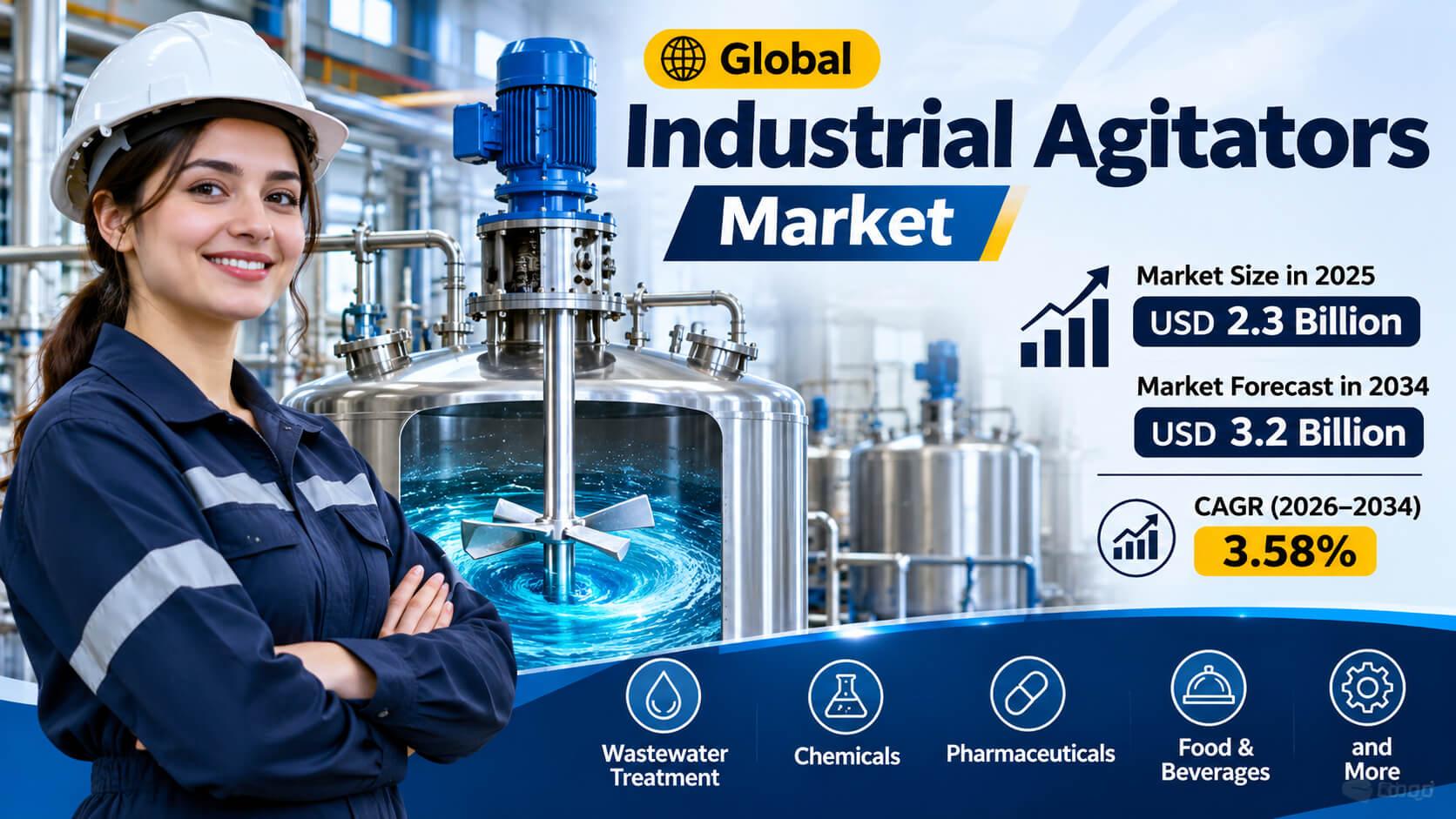
The global industrial agitators market is experiencing steady growth as industries increasingly prioritize efficient mixing, process optimization, energy conservation, and product quality. The market reached USD 2.3 Billion in 2025 and is projected to reach USD 3.2 Billion by 2034, exhibiting a CAGR of 3.58% during 2026–2034.
The industry is being influenced by increasing demand from wastewater treatment, chemicals, pharmaceuticals, food and beverages, and construction industries. Growing investments in industrial automation, advancements in energy-efficient agitator designs, and rising demand for customized mixing equipment are further supporting market expansion. Additionally, stringent quality and environmental regulations are encouraging manufacturers to adopt advanced agitator systems that improve operational efficiency and reduce energy consumption.
Industrial Agitators Market Snapshot
-
Base Year: 2025
-
Historical Period: 2020–2025
-
Forecast Period: 2026–2034
-
Market Size (2025): USD 2.3 Billion
-
Market Forecast (2034): USD 3.2 Billion
-
CAGR (2026–2034): 3.58%
-
Leading Region: North America
-
Major Market Drivers: Industrial automation, energy efficiency, and increasing demand from key processing industries
-
Key Application Industries: Chemicals, pharmaceuticals, wastewater treatment, food and beverages, and construction
North America represents the leading regional market for industrial agitators, supported by its established chemical, pharmaceutical, and wastewater treatment industries, along with increasing adoption of automated and energy-efficient mixing technologies.
Request Customized Industrial Agitators Market Insights
Assess market opportunities, evaluate regional demand, and understand competitive developments across the global industrial agitators industry. Access detailed market intelligence to support your product strategy, investment planning, and business expansion decisions.
What Is Driving Industrial Agitators Market Growth?
Increasing Demand from Chemical, Pharmaceutical, and Food Processing Industries
The growing demand for efficient and reliable mixing solutions across the chemical, pharmaceutical, and food and beverage industries is a key factor driving the expansion of the global industrial agitator market. These industries increasingly rely on advanced agitation equipment to ensure uniform product composition, maintain processing consistency, and enhance overall manufacturing efficiency.
In pharmaceutical manufacturing, agitators play a critical role in blending active pharmaceutical ingredients, preparing suspensions, homogenizing liquid formulations, and maintaining product uniformity. Similarly, chemical processing facilities depend on high-performance agitation systems to handle diverse materials, including solvents, additives, and complex chemical compounds. The increasing scale of chemical production is further strengthening demand for technologically advanced industrial mixing equipment. According to industry reports cited in the market assessment, India's total production of major petrochemicals and chemicals reached 40,580 thousand metric tons in 2023, highlighting the growing requirement for efficient industrial processing solutions.
Furthermore, the expansion of the food and beverage processing industry is generating increased demand for hygienic and high-efficiency agitators capable of handling ingredients with varying viscosities while complying with stringent quality and safety standards. These evolving industrial requirements are creating opportunities across specialized equipment categories, including the agitator pump market, which supports efficient fluid circulation and mixing; the industrial portable agitator market, which caters to flexible mixing requirements across multiple tanks and processing operations; and the side-entry industrial agitator market, which is gaining relevance in large storage tanks and industrial vessels requiring effective bulk mixing. Collectively, these applications are encouraging manufacturers to develop innovative, application-specific agitation systems that improve processing efficiency, operational flexibility, and product quality.
Growing Adoption of Industrial Automation and Energy-Efficient Equipment
Industrial facilities are increasingly adopting automated equipment to improve productivity, minimize operational costs, and maintain consistent manufacturing standards. This shift is encouraging demand for industrial agitators integrated with advanced control systems, variable-speed drives, and digital monitoring capabilities.
Energy efficiency has become an important consideration for industrial operators, particularly in sectors involving continuous mixing operations. Manufacturers are focusing on innovative impeller designs, optimized motor systems, and improved mixing configurations that reduce power consumption without compromising performance.
Automated agitators also enable operators to regulate mixing speed, monitor operating conditions, and maintain precise process parameters. These capabilities are particularly important in pharmaceutical and chemical manufacturing, where small variations in mixing conditions can influence final product quality.
Furthermore, the integration of industrial automation technologies is helping facilities reduce manual intervention, improve production consistency, and optimize equipment utilization, supporting the adoption of advanced agitator systems.
Rising Demand for Customized Mixing Solutions
Different industrial applications involve varying requirements related to liquid viscosity, tank dimensions, material composition, mixing intensity, and production volume. Consequently, demand for customized industrial agitators is increasing across several end-use industries.
Manufacturers are developing application-specific equipment to address the distinct requirements of wastewater treatment, cosmetics, food processing, pharmaceuticals, and chemical production. Customized agitators can improve mixing efficiency, reduce foam formation, handle challenging materials, and support specific production processes.
For instance, in June 2024, Tetra Pak introduced an industrial agitator/mixer specifically designed to reduce foam formation during the mixing of liquid food products. This development highlights the growing importance of application-oriented equipment innovation.
The increasing emphasis on process efficiency, product consistency, and sustainability is encouraging companies to invest in agitators designed around their specific operational requirements.
Industrial Agitators Market Trends to Watch
Three major trends are shaping the development of the global industrial agitators industry.
Smart and automated agitators: The integration of Internet of Things (IoT) technologies, digital monitoring systems, and advanced control mechanisms is transforming industrial mixing operations. Smart agitators enable real-time equipment monitoring, improved process control, and optimized operating performance. These solutions are particularly relevant to pharmaceutical and chemical industries, where precise mixing conditions are essential.
Energy-efficient agitator designs: Manufacturers are increasingly focusing on improved impeller configurations, optimized motor systems, and innovative mixing technologies to minimize energy consumption. These developments are helping industrial operators reduce operating expenses while maintaining efficient production processes.
Modular and customized equipment: Modular agitator configurations are gaining importance as industrial facilities seek flexible equipment that can accommodate different production requirements. Customizable designs allow manufacturers to address specific tank configurations, material properties, and mixing applications while improving equipment adaptability.
Technological innovation is also creating opportunities for manufacturers to improve equipment reliability and reduce maintenance requirements. The adoption of variable-speed drives, advanced materials, and digital monitoring technologies is supporting the development of more efficient industrial mixing solutions.
Industrial Agitators Market Segmentation
The global industrial agitators market is analyzed by type, mounting type, distribution channel, and industry vertical. Each segment represents different equipment requirements and application opportunities across industrial processing activities.
By Type
-
Industrial Stirrer
-
Paint Mixers
-
High Speed Stirrers
-
Chemical Agitators
-
Others
Industrial stirrers are essential equipment used for blending and mixing liquids, slurries, and other materials across various manufacturing applications. They are widely utilized in chemicals, pharmaceuticals, and food and beverage processing to achieve product homogeneity and maintain consistent production quality.
Their ability to handle large volumes and different material viscosities makes them suitable for multiple industrial processes. Industrial stirrers are available in different configurations to accommodate specific operational requirements, supporting their widespread adoption across manufacturing facilities.
Paint mixers are specialized mixing systems used to blend pigments, additives, solvents, and other components to achieve uniform paint formulations. These systems are important in the production of paints and coatings, where accurate color dispersion and consistent texture are essential.
Paint mixers are designed to handle materials with varying viscosities and operate at different speeds depending on formulation requirements. Their applications extend across the automotive, construction, and industrial coatings sectors.
For instance, in March 2024, ROSS Mixers introduced reconditioned paint mixers, including the DPM-4 model, for high-viscosity applications. These mixers feature specialized blades designed to blend thick and semi-solid materials efficiently.
High-speed stirrers are used in applications requiring rapid and intensive mixing, particularly in pharmaceutical, chemical, and cosmetics manufacturing. They operate at elevated speeds to blend liquids, emulsions, and slurries while improving process efficiency.
Their ability to produce fine dispersions and maintain product uniformity makes them suitable for applications where precise mixing is essential. Adjustable operating speeds and customizable configurations further support their adoption across different industrial environments.
Chemical agitators are specifically designed to handle corrosive, hazardous, and chemically reactive substances. These systems are engineered to withstand challenging operating conditions while maintaining safe and efficient mixing performance.
They are widely used in petrochemical processing, pharmaceutical manufacturing, and water treatment applications. Their ability to accommodate different chemical compositions and operating requirements makes them important for maintaining product consistency and process reliability.
By Mounting Type
-
Top-mounted
-
Side-mounted
-
Bottom-mounted
Top-mounted agitators accounted for the largest market share in 2025, supported by their versatility, operational flexibility, and widespread application across several industries.
These systems are commonly used in chemical, pharmaceutical, and food and beverage processing facilities. Their configuration allows efficient mixing in large and deep tanks, making them suitable for heavy-duty industrial applications.
Top-mounted agitators can accommodate different impeller configurations and operating speeds, allowing manufacturers to customize equipment according to specific mixing requirements.
Additionally, improvements in energy efficiency, accessibility, and maintenance convenience are supporting their continued adoption. Their ability to deliver reliable mixing performance across different production environments reinforces their leading position within the mounting-type segment.
Side-mounted agitators are commonly used in large storage tanks and industrial vessels where efficient circulation and mixing are required. Bottom-mounted agitators are utilized in applications where specific flow patterns, tank configurations, or specialized mixing requirements make bottom installation suitable.
By Distribution Channel
-
Online
-
Offline
The distribution channel segment comprises online and offline sales, with both channels supporting the procurement of industrial mixing equipment.
Online distribution is gaining importance as manufacturers and suppliers increasingly utilize digital platforms to reach industrial buyers. Company websites and e-commerce platforms provide access to detailed product specifications, equipment configurations, technical information, and pricing details.
These channels allow customers to compare different agitator models and evaluate product features before making purchasing decisions. Digital distribution also improves market accessibility and helps suppliers reach customers across different geographical markets.
Offline distribution remains important for industrial agitators, particularly for high-value equipment and customized installations. Industrial buyers frequently require technical consultations, equipment demonstrations, installation assistance, and after-sales support before purchasing specialized mixing systems.
Physical distributors, sales representatives, and authorized agents help manufacturers establish long-term customer relationships while providing application-specific guidance. The availability of technical assistance and maintenance services continues to support the importance of offline distribution.
By Industry Vertical
-
Chemicals and Paints
-
Material and Construction
-
Food and Beverages
-
Pharmaceutical
-
Consumer Goods
-
Others
Chemicals and Paints
The chemicals and paints industry represents an important application area for industrial agitators due to the requirement for precise mixing of chemicals, solvents, pigments, and additives.
Agitators help manufacturers achieve uniform formulations, improve production consistency, and maintain the desired characteristics of finished products. Their ability to handle different material properties and processing conditions makes them essential across various chemical manufacturing operations.
Furthermore, stringent safety and quality requirements are encouraging companies to adopt reliable mixing systems that offer improved control and operational performance.
Material and Construction
Industrial agitators play an important role in the production of cement, adhesives, coatings, and other construction materials. These applications require consistent mixing to achieve the desired material properties and maintain product quality.
The increasing demand for advanced construction materials is supporting the adoption of durable agitators capable of handling viscous and abrasive substances. Energy-efficient mixing systems that can operate continuously under demanding conditions are also gaining importance across construction-related manufacturing facilities.
Food and Beverages
The food and beverage industry relies on industrial agitators for blending, homogenizing, and mixing ingredients during large-scale production.
These systems help maintain consistent product quality while meeting hygiene and safety requirements. They are used in processing applications involving beverages, sauces, dairy products, and other liquid and semi-liquid food products.
The increasing demand for processed and packaged foods is encouraging manufacturers to invest in efficient mixing equipment that can handle varying viscosities and production volumes. Specialized agitator designs that minimize foam formation and improve ingredient distribution are also creating opportunities in this segment.
Pharmaceutical
The pharmaceutical industry depends on industrial agitators for applications involving the preparation of suspensions, emulsions, liquid formulations, and other pharmaceutical products.
Precise mixing is essential to ensure uniform distribution of active ingredients and maintain consistent product quality. The growing focus on biopharmaceutical manufacturing and stringent regulatory requirements is increasing demand for specialized agitators that meet high standards of hygiene, reliability, and process control.
Furthermore, automation and digital monitoring technologies are helping pharmaceutical manufacturers maintain accurate production parameters and improve manufacturing efficiency.
Consumer Goods
The consumer goods industry, including personal care and household products, represents another important application area for industrial agitators.
Manufacturers use these systems to blend ingredients in products such as lotions, shampoos, cosmetics, detergents, and cleaning solutions. Consistent mixing is necessary to achieve the desired texture, stability, and performance of finished products.
Growing consumer demand for personal care and household products is supporting the need for efficient industrial mixing equipment capable of handling different formulations and production requirements.
Regional Industrial Agitators Market Outlook
North America
North America represents the largest regional market for industrial agitators, supported by its established wastewater treatment, chemical, and pharmaceutical industries.
The region benefits from a strong industrial manufacturing base and increasing adoption of automation technologies across production facilities. Manufacturers are investing in advanced agitators that improve mixing accuracy, reduce energy consumption, and enhance operational efficiency.
The United States is a particularly important market due to its substantial pharmaceutical industry and continued investment in industrial automation. According to industry reports cited in the market assessment, the United States accounts for 41% of total global pharmaceutical expenditure, highlighting the importance of its pharmaceutical manufacturing ecosystem.
Strict regulatory requirements related to energy consumption, environmental protection, and industrial safety are encouraging companies to upgrade existing equipment and adopt advanced mixing solutions.
Furthermore, the increasing deployment of smart agitators, digital monitoring systems, and energy-efficient designs is strengthening North America's position in the global industrial agitators market.
Asia Pacific
Asia Pacific represents an important market for industrial agitators, supported by expanding manufacturing activities, growing chemical production, and increasing investments in industrial infrastructure.
China, India, Japan, South Korea, Australia, and Indonesia are among the important markets contributing to regional demand. The expansion of pharmaceutical manufacturing, food processing, construction materials, and chemical industries is creating opportunities for industrial mixing equipment suppliers.
The region's growing industrial base is encouraging manufacturers to adopt agitators that offer high production capacity, operational reliability, and cost efficiency.
India is particularly important due to its expanding chemical and pharmaceutical industries. The growing production of petrochemicals, specialty chemicals, and processed food products is strengthening demand for industrial mixing solutions.
Additionally, the increasing adoption of industrial automation and energy-saving technologies is supporting the development of advanced agitator systems across Asia Pacific.
Europe
Europe benefits from its established chemical, pharmaceutical, food processing, and manufacturing industries, which generate consistent demand for industrial agitators.
Countries such as Germany, France, the United Kingdom, Italy, and Spain represent important markets for industrial mixing equipment. The region's strong manufacturing infrastructure and emphasis on technological innovation are supporting the adoption of advanced agitator systems.
European manufacturers are increasingly focusing on equipment that improves energy efficiency, minimizes maintenance requirements, and supports consistent production quality.
Environmental regulations and sustainability objectives are also encouraging industrial facilities to upgrade their mixing technologies. The growing adoption of automation, digital monitoring, and modular equipment designs is further contributing to market development across the region.
Latin America
Latin America's industrial agitators market is supported by the development of chemical manufacturing, food processing, construction materials, and wastewater treatment infrastructure.
Brazil and Mexico represent important markets, driven by their established industrial sectors and expanding manufacturing activities.
The growing demand for processed food products, paints, coatings, and construction materials is increasing the need for reliable mixing equipment. Industrial agitators are also gaining importance in water and wastewater treatment applications, where efficient mixing is essential for treatment processes.
Furthermore, increasing investments in manufacturing modernization and the adoption of energy-efficient equipment are creating opportunities for industrial agitator suppliers across the region.
Middle East and Africa
The Middle East and Africa region presents opportunities for industrial agitators through expanding chemical processing, water treatment, construction, and industrial infrastructure projects.
The region's growing emphasis on water management and wastewater treatment is particularly important for the adoption of industrial mixing equipment. Agitators are used in treatment facilities to support chemical dosing, sludge processing, and efficient liquid mixing.
The expansion of petrochemical and chemical manufacturing activities is also creating demand for specialized agitators capable of handling challenging operating conditions.
Additionally, increasing investments in infrastructure development and industrial diversification are encouraging companies to adopt durable, energy-efficient, and application-specific mixing systems.
Competitive Landscape
The global industrial agitators market is characterized by competition among established equipment manufacturers and specialized mixing technology providers. Companies are focusing on product innovation, customization, energy efficiency, and technological advancements to strengthen their market positions.
Leading manufacturers are expanding their product portfolios to serve diverse industrial applications, including chemical processing, pharmaceuticals, wastewater treatment, food and beverages, and construction materials.
The integration of IoT-based monitoring systems, variable-speed drives, and advanced impeller configurations is becoming an important competitive strategy. These technologies help improve mixing performance, reduce energy consumption, and minimize equipment downtime.
Manufacturers are also emphasizing modular designs and application-specific solutions to address the varying requirements of industrial customers. Strategic collaborations, product launches, and improvements in after-sales support are further helping companies strengthen their competitive positioning.
Major companies operating in the global industrial agitators market include:
-
Dynamix Agitators Inc.
-
EKATO Holding GmbH
-
Mixer Direct
-
NOV Inc.
-
Silverson
-
SPX FLOW Inc.
-
Statiflo International Ltd.
-
Sulzer Ltd.
-
TACMINA CORPORATION
-
Xylem Inc.
Recent Industry Developments
June 2023: INOXPA introduced DINAMIX SMX, a new range of side-entry agitators based on a modular design concept. The equipment was developed to provide flexibility and adaptability for different industrial applications, including homogenization processes in the cosmetics, pharmaceutical, and food industries.
March 2023: Milton Roy expanded its HELISEM agitator series by introducing five mixer series, including VRG, VDA, FRH, VRH, and VRP. The products were designed for applications such as dissolution, homogenization, dilution, and flocculation across water treatment and chemical processing industries.
July 2023: SEW-EURODRIVE introduced its new X.e series agitator gear design, incorporating upgraded gear and motor technology, increased permissible forces, and a modular configuration. The integration of digital twin technology for design optimization was aimed at improving equipment reliability and operational efficiency.
Where Are the Biggest Industrial Agitators Market Opportunities?
The global industrial agitators industry presents opportunities across several areas:
-
Pharmaceutical manufacturing: Increasing pharmaceutical production and stringent quality requirements are creating demand for precise and hygienic mixing equipment.
-
Chemical processing: Expanding chemical and petrochemical production is supporting demand for specialized agitators capable of handling complex substances.
-
Wastewater treatment: Investments in water management and wastewater infrastructure are creating opportunities for efficient mixing technologies.
-
Energy-efficient equipment: Industrial facilities are increasingly seeking agitators that minimize energy consumption while maintaining high mixing performance.
-
Smart and automated systems: IoT-enabled monitoring, variable-speed drives, and automated control systems are creating opportunities for technologically advanced equipment.
-
Customized agitator solutions: Industry-specific equipment designed around viscosity, tank configuration, and processing requirements can help manufacturers differentiate their offerings.
-
Food and beverage processing: Growing demand for processed foods and beverages is encouraging investment in hygienic and high-performance mixing systems.
-
Maintenance-friendly designs: Manufacturers developing equipment with simplified maintenance requirements and longer service life can address important operational concerns among industrial buyers.
These opportunities are particularly relevant as industries increasingly prioritize process efficiency, product consistency, sustainability, and automation. Manufacturers that combine advanced engineering with application-specific solutions can strengthen their competitive positioning in the evolving industrial agitators market.
Get Detailed Industrial Agitators Market Intelligence
The headline market figures provide a useful overview of the industry's growth prospects, but businesses evaluating market entry, product development, competitive positioning, investment opportunities, or regional expansion may require deeper market intelligence.
A comprehensive industrial agitators market report provides insights into:
-
Market size and growth forecasts
-
Type-wise market segmentation
-
Mounting-type analysis
-
Distribution channel assessment
-
Industry vertical analysis
-
Regional and country-level market performance
-
Market trends and growth drivers
-
Technological advancements in agitator design
-
Competitive landscape and key company profiles
-
Emerging business opportunities
-
Recent industry developments
Detailed market intelligence can help equipment manufacturers, suppliers, investors, and industrial businesses evaluate demand patterns, identify high-potential applications, and make informed strategic decisions.
Request Customized Industrial Agitators Market Insights
Assess market opportunities, evaluate regional demand, and understand competitive developments across the global industrial agitators industry. Access detailed market intelligence to support your product strategy, investment planning, and business expansion decisions.
Industrial Agitators Market FAQs
What is the current size of the global industrial agitators market?
The global industrial agitators market reached USD 2.3 Billion in 2025 and is projected to reach USD 3.2 Billion by 2034.
What is the expected CAGR of the industrial agitators market?
The global industrial agitators market is expected to grow at a CAGR of 3.58% during 2026–2034.
Which region dominates the industrial agitators market?
North America represents the largest regional market, supported by its established chemical, pharmaceutical, and wastewater treatment industries, along with increasing adoption of automation and energy-efficient technologies.
What are the major factors driving the industrial agitators market?
Major growth drivers include increasing demand from chemical and pharmaceutical industries, expansion of wastewater treatment infrastructure, industrial automation, technological advancements, and the growing adoption of energy-efficient and customized mixing equipment.
What are the major types of industrial agitators?
The major types include industrial stirrers, paint mixers, high-speed stirrers, chemical agitators, and other specialized mixing equipment.
Which mounting type holds the largest market share?
Top-mounted agitators account for the largest share of the market by mounting type, owing to their versatility, ability to handle large volumes, and widespread use across different industrial applications.
Who are the major companies in the industrial agitators market?
Major companies include Dynamix Agitators Inc., EKATO Holding GmbH, Mixer Direct, NOV Inc., Silverson, SPX FLOW Inc., Statiflo International Ltd., Sulzer Ltd., TACMINA CORPORATION, and Xylem Inc.
Conclusion
The global industrial agitators market is evolving as industries increasingly prioritize efficient mixing processes, operational reliability, automation, and energy conservation. Valued at USD 2.3 Billion in 2025, the market is projected to reach USD 3.2 Billion by 2034, expanding at a CAGR of 3.58% during 2026–2034.
Growth opportunities are emerging across chemical processing, pharmaceutical manufacturing, wastewater treatment, food and beverage production, and construction materials. North America maintains its leading position, supported by its established industrial infrastructure and increasing adoption of advanced mixing technologies.
Technological advancements, including IoT-enabled monitoring, energy-efficient impeller designs, variable-speed drives, and customized equipment configurations, are further transforming the industry. Companies that focus on product innovation, operational efficiency, and application-specific solutions can strengthen their competitive positioning in the evolving industrial agitators market.
About the Author
IMARC Group is a global market research company providing data-driven insights and expert consulting services to businesses seeking to achieve their strategic objectives. With a multidisciplinary team of industry experts, IMARC delivers comprehensive market intelligence across sectors including energy and mining, construction and manufacturing, automotive, chemicals and materials, healthcare, and more.
Media & Sales Contact
IMARC Group
United States: +1-201-971-6302
India: +91-120-433-0800
United Kingdom: +44-753-714-6104
