

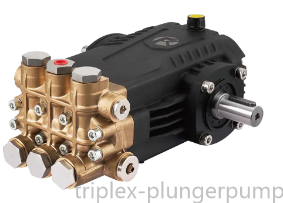

Industrial cleaning and fluid handling operations often require equipment capable of delivering water at controlled pressure over repeated working cycles. A Three Plunger High Pressure Pump uses multiple reciprocating plungers to move liquid through a coordinated pumping process. This construction is widely associated with applications that require consistent fluid delivery and dependable mechanical operation. Its suitability depends on the required working conditions, fluid characteristics, system configuration, and maintenance practices. Understanding how the pumping mechanism works can help industrial buyers evaluate equipment for cleaning, manufacturing, and maintenance environments.
The operating principle is based on the reciprocating movement of plungers inside individual pumping chambers. As a plunger moves backward, the chamber draws in liquid through an inlet valve. During the forward movement, the inlet closes and liquid is discharged through an outlet valve. Multiple plungers operate in a coordinated sequence, helping distribute the pumping action across the operating cycle. This arrangement can reduce the variation associated with a single pumping chamber and support a more consistent delivery pattern when the pump is correctly designed.
The performance of the complete system depends on the relationship between the plungers, valves, seals, crankshaft, connecting components, and drive mechanism. Each part has a specific role in converting mechanical movement into pressurized fluid delivery. Accurate component alignment helps reduce unnecessary vibration and mechanical stress, while suitable valve design supports effective intake and discharge. Sealing arrangements are equally important because leakage can reduce efficiency and affect pressure stability. Regular inspection helps maintain the interaction between these components.
Industrial cleaning is one important application for this type of equipment. Manufacturing facilities, vehicle maintenance centers, workshops, and commercial cleaning providers may use pressurized water to remove grease, dust, mud, and other deposits. The equipment can also support cleaning tasks involving machinery, production areas, and industrial surfaces. However, the required operating conditions vary according to the material being cleaned and the type of contamination. Operators should select suitable nozzles and cleaning methods rather than assuming that higher pressure is always the best solution.
Material selection has a direct influence on service life. Components exposed to water and cleaning agents need to withstand the conditions in which the pump operates. Corrosion resistance, mechanical strength, surface quality, and compatibility with sealing materials should all be considered. The liquid being handled may also contain particles or substances that influence wear. Buyers should provide suppliers with accurate information about water quality, chemical exposure, and expected operating frequency. This helps determine whether the proposed materials and configuration are suitable for the application.
The drive system should be matched to the mechanical requirements of the pump. Motor performance, transmission arrangement, and installation conditions influence how smoothly the pumping mechanism operates. An unsuitable drive configuration may increase vibration, energy consumption, or component wear. Proper mounting and alignment can help reduce unnecessary mechanical stress. In addition, the surrounding system should provide an appropriate water supply and suitable piping connections. A complete equipment assessment should therefore consider the pump and its supporting components together.
Maintenance is essential for preserving reliable operation. Operators should inspect plungers, seals, inlet and outlet valves, hoses, and connection points according to the manufacturer's recommendations. Changes in pressure, unusual noise, excessive vibration, or visible leakage may indicate that the equipment needs attention. Water filtration may also be necessary where the supply contains suspended particles that could affect internal components. Using compatible replacement parts and following the recommended service schedule can help reduce unplanned downtime.
Safety procedures should be followed whenever pressurized water equipment is operating. Operators need suitable training and protective equipment, and all hoses and fittings should be checked before use. The water stream must not be directed toward people or animals. Delicate surfaces and sensitive components should be cleaned using an appropriate pressure setting and nozzle. Before inspection or repair, the system should be switched off, isolated from its power source, and depressurized according to the operating manual.
For industrial distributors and purchasing teams, evaluating a Three Plunger High Pressure Pump requires attention to more than its basic construction. Buyers should confirm the intended pressure and flow conditions, drive requirements, wetted materials, connection arrangements, maintenance needs, and availability of replacement components. These details help establish whether the equipment is appropriate for the expected workload. FEIKE provides pump solutions for different industrial applications, and further product information is available at https://www.triplex-plungerpump.com/product/pumps/.

