

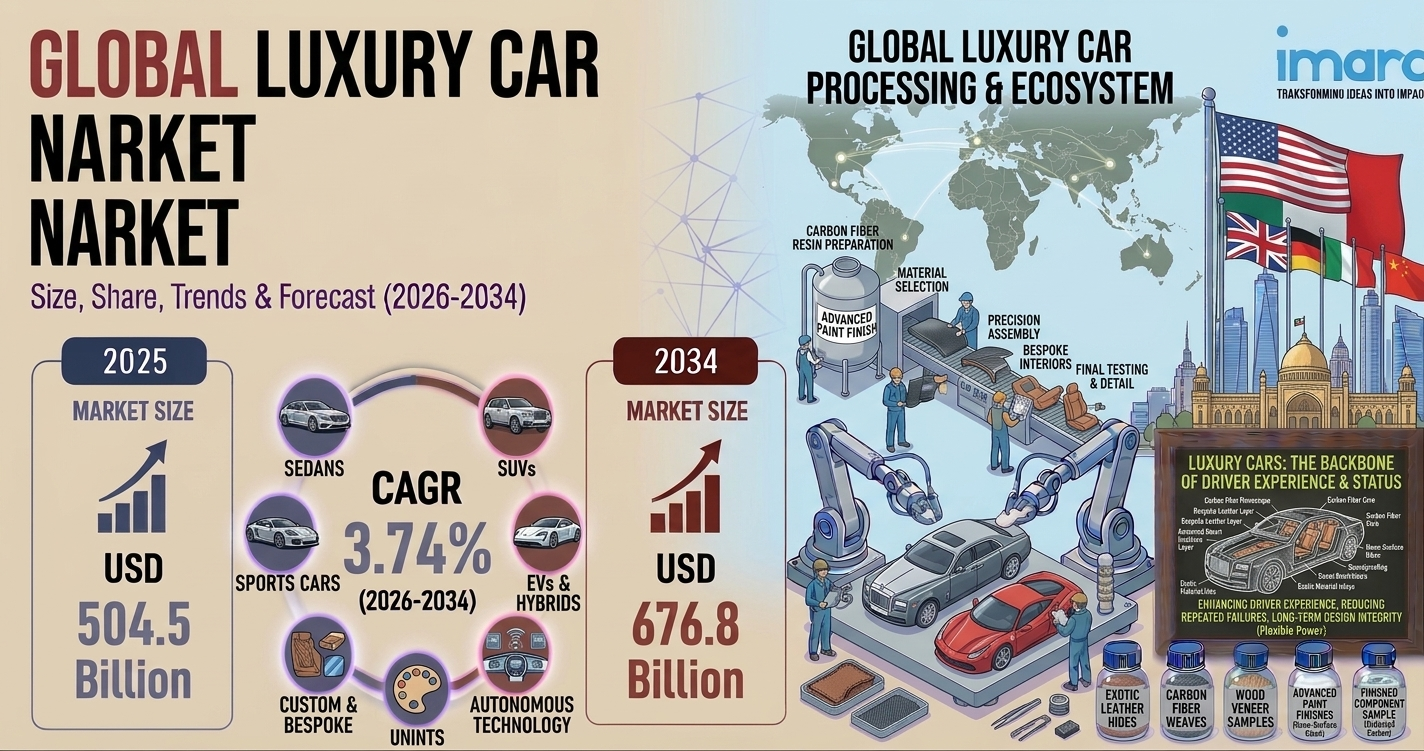
Luxury Car Market Size Projected to Reach USD 676.8 Billion by 2034 with a CAGR of 3.74%

IMARC Group has recently released a new research study titled “Luxury Car Market Report by Vehicle Type, Fuel Type, Price Range, and Region, 2026-2034,” offers a detailed analysis of the market drivers, segmentation, growth opportunities, trends and competitive landscape to understand the current and future market scenarios.
Luxury Car Market Size, Growth, and Forecast (2026-2034)
The luxury car market size grew from USD 486.4 Billion in 2025 to USD 504.5 Billion in 2026 and is projected to reach USD 676.8 Billion by 2034, growing at a CAGR of 3.74% during 2026-2034. Growing demand for opulence and comfort in vehicles, advancements in automotive technology, and rising awareness of sustainability are the primary factors driving the luxury car market.
A luxury car is a premium automobile designed to offer superior comfort, performance, and advanced features compared to standard vehicles. These cars emphasize high-quality materials, sophisticated engineering, advanced safety systems, state-of-the-art infotainment, and high-performance engines.
Asia Pacific currently dominates the luxury cars market, supported by rapid economic growth, a rising number of high-net-worth individuals, and the launch of new variants by top manufacturers. Rising disposable incomes and increased demand for premium vehicles continue to lift demand worldwide.
Explore Growth Opportunities in the Luxury Car Market - Grab Your Sample Report for Evaluation: https://www.imarcgroup.com/luxury-car-market/requestsample
Key Trends Driving the Luxury Car Market
• Rising disposable income: Growing spending power is pushing buyers toward vehicles that signal status and prestige, with craftsmanship, comfort, plush interiors, and top-tier safety standards catalyzing demand. Brand prestige and exclusivity further support the luxury car market among high-income consumers seeking differentiated products.
• Technology, electrification, and expanding product offerings: Manufacturers are introducing electric and hybrid models with IoT connectivity, AI-driven interfaces, and autonomous driving capabilities to elevate the driving experience. Advanced infotainment and enhanced safety features attract tech-savvy buyers and shape the luxury car market outlook.
• Personalization, bespoke craftsmanship, and flexible ownership: Buyers increasingly want vehicles tailored to their preferences, which supports demand for customization and the luxury car coachbuilding market at the top end, where handcrafted interiors and bespoke materials define ultra-luxury models. Financing and leasing options are also widening access, strengthening the luxury car leasing market in mature automotive economies.
Luxury Car Market Report Segmentation:
The luxury car market report provides a detailed segmentation analysis to help businesses identify key growth segments and evolving industry dynamics. The market is categorized based on vehicle type, fuel type, price range, and region, offering comprehensive insights across the luxury cars market.
Vehicle Type Insights:
• Sedan: Sedans are the largest segment, known for timeless elegance, superior comfort, spacious interiors with premium materials, and next-generation safety and infotainment technologies.
• Sports Utility Vehicle: Luxury SUVs are gaining preference as buyers look for high-end, versatile vehicles that combine style with functionality.
• Hatchback: Hatchbacks serve urban buyers seeking compact and premium options, including electric variants.
Fuel Type Insights:
• Gasoline: Gasoline leads the market, backed by powerful and refined internal combustion engines, an established consumer base, and continued R&D investment.
• Diesel: Diesel models continue to serve buyers who prioritize torque and long-distance driving capability.
• Electric: Electric luxury cars are gaining traction as sustainability concerns, government incentives, and charging infrastructure support adoption.
Price Range Insights:
• Entry-Level: Entry-level luxury cars lead the market, offering a taste of luxury at a lower price point than higher-tier peers.
• Mid-Level and High-End: Mid-level cars balance affordability with premium features, while high-end models deliver elite craftsmanship, sophisticated technology, and high performance.
• Ultra: Ultra-luxury cars sit at the top of the market, built with bespoke materials and handcrafted interiors, which links closely to the luxury car coachbuilding market.
Regional Insights:
Asia Pacific: Asia Pacific holds the largest share, led by China and India, where a growing base of high-net-worth individuals, rapid urbanization, and government incentives for electric vehicles are boosting demand.
North America: North America benefits from high disposable incomes, a preference for electric and autonomous technologies, and widely available financing and leasing options that support the luxury car leasing market.
Europe: Europe is driven by a tradition of automotive excellence in Germany, the United Kingdom, and Italy, along with strict environmental regulations and strong demand for premium brands.
Latin America: Latin America, led by Brazil and Mexico, is supported by rising disposable incomes, urbanization, and customized financing options for SUVs and premium models.
Middle East and Africa: The Middle East and Africa market is shaped by high-net-worth individuals, strong demand for premium SUVs, and rising interest in electric and hybrid luxury cars in the UAE and Saudi Arabia.
Luxury Car Market: Recent News and Developments
May 2026: Mercedes-AMG unveiled its first all-electric GT 4-Door Coupe, built on the new AMG.EA architecture and the first series-production vehicle to use axial flux motors. The GT 63 delivers up to 860 kW from three motors, while the GT 55 offers 600 kW, with a claimed range of up to about 700 km under WLTP.
May 2026: Ferrari unveiled the Luce, its first fully electric vehicle, a five-seat, four-door model with roughly 1,050 cv and a claimed range above 530 km under WLTP. The launch arrives as several luxury carmakers delay or scale back electrification plans amid slower demand.
Challenges Impacting the Luxury Car Market
Demand for high-end electric vehicles has slowed in some markets, with several luxury carmakers postponing or scaling back electrification plans because of weaker-than-expected uptake and rising development costs.
Economic volatility in emerging regions, particularly parts of Latin America, can limit consumer spending on premium vehicles and challenge manufacturers expanding their regional footprint.
Investment Opportunities in the Luxury Car Market
The luxury car market presents compelling investment opportunities supported by its projected growth from USD 486.4 Billion in 2025 to USD 676.8 Billion by 2034. Electric and hybrid luxury models with advanced connectivity and autonomous features represent a high-value opportunity as sustainability awareness grows.
Emerging markets in Asia Pacific, bespoke customization services, and flexible ownership models such as leasing offer additional growth avenues. Companies that combine technological leadership with local manufacturing and tailored products can build strong positions in the luxury cars market.
Outlook of the Luxury Car Market (2026-2034)
The outlook for the luxury car market is positive, supported by rising disposable incomes, continuous technological innovation, and growing demand for sustainable premium mobility. The market is projected to grow from USD 504.5 Billion in 2026 to USD 676.8 Billion by 2034 at a CAGR of 3.74%.
Electrified performance models, personalization, digital customer experiences, and expansion across Asia Pacific will be the defining trends shaping the luxury car market through 2034.
Key Players in the Luxury Car Market
The luxury car market is served by established global automakers competing on the basis of electrification, digital innovation, brand heritage, and regional expansion, including AB Volvo, Aston Martin Lagonda Global Holding Plc, BMW AG, Nissan Motor Company Ltd., Tesla Inc., Toyota Motor Corporation, and Volkswagen AG.
Daimler AG (Mercedes-Benz): A global luxury leader investing heavily in electric vehicles, Mercedes-AMG unveiled its first all-electric GT 4-Door Coupe in May 2026, marking a new era for its performance division.
Ferrari N.V.: The Italian sports car maker revealed the Luce in May 2026, its first fully electric model, representing one of the biggest strategic moves in the brand’s history.
Frequently Asked Questions (FAQs): Luxury Car Market
1. What is the current luxury car market size?
The luxury car market size grew from USD 486.4 Billion in 2025 to USD 504.5 Billion in 2026 and is projected to reach USD 676.8 Billion by 2034, growing at a CAGR of 3.74% during 2026-2034.
2. What is a luxury car?
A luxury car is a premium automobile offering superior comfort, performance, and advanced features, with high-quality materials, sophisticated engineering, advanced safety systems, and state-of-the-art infotainment.
3. What are the key drivers of the luxury car market?
Key drivers include growing demand for comfort and opulence, advancements in safety, connectivity, and performance technology, rising disposable incomes, personalization options, and increasing awareness of sustainability.
4. Which segments and region lead the luxury cars market?
Sedans lead by vehicle type, gasoline leads by fuel type, and entry-level cars lead by price range, while Asia Pacific is the dominant region.
5. Who are the key players in the luxury car market?
Key players in the luxury car market include AB Volvo, Aston Martin Lagonda Global Holding Plc, BMW AG, Daimler AG, Ferrari N.V., Nissan Motor Company Ltd., Tesla Inc., Toyota Motor Corporation, and Volkswagen AG.
Author IMARC Group
IMARC Group is a global management consulting firm that helps the world's most ambitious changemakers to create a lasting impact. The company provide a comprehensive suite of market entry and expansion services. IMARC offerings include thorough market assessment, feasibility studies, company incorporation assistance, factory setup support, regulatory approvals and licensing navigation, branding, marketing and sales strategies, competitive landscape and benchmarking analyses, pricing and cost research, and procurement research.
Contact Us
IMARC Group,
134 N 4th St. Brooklyn, NY 11249, USA,
Email: [email protected],
United States: +1-201971-6302
