


Market Overview:
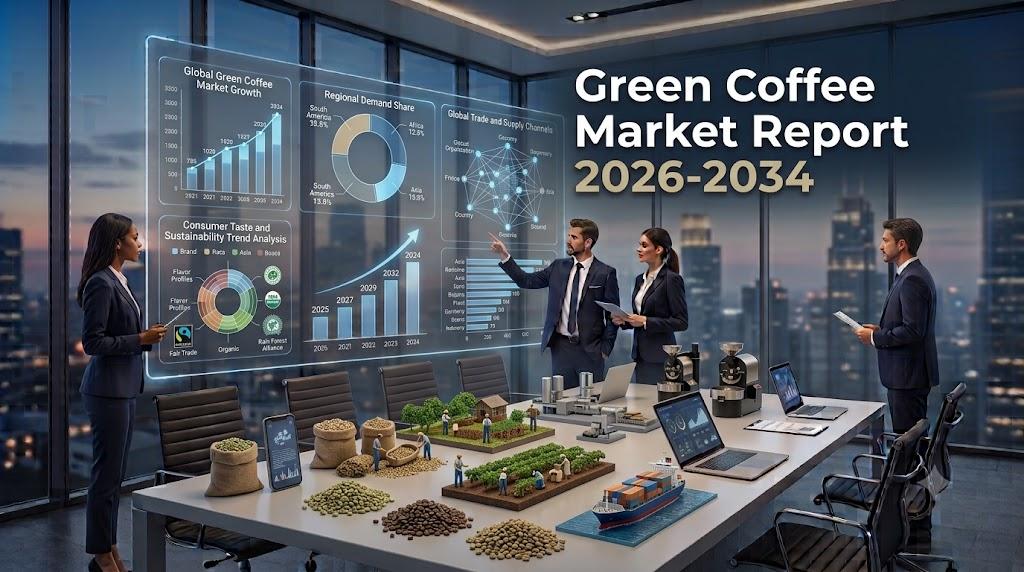
According to IMARC Group’s latest research publication, “Green Coffee Market: Global Industry Trends, Share, Size, Growth, Opportunity and Forecast 2026-2034”, The global green coffee market grew from USD 39.69 Billion in 2025 to USD 41.45 Billion in 2026 and is projected to reach USD 54.48 Billion by 2034, exhibiting a CAGR of 3.48% during 2026-2034.
This detailed analysis primarily encompasses industry size, business trends, market share, key growth factors, and regional forecasts. The report offers a comprehensive overview and integrates research findings, market assessments, and data from different sources. It also includes pivotal market dynamics like drivers and challenges, while also highlighting growth opportunities, financial insights, technological improvements, emerging trends, and innovations. Besides this, the report provides regional market evaluation, along with a competitive landscape analysis.
How the Green Coffee Industry Is Reshaping Global Beverage and Wellness Markets
- Arabica coffee commands a 64.8% type share in 2025, driven by its premium flavor complexity and dominant positioning across specialty roasters, gourmet retail, and upscale foodservice worldwide.
- Roasted coffee leads the product segment with a 46.3% share in 2025, reflecting consistent green bean procurement demand from commercial manufacturers, supermarket private-label programs, and specialty roasters.
- Green coffee bean extract is the fastest-growing product at approximately 4.2% growth through 2034, driven by expanding nutraceutical applications leveraging chlorogenic acid’s metabolic health benefits.
- In October 2025, FreshBrew Group acquired White Coffee Corp.’s Branded Coffee licensed division, expanding its production capacity to approximately 150,000 pounds daily and strengthening its licensed retail coffee portfolio.
- Europe accounts for 36.8% of the global market in 2025, underpinned by the highest per-capita coffee consumption globally, robust specialty retail infrastructure, and growing demand for sustainably certified and traceable origins.
Download a sample PDF of this report: https://www.imarcgroup.com/green-coffee-market/requestsample
Key Trends in the Green Coffee Market
- Direct Trade and Traceability Transforming Green Coffee Procurement: Direct trade models that enable financial relationships between roasters and farming cooperatives are accelerating. Digital traceability platforms using blockchain allow end consumers to verify origin, processing method, and farmer compensation. These models command significant retail price premiums and satisfy growing regulatory transparency requirements, including the EU Deforestation Regulation (EUDR) effective 2025, which mandates detailed supply chain documentation for all imported coffee entering European markets.
- Specialty Coffee Subscription Models Expanding Green Bean Demand: Direct-to-consumer subscription platforms for specialty roasted and home-roasting green bean subscriptions are growing at 15-20% annually in North America and Europe. These models generate predictable, recurring green coffee procurement demand outside traditional wholesale channels, improving supply chain planning for origin farmers and specialty exporters while reducing dependency on volatile spot markets.
- Green Coffee Extract Entering Mainstream Health and Wellness Categories: Green coffee bean extract standardized to 45-50% chlorogenic acid content is being incorporated into weight management supplements, metabolic health formulations, and functional beverages. Major supplement brands launching green coffee extract products are creating a high-value parallel demand channel entirely distinct from traditional beverage applications, with the extract segment projected to reach approximately 4.2% growth through 2034.
- Sustainability Certifications Reshaping Green Coffee Supply Chains: Rainforest Alliance, Fair Trade, and Organic certifications are increasingly mandatory for entry into European supermarket and foodservice buyer programs. The growing emphasis on climate-responsible sourcing is encouraging investment in precision fermentation for coffee flavor development and AI-powered quality grading tools, such as near-infrared (NIR) spectroscopy, which reduce reliance on manual cupping at export stations across major origin countries.
- Cold Brew and RTD Coffee Driving Specialty Green Bean Sourcing: The growing popularity of ready-to-drink and cold brew coffee products is expanding procurement requirements for green coffee varieties suited to cold extraction. China’s coffee consumption is growing at 15%+ annually, with Luckin Coffee, Starbucks China, and domestic specialty chains generating significant demand for green beans suited to premium cold-extraction formats, stimulating new origin relationships across Southeast Asia and Latin America.
We explore the factors propelling the green coffee market growth, including technological advancements, consumer behaviors, and regulatory changes.
Growth Factors in the Green Coffee Market
- Rising Global Coffee Consumption Creating Sustained Procurement Volumes: The International Coffee Organization projects worldwide coffee consumption to increase by over 3.0% in 2023-2024, with total global consumption reaching 177.0 million bags. This consistent demand growth directly translates into sustained green coffee procurement volumes across all product categories and distribution channels, providing a stable structural foundation for market expansion through 2034.
- E-Commerce Channel Expansion Enabling Direct Market Access: Digital marketplaces are enabling direct interaction between producers and buyers, improving pricing transparency, streamlining distribution channels, and widening market reach for premium and specialty coffee varieties, including single-origin and micro-lot offerings. This structural shift is particularly impactful in Asia Pacific, where China’s rapidly growing specialty coffee consumption relies heavily on e-commerce platforms for premium green bean discovery and retail distribution.
- EU Deforestation Regulation Accelerating Investment in Supply Chain Technology: The EUDR, effective 2025, requires detailed supply chain documentation for all imported coffee, directly accelerating capital deployment into traceability technology, satellite monitoring, and sustainable farming practices. This regulatory catalyst is creating durable competitive advantages for green coffee traders with established compliance infrastructure, particularly Neumann Gruppe GmbH, which announced a partnership with osapiens in August 2024 to strengthen EUDR compliance across its global supply chain.
- Arabica Premium Positioning Supporting Price Realization: Specialty roasters and artisanal cafes source Arabica as their primary input, commanding wholesale price premiums of 30-50% over Robusta varieties in global green coffee markets. Finland averages 12 kg per capita per year of coffee consumption, the highest globally, underscoring the depth of demand for premium Arabica-based products across Scandinavian markets and demonstrating the structural strength of Europe’s 36.8% market share position.
- Asia Pacific Urbanization and Middle-Class Growth Generating New Demand: Asia Pacific, representing 22.9% of the global green coffee market in 2025, is the fastest-growing regional segment in absolute value terms. Rising urbanization, growing middle-class affluence, and expanding café culture across China, Vietnam, India, and Indonesia are collectively driving incremental green coffee demand beyond traditional consuming regions, with the segment projected to grow at approximately 3.8% through 2034.
Leading Companies Operating in the Global Green Coffee Industry:
- Neumann Gruppe GmbH
- Belco
- wscafe company limited
Green Coffee Market Report Segmentation:
Breakup By Type:
- Arabica
- Robusta
Arabica accounts for the largest share at 64.8% in 2025, owing to its superior flavor complexity, premium market positioning, and dominant role across specialty roasting, gourmet retail, and upscale foodservice globally.
Breakup By Product:
- Roasted Coffee
- Instant/Soluble Coffee
- Green Coffee Bean Extract
Roasted coffee leads with a 46.3% share in 2025, representing the primary end-use conversion pathway for green coffee beans across commercial manufacturers, specialty roasters, and supermarket private-label programs.
Breakup By Distribution Channel:
- Hypermarkets and Supermarkets
- Departmental Stores
- Specialty Stores
- Online
- Others
Breakup By End User:
- Retail
- Coffee Cafes
- Others
Breakup By Region:
- North America (United States, Canada)
- Asia Pacific (China, Japan, India, South Korea, Australia, Indonesia, Others)
- Europe (Germany, France, United Kingdom, Italy, Spain, Others)
- Latin America (Brazil, Mexico, Others)
- Middle East and Africa
Europe holds the leading position with a 36.8% market share in 2025, supported by the highest per-capita coffee consumption globally, well-developed specialty retail infrastructure, and strong consumer demand for premium, traceable, and sustainably sourced green coffee across the region.
Recent News and Developments in the Green Coffee Market
- October 2025: FreshBrew Group, one of the largest private-label coffee and tea roasters in the United States, acquired White Coffee Corp.’s Branded Coffee licensed division. The acquisition expanded FreshBrew’s production capacity to approximately 150,000 pounds daily and included the nation’s largest portfolio of licensed bagged coffee and K-Cup products, strengthening the group’s positioning in premium retail coffee channels.
- January 2026: Green Mountain Coffee Roasters announced a collaboration with Academy Award winner Kevin Costner to develop a series of new coffee blends. The partnership, supported by Costner’s first brand campaign in 30 years, highlighted Green Mountain’s commitment to responsible sourcing and premium flavor development, targeting the growing consumer segment seeking authentic, origin-driven coffee experiences.
- June 2026: Oatly and Nespresso renewed their global collaboration, building on their successful 2025 partnership to place iced, plant-based coffee at the center of summer drinking culture. The 2026 collaboration expanded into 11 additional cities, bringing the total footprint to 26 markets worldwide, and reinforcing the growing convergence of premium green coffee sourcing with plant-based dairy alternatives in specialty RTD formats.
Note: If you require specific details, data, or insights that are not currently included in the scope of this report, we are happy to accommodate your request. As part of our customization service, we will gather and provide the additional information you need, tailored to your specific requirements. Please let us know your exact needs, and we will ensure the report is updated accordingly to meet your expectations.
About Us:
IMARC Group is a global management consulting firm that helps the world’s most ambitious changemakers to create a lasting impact. The company provides a comprehensive suite of market entry and expansion services. IMARC offerings include thorough market assessment, feasibility studies, company incorporation assistance, factory setup support, regulatory approvals and licensing navigation, branding, marketing and sales strategies, competitive landscape and benchmarking analyses, pricing and cost research, and procurement research.
Contact Us:
IMARC Group
134 N 4th St. Brooklyn, NY 11249, USA
Email: [email protected]
Tel No: (D) +91 120 433 0800
United States: +1-201-971-6302
