

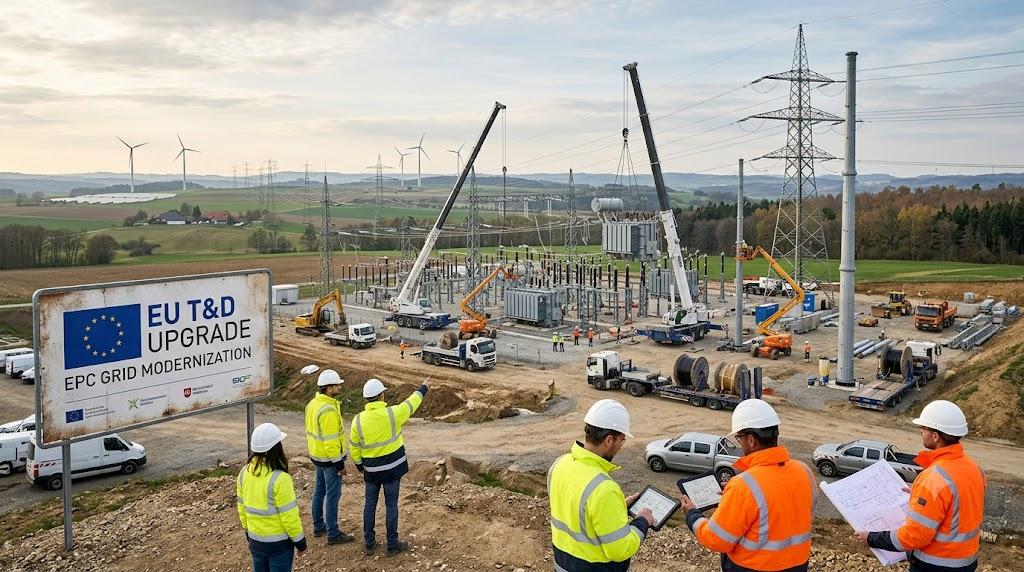
How Electrification Is Creating New Opportunities in Europe's T&D EPC Sector

Strengthening Europe's Power Grid Resilience Through T&D Upgrade Projects
Europe’s electricity networks are exposed to a broader set of risks than routine equipment ageing. Extreme weather, wildfire, flooding, cyber incidents, equipment failure, and changing generation patterns can all challenge reliable operation. Grid reinforcement and upgrade EPC programmes therefore have a growing resilience role. Their purpose is not only to add capacity, but also to help networks withstand disturbances, recover faster, and maintain essential electricity services.
The EU Transmission & Distribution (T&D) Upgrade EPC Market Report perspective includes investment in physical assets, control systems, and construction practices that reduce vulnerability. Resilience is location-specific. A coastal network may prioritise flood protection and corrosion management, while a region exposed to storms may focus on stronger structures, vegetation management, and faster fault restoration.
Ageing assets and replacement priorities
Many network components operate for decades, and condition varies according to loading, environment, maintenance history, and technology. Utilities must decide whether to refurbish, uprate, or replace equipment. Transformer replacement can improve efficiency and reliability, while new switchgear and protection systems may address safety and operational limitations. Cable replacement and line reconstruction can also reduce failure exposure and increase capacity.
Asset decisions require reliable condition data. Inspections, diagnostics, failure records, and criticality assessments help utilities rank interventions. EPC contractors can support this process through surveys and engineering assessments, but the asset owner retains responsibility for defining operational priorities. Clear technical baselines reduce the risk of scope changes after construction begins.
Designing for climate exposure
Climate adaptation is becoming more relevant in grid design. Flood-prone substations may require raised equipment platforms, drainage improvements, barriers, or revised access arrangements. Overhead lines can be assessed for wind loading, temperature conditions, and structural resilience. Underground cables reduce exposure to some weather events but introduce different challenges involving excavation, water ingress, repair access, and thermal performance.
Resilience measures should be proportionate to the risks and the consequences of asset failure. Redundant circuits, sectionalising equipment, alternative supply paths, and mobile substations can improve continuity, although they add cost and operational complexity. Engineering teams need to assess the full network rather than optimise individual assets in isolation.
Construction quality and safety
The resilience of a completed asset depends heavily on construction quality. Foundation design, cable jointing, earthing, protection settings, sealing, and equipment installation must meet demanding technical requirements. Quality assurance should be embedded from design review through factory acceptance testing, site installation, and final commissioning.
Working in operating substations and along existing rights-of-way creates safety risks. EPC teams must coordinate permits, isolation procedures, temporary works, lifting operations, and emergency arrangements. Competent supervision and accurate as-built documentation support safer maintenance after handover. Poor documentation can undermine the value of otherwise successful infrastructure investment.
Supply-chain resilience
The availability of transformers, high-voltage cables, switchgear, and specialist components can affect both project delivery and system resilience. Utilities may reduce exposure through framework agreements, supplier diversification, strategic spares, and early procurement. EPC firms can add value by tracking manufacturing milestones, inspecting quality, and coordinating logistics for oversized equipment.
Supply-chain decisions should consider repairability and long-term support, not only initial price. Standardisation may simplify spares management, while excessive dependence on a single supplier can create operational risk. Procurement teams should balance technical consistency with supply security.
Investment priorities and outlook
Resilience spending is likely to be integrated into wider transmission and distribution modernisation plans. The opportunity set includes substation hardening, line uprating, undergrounding in selected locations, advanced protection, network automation, and replacement of vulnerable components. The EU Transmission & Distribution (T&D) Upgrade EPC Market Size assessment should distinguish resilience-led expenditure from capacity expansion and routine maintenance, because project drivers and procurement pathways can differ.
For utilities, the business case should quantify avoided outages, reduced restoration time, asset life extension, and protection of critical loads where possible. For contractors, competitive differentiation will come from risk assessment, robust design, disciplined construction, and proven commissioning. Resilient grids are built through a combination of strategic planning and dependable execution, making EPC capability central to Europe’s energy security. Long-term value depends on aligning engineering, procurement, operations, climate adaptation, workforce capability, and maintenance planning throughout each asset’s lifecycle.
