

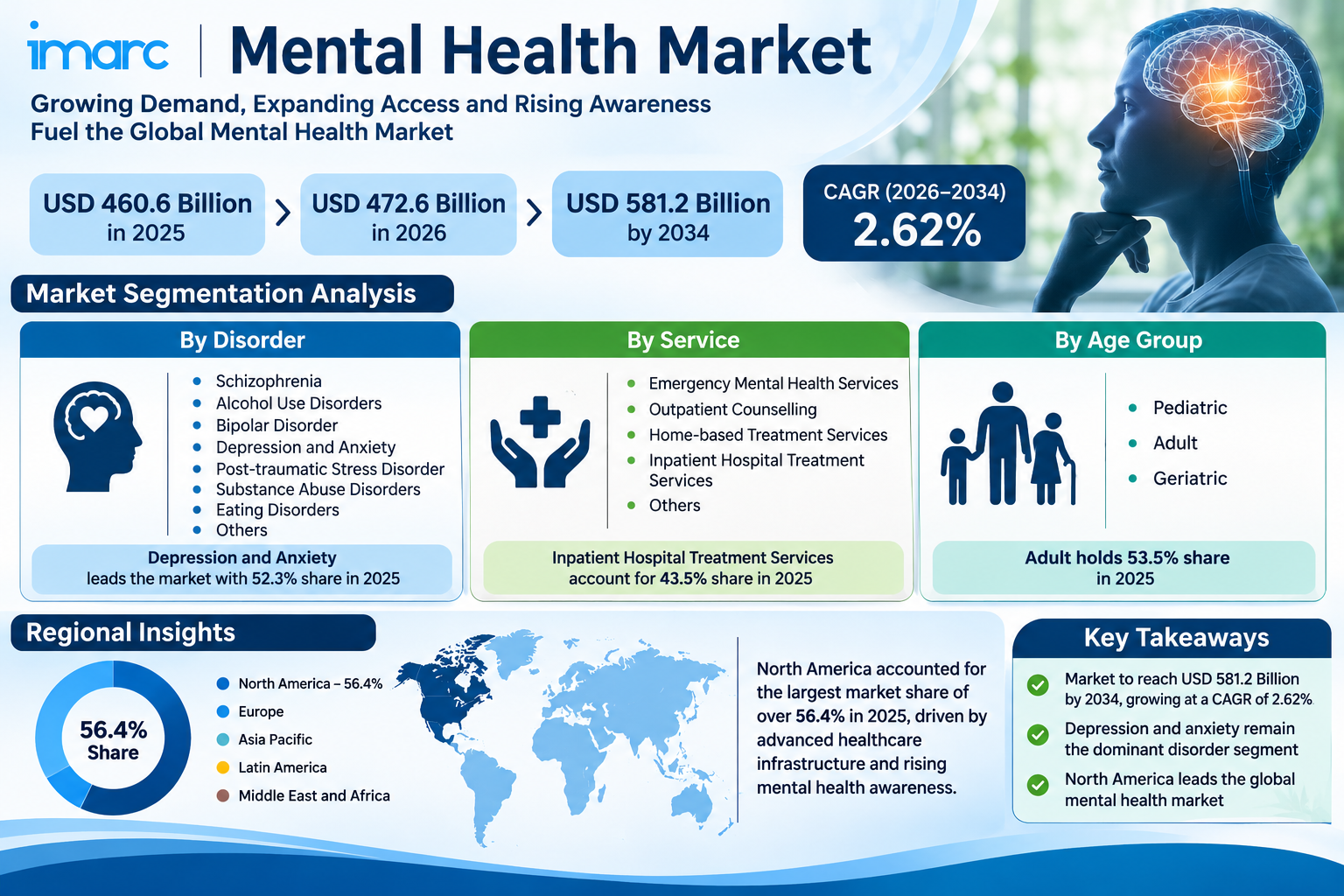
Mental Health Market Size Projected to Reach USD 581.2 Billion by 2034 with a CAGR of 2.62%

IMARC Group has recently released a new research study titled “Mental Health Market Report by Disorder, Service, Age Group, and Region, 2026-2034,” offers a detailed analysis of the market drivers, segmentation, growth opportunities, trends and competitive landscape to understand the current and future market scenarios.
Mental Health Market Size, Growth, and Forecast (2026-2034)
The mental health market size grew from USD 460.6 Billion in 2025 to USD 472.6 Billion in 2026 and is projected to reach USD 581.2 Billion by 2034, growing at a CAGR of 2.62% during 2026-2034. Rising demand for mental health services, advancements in telehealth and digital mental health platforms, supportive government programs and policies, and growing business attention to workers’ mental health are the primary factors driving the mental health market.
North America currently dominates the mental health market, holding a share of over 56.4% in 2025. Increasing awareness of mental health issues, the rising prevalence of depression, anxiety, and stress disorders, and growing acceptance of seeking professional help continue to expand demand for care.
Technology has made services more accessible, especially in remote areas, through telemedicine and mental health apps. Rising funding for research and treatment, along with employers prioritizing employee well-being, further supports growth across the mental health market.
Explore Growth Opportunities in the Mental Health Market - Grab Your Sample Report for Evaluation: https://www.imarcgroup.com/mental-health-market/requestsample
Key Trends Driving the Mental Health Market
• Increasing mental health awareness: Shifting societal attitudes and reduced stigma are giving people the confidence to seek support. According to the World Health Organization, 970 million people worldwide lived with a mental disorder in 2019, with anxiety and depression the most prevalent, and governments and providers are investing in infrastructure to meet the demand.
• Rapid expansion of telehealth and digital platforms: Telemedicine, mobile apps, and online therapy services offer convenience and privacy while removing geographic barriers, particularly in rural and underserved areas. Digital therapy tools and AI-driven personalization are strengthening access and shaping the mental health market outlook.
• Rising corporate focus on employee mental well-being: Employers are investing in employee assistance programs, manager training, and flexible work arrangements to reduce absenteeism, turnover, and healthcare costs. Employee mental health market size statistics point to strong momentum, with nearly 80% of Fortune 500 companies running employee assistance programs and a 2026 Lyra Health study finding that one in three workers is only “merely surviving” and that 69% of benefits leaders saw performance decline.
Mental Health Market Report Segmentation:
The mental health market report provides a detailed segmentation analysis to help businesses identify key growth segments and evolving industry dynamics. The market is categorized based on disorder, service, age group, and region, offering comprehensive insights across the mental health market.
Disorder Insights:
• Depression and Anxiety: Depression and anxiety lead the market with around 52.3% share in 2025, as demand for accessible and effective interventions drives new therapies and digital solutions.
• Other Disorders: Schizophrenia, alcohol use disorders, bipolar disorder, post-traumatic stress disorder, substance abuse disorders, eating disorders, and other conditions are also covered, each supported by specialized treatment and support services.
Service Insights:
• Inpatient Hospital Treatment Services: Inpatient hospital treatment services lead with around 43.5% share in 2025, providing round-the-clock care, stabilization, and multidisciplinary treatment for severe conditions and crises.
• Emergency, Outpatient Counselling, and Home-based Services: Emergency services, outpatient counselling, and home-based treatment extend care across the continuum, supporting early intervention and ongoing recovery.
Age Group Insights:
• Adult: Adults lead with around 53.5% share in 2025, reflecting the large number of people seeking therapy, counseling, and psychiatric treatment for conditions such as depression, anxiety, and bipolar disorder.
• Pediatric and Geriatric: Pediatric and geriatric groups are gaining attention as school-based programs expand and aging populations require specialized care.
Regional Insights:
- North America: North America holds over 56.4% of the market, supported by advanced healthcare infrastructure, awareness campaigns, and leadership in digital mental health, with the United States accounting for more than 91.80% of the regional market.
- Europe: Europe is driven by public health policies and digital therapy adoption, with more than 150 million people in the WHO European region living with a mental illness in 2021 and only one in three people with depression receiving the treatment they need.
- Asia Pacific: Asia Pacific is expanding as the burden of untreated conditions, rising awareness, and government investment in countries such as Australia, Japan, and India drive demand.
- Latin America: Latin America is growing as Brazil and Mexico integrate mental health into basic healthcare, supported by partnerships with NGOs and community initiatives.
- Middle East and Africa: The Middle East and Africa region is seeing increased focus from governments and NGOs, with initiatives such as Saudi Arabia’s National Centre for Mental Health Promotion expanding access.
Mental Health Market: Recent News and Developments
- April 2026: Modern Health, a global workplace mental health platform, released its 2026 workplace report based on a survey of 1,000 full-time US employees. It found that only 33% strongly agree their employer values their mental health, down from 41% in 2025, while 48% say their job negatively affected their mental health over the past year and 89% say more mental health benefits are needed.
- November 2026: Acadia Healthcare reported third quarter 2026 results, noting it added 220 licensed beds during the quarter, including a 144-bed de novo facility near Jacksonville, Florida. The company operates 280 behavioral health facilities across 40 states and Puerto Rico and serves more than 85,000 patients daily.
Challenges Impacting the Mental Health Market
Access gaps remain a major challenge, as a large share of people with mental disorders still do not receive treatment, and cultural stigma persists in several regions despite improving awareness.
Providers face workforce shortages, reimbursement pressures, and rising operating costs, while employers struggle to turn benefits into trust, as survey data show growing gaps between program availability and employee confidence.
Investment Opportunities in the Mental Health Market
The mental health market presents compelling investment opportunities supported by its projected growth from USD 460.6 Billion in 2025 to USD 581.2 Billion by 2034. Digital mental health platforms, tele-therapy, and AI-enabled care tools offer scalable ways to widen access and personalize treatment.
Workplace mental health programs, behavioral health hospital capacity through health system partnerships, and school-based services are additional growth avenues. Providers that combine clinical quality with digital convenience can build strong positions in the mental health market.
Outlook of the Mental Health Market (2026-2034)
The outlook for the mental health market is positive, supported by rising awareness, supportive government policies, and the continued adoption of digital care models. The market is projected to grow from USD 472.6 Billion in 2026 to USD 581.2 Billion by 2034 at a CAGR of 2.62%.
Telehealth integration, employer-sponsored programs, and expansion of inpatient and outpatient capacity will be the defining trends shaping the mental health market through 2034.
Key Players in the Mental Health Market
The mental health market is served by behavioral health providers and hospital operators competing on the basis of clinical quality, facility network, and service breadth, including Ascension Seton, Behavioral Health Network Inc., CareTech Holdings PLC, North Range Behavioral Health, Promises Behavioral Health, Pyramid Healthcare, Strategic Behavioral Health LLC, and Sevita (The MENTOR Network).
- Acadia Healthcare: The largest stand-alone behavioral healthcare company in the United States, Acadia operates 280 facilities across 40 states and Puerto Rico and continues to expand capacity, adding 220 licensed beds in the third quarter of 2026, including a 144-bed facility near Jacksonville, Florida.
- Universal Health Services Inc.: A major operator of behavioral health and acute care hospitals, Universal Health Services is a leading participant in inpatient mental health treatment in the United States.
Frequently Asked Questions (FAQs): Mental Health Market
1. What is the current mental health market size?
The mental health market size grew from USD 460.6 Billion in 2025 to USD 472.6 Billion in 2026 and is projected to reach USD 581.2 Billion by 2034, growing at a CAGR of 2.62% during 2026-2034.
2. What are the key drivers of the mental health market?
Key drivers include increasing awareness of mental health issues, the rising prevalence of mental disorders, greater acceptance of seeking help, telehealth and digital platforms, supportive government policies, and growing employer investment in workforce mental health.
3. Which segments lead the mental health market?
Depression and anxiety lead by disorder with around 52.3% share, inpatient hospital treatment services lead by service with around 43.5%, and adults lead by age group with around 53.5%.
4. Which region accounts for the largest mental health market share?
North America dominates the mental health market, holding over 56.4% share in 2025, supported by advanced healthcare infrastructure, awareness campaigns, and leadership in digital mental health solutions.
5. Who are the key players in the mental health market?
Key players in the mental health market include Acadia Healthcare, Ascension Seton, Behavioral Health Network Inc., CareTech Holdings PLC, North Range Behavioral Health, Promises Behavioral Health, Pyramid Healthcare, Strategic Behavioral Health LLC, Sevita (The MENTOR Network), and Universal Health Services Inc., among others.
Author IMARC Group
IMARC Group is a global management consulting firm that helps the world's most ambitious changemakers to create a lasting impact. The company provide a comprehensive suite of market entry and expansion services. IMARC offerings include thorough market assessment, feasibility studies, company incorporation assistance, factory setup support, regulatory approvals and licensing navigation, branding, marketing and sales strategies, competitive landscape and benchmarking analyses, pricing and cost research, and procurement research.
Contact Us
IMARC Group,
134 N 4th St. Brooklyn, NY 11249, USA,
Email: [email protected],
United States: +1-201971-6302
