


The global AI Agent Orchestration Market is becoming an important part of enterprise artificial intelligence infrastructure as organizations move from isolated AI applications toward coordinated, autonomous workflows. Businesses increasingly require intelligent systems capable of managing multiple AI agents, allocating tasks, monitoring performance, and integrating decisions across enterprise operations.
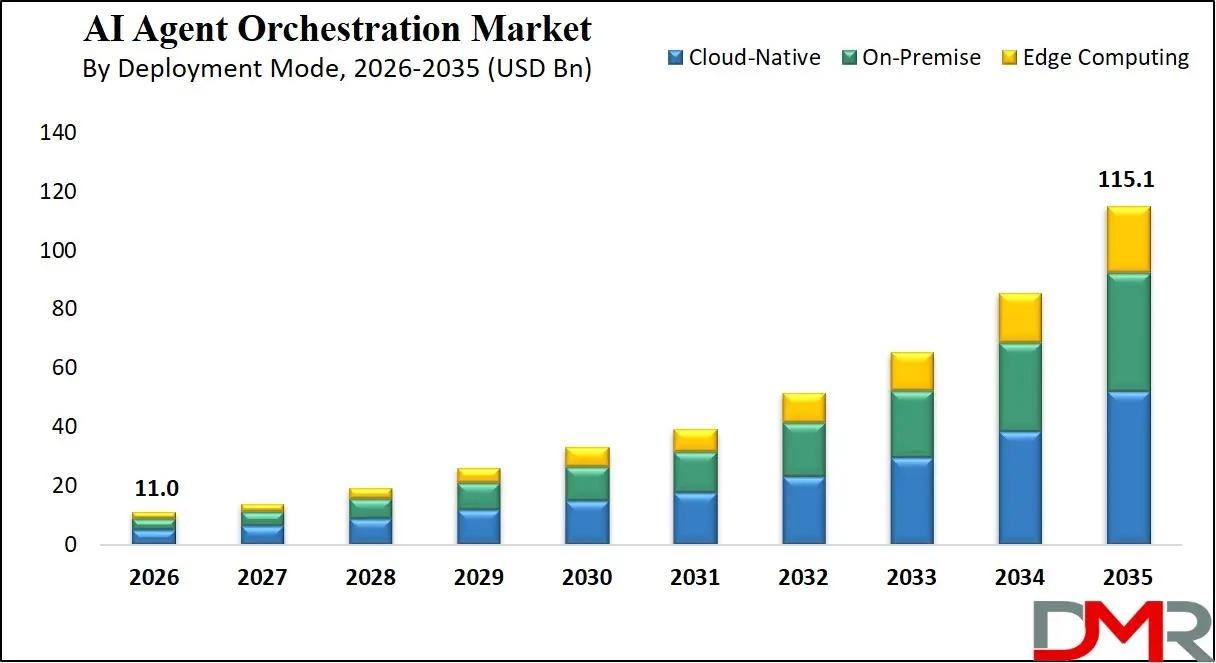
According to Dimension Market Research, the global market is estimated to reach USD 11.0 billion in 2026 and is projected to expand to USD 115.1 billion by 2035, growing at a CAGR of 29.8%. This expansion reflects increasing investment in multi-agent coordination, cloud-native infrastructure, real-time workflow intelligence, and enterprise automation.
As organizations adopt advanced AI technologies, orchestration platforms are emerging as essential systems for improving operational reliability, reducing manual intervention, and supporting scalable intelligent automation.
What Is the AI Agent Orchestration Market?
AI agent orchestration refers to technologies that coordinate, monitor, and manage multiple autonomous AI agents within interconnected digital workflows. Instead of allowing individual agents to operate independently, orchestration systems organize their responsibilities, control information exchange, and maintain workflow continuity.
These technologies combine agent frameworks, orchestration engines, state management systems, and monitoring tools to support complex enterprise operations.
For example, an organization may use multiple AI agents for customer support, data analysis, compliance monitoring, and operational planning. An orchestration system enables these agents to exchange information and complete related tasks while maintaining visibility and control.
This coordination is particularly valuable for enterprises managing complex cloud environments, distributed applications, and large-scale automation initiatives.
Why Is the AI Agent Orchestration Market Growing?
The growing adoption of autonomous AI systems is increasing demand for technologies that can coordinate complex tasks across business applications.
Traditional automation often depends on predefined instructions. Modern agentic AI systems require more adaptive coordination, allowing workflows to respond to changing information, operational conditions, and business priorities.
Advancements in multi-agent learning, intelligent task decomposition, and real-time workflow inference are strengthening orchestration capabilities. Enterprises are also investing in predictive monitoring and automated conflict resolution to improve system reliability.
Another important growth factor is the increasing emphasis on AI governance. Organizations need transparent systems that support performance monitoring, operational accountability, and compliance requirements.
Cloud infrastructure modernization further supports adoption by enabling organizations to coordinate AI agents across interconnected enterprise environments.
Get a Free Sample of the AI Agent Orchestration Market Report
Explore detailed market forecasts, technology trends, competitive developments, regional opportunities, and industry segmentation through Dimension Market Research's comprehensive analysis.
https://dimensionmarketresearch.com/request-sample/ai-agent-orchestration-market/
AI Agent Orchestration Market Statistics
The following findings highlight the market's projected development:
● 2026 Market Size: USD 11.0 Billion
● 2035 Forecast Revenue: USD 115.1 Billion
● Forecast CAGR: 29.8%
● Leading Component: Orchestration Engines, 36.9%
● Leading Deployment: Cloud-Native, 43.9%
● Leading End-User Industry: Healthcare, 33.3%
● Leading Region: North America, 40.6%
All segment and regional shares refer to 2026 estimates or projections.
Which Technologies and Segments Are Leading Adoption?
Orchestration Engines Support Intelligent Workflow Coordination
Orchestration engines are projected to account for 36.9% of market revenue in 2026, making them the largest component category.
Their importance comes from coordinating agent activities, managing complex workflows, and enabling integration across enterprise software environments.
Meanwhile, state management technologies are gaining importance because organizations require consistent memory, context retention, and workflow continuity during interactions involving multiple AI agents.
Cloud-Native Deployment Leads the Market
Cloud-native systems are expected to represent 43.9% of the market in 2026.
Their adoption reflects demand for scalable computing infrastructure, centralized agent monitoring, and flexible deployment environments.
Cloud-native orchestration supports distributed workloads while allowing enterprises to manage AI applications across interconnected systems.
Edge computing is also emerging as a rapidly growing deployment approach, particularly for manufacturing and telecommunications applications requiring localized processing and real-time decisions.
Healthcare Emerges as the Largest End-User Industry
Healthcare is projected to hold 33.3% of market revenue in 2026.
Healthcare organizations increasingly require coordinated digital systems for patient journey management, clinical trial automation, and operational workflow optimization.
Manufacturing is identified as the fastest-growing end-user industry, supported by robotics coordination, predictive maintenance, and intelligent production management.
Financial services, retail, and telecommunications also represent important application areas.
Regional Outlook: North America Leads, Asia-Pacific Accelerates
North America is projected to dominate the global market with a 40.6% share in 2026.
The region benefits from substantial enterprise AI investment, advanced software infrastructure, established technology providers, and growing deployment of multi-agent systems.
The United States market is estimated at USD 3.8 billion in 2026, with a projected CAGR of 27.9%.
Europe represents another significant market, with an estimated value of USD 2.4 billion in 2026. Regional demand is supported by enterprise modernization, AI governance requirements, and investments in interoperable digital infrastructure.
Asia-Pacific is identified as the fastest-growing region, supported by increasing AI adoption across China, India, Japan, and other emerging digital economies.
Technology Trends, Opportunities, and Challenges
A major technology trend involves predictive orchestration monitoring. Enterprises are adopting systems that detect workflow anomalies, assess agent performance, and optimize task execution using operational data.
Real-time state graph optimization and cloud-native telemetry are also becoming important for managing large groups of AI agents.
Growth opportunities include expanding enterprise automation programs, cloud infrastructure integration, and intelligent workflow deployment across emerging economies.
However, implementation complexity remains a challenge. High integration costs, computational validation requirements, limited interoperability standards, and data privacy considerations can constrain adoption.
Vendors capable of providing reliable, transparent, and interoperable orchestration solutions may be better positioned to address these requirements.
Competitive Landscape and Enterprise AI Innovation
The competitive landscape includes established technology companies and specialized AI framework providers.
Prominent companies identified in the DMR report include Microsoft Corporation, Amazon Web Services, Google LLC, IBM Corporation, Oracle Corporation, Salesforce, SAP SE, OpenAI, Anthropic, ServiceNow, LangChain, LlamaIndex, and CrewAI.
Competition increasingly focuses on multi-agent architectures, enterprise integrations, workflow observability, and scalable deployment capabilities.
Partnerships between technology providers and enterprise automation companies are also shaping product development as organizations seek orchestration solutions compatible with existing digital infrastructure.
Explore the Complete AI Agent Orchestration Market Analysis
Dimension Market Research provides detailed forecasts, segment analysis, regional assessments, competitive intelligence, and technology insights to support enterprise planning and investment decisions.
Access the full report and available purchase options:
https://dimensionmarketresearch.com/checkout/ai-agent-orchestration-market/
Frequently Asked Questions
1. What is the AI Agent Orchestration Market size in 2026?
The global market is estimated to reach USD 11.0 billion in 2026.
2. What is the projected CAGR of the AI Agent Orchestration Market?
The market is expected to grow at a CAGR of 29.8% from 2026 to 2035.
3. Which component dominates the AI Agent Orchestration Market?
Orchestration Engines lead the component category with a projected 36.9% share in 2026.
4. Which region leads the AI Agent Orchestration Market?
North America leads with an estimated 40.6% market share in 2026.
5. What is the future outlook for the AI Agent Orchestration Market?
The market is forecast to reach USD 115.1 billion by 2035, supported by multi-agent automation, cloud-native deployments, and increasing enterprise AI integration.
Conclusion
The global AI Agent Orchestration Market is evolving into a significant component of intelligent enterprise infrastructure.
Increasing adoption of autonomous agents, advancements in orchestration engines, and growing demand for scalable cloud-native systems are creating substantial opportunities.
As enterprises prioritize coordinated automation, monitoring, interoperability, and AI governance, orchestration technologies are expected to play an increasingly important role in digital transformation through 2035.
Related AI and Enterprise Automation Market Insights
AI Agent Orchestration Platform Market Size
The global AI Agent Orchestration Platform Market is projected to increase from USD 13.7 billion in 2026 to USD 88.6 billion by 2035, expanding at a 23.0% CAGR. Growth reflects increasing adoption of enterprise AI platforms, cloud-native orchestration, and coordinated multi-agent applications.
AI Agents Market Share
The global AI Agents Market is projected to grow from USD 7.5 billion in 2025 to USD 231.9 billion by 2034, registering a 46.3% CAGR. Rising applications across customer service, software development, finance, and enterprise automation are supporting market expansion.
Process Orchestration Market Growth
The global Process Orchestration Market is forecast to expand from USD 19.8 billion in 2025 to USD 129.8 billion by 2034, growing at a 23.2% CAGR. Increasing adoption of business process automation, low-code platforms, and cloud-native integration solutions is supporting demand.
