

Protein Engineering Market Size, Share, Latest Insights and Forecast 2026-2034

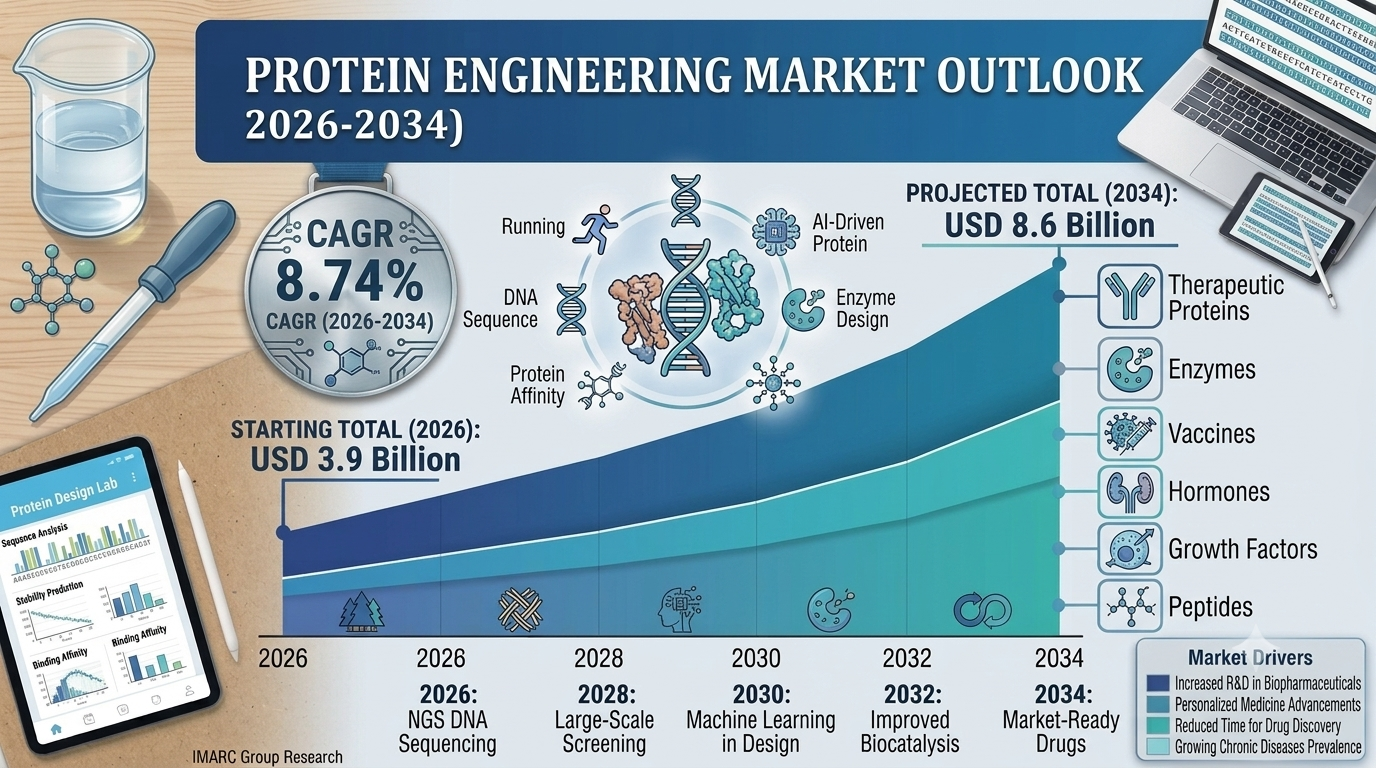
According to IMARC Group, the global protein engineering market size reached USD 3.9 Billion in 2025 and is projected to reach USD 8.6 Billion by 2034, expanding at a CAGR of 8.74% during 2026–2034. This strong protein engineering market growth trajectory reflects rising demand for biologics, accelerating adoption of AI-driven protein design, expanding synthetic biology applications, and growing government and academic investment in protein-based therapeutics.
Protein Engineering Industry Overview
Protein engineering refers to the design and modification of protein structures to achieve enhanced stability, specificity, binding affinity, or catalytic activity for a defined application. By combining rational design techniques such as computational modeling and structural bioinformatics with directed evolution and high-throughput screening, researchers can create proteins that outperform their naturally occurring counterparts for therapeutic, diagnostic, and industrial use.
Engineered proteins are deployed across a broad continuum of use cases:
- Therapeutic biologics: Monoclonal antibodies, recombinant insulin, coagulation factors, growth factors, and antibody-drug conjugates
- Vaccine development: Antigen design, adjuvant optimization, and recombinant vaccine platforms
- Drug discovery and pharmaceutical R&D: Target validation, binding-affinity optimization, and immunogenicity screening
- Industrial biotechnology: Engineered enzymes for biocatalysis, green chemistry, and sustainable manufacturing
- Agriculture and food technology: Precision-fermentation proteins and alternative-protein development
Global Protein Engineering Market Size & Key Statistics
Below are the key protein engineering market statistics drawn from IMARC Group's comprehensive market analysis:
|
Report Attribute |
Key Statistics |
|
Base Year |
2025 |
|
Historical Period |
2020–2025 |
|
Forecast Period |
2026–2034 |
|
Protein Engineering Market Size in 2025 |
USD 3.9 Billion |
|
Market Forecast in 2034 |
USD 8.6 Billion |
|
Market Growth Rate (2026–2034) |
8.74% CAGR |
|
Largest Region |
North America (40.6% share in 2025) |
|
Leading Product & Services Segment |
Instruments (53.2% share) |
|
Leading Protein Type Segment |
Monoclonal Antibodies (24.5% share) |
|
Leading Technology Segment |
Rational Protein Design |
|
Leading End-Use Segment |
Pharmaceutical & Biotechnology Companies (45.3% share) |
Request for a Sample Report for Detailed Protein Engineering Market Share Evaluation: https://www.imarcgroup.com/protein-engineering-market/requestsample
Key Market Drivers & Protein Engineering Market Trends in 2025
Several powerful forces are shaping protein engineering market trends and fuelling sustained growth expectations across global biopharmaceutical and industrial biotechnology markets:
1. AI-Driven Protein Design and Computational Modeling
Artificial intelligence and machine learning are transforming protein engineering by predicting protein structures, optimizing folding and stability, and accelerating candidate selection through automated high-throughput screening. Deep learning models now analyze vast biological datasets to identify novel protein sequences with targeted properties, dramatically compressing discovery timelines and reducing R&D costs.
2. Expanding Synthetic Biology Applications
Rising investment in synthetic biology is a major catalyst for the market. IMARC Group estimates the global synthetic biology market at USD 18.5 Billion in 2024, projected to reach USD 66.7 Billion by 2033 at a 15.3% CAGR. Researchers are leveraging CRISPR-based modifications and AI-driven algorithms to design custom proteins with enhanced stability and functionality for healthcare and industrial applications.
3. Rising Prevalence of Protein-Deficient Diseases
Malnutrition-related disorders and genetic conditions requiring protein supplementation continue to drive demand. Studies indicate that 2–10% of children aged 1–9 in developing nations experience severe protein-calorie malnutrition, prompting biopharmaceutical companies to develop recombinant proteins for conditions such as cystic fibrosis, hemophilia, and growth hormone deficiencies.
4. Advancements in Genetic and Metabolic Engineering
Directed evolution, recombinant DNA technology, and gene-synthesis innovations are enabling large-scale production of engineered proteins with superior bioactivity and reduced immunogenicity. Improved expression systems and metabolic pathway engineering are boosting protein yields across microbial and plant-based production hosts.
5. Growing Government and Academic Research Funding
Public research grants and government-backed initiatives are accelerating foundational studies in protein structure and function. Academic institutions are increasingly collaborating with biotech firms to translate laboratory discoveries into commercial protein engineering solutions, particularly in AI-driven protein modeling and precision therapeutics.
6. Expanding Industrial and Agricultural Applications
Beyond healthcare, engineered proteins are gaining traction in biofuels, food processing, precision fermentation, and environmental biotechnology, broadening the addressable base for the industry and reinforcing long-term protein engineering market growth.
Key Market Segmentation
By Product & Services
- Instruments
- Reagents
- Services and Software
Instruments represent the largest segment, accounting for 53.2% of the market in 2025. High-performance chromatography systems, mass spectrometry platforms, automated liquid handling systems, and next-generation sequencing tools enable precise protein characterization, purification, and structural analysis, underpinning the bulk of engineering workflows across pharmaceutical and biotech R&D.
By Protein Type
- Insulin
- Monoclonal Antibodies
- Coagulation Factors
- Vaccines
- Growth Factors
- Others
Monoclonal antibodies dominate the protein type segment with a 24.5% share in 2025, driven by their central role in targeted oncology and autoimmune disease treatment. Recombinant DNA techniques and AI-powered optimization are improving binding affinity, specificity, and manufacturing scalability for antibody-based therapeutics.
By Technology
- Irrational Protein Design
- Rational Protein Design
Rational protein design leads the technology segment, relying on computational modeling, structural bioinformatics, and AI-driven algorithms to predict and optimize protein structures with precision. This approach reduces trial-and-error experimentation, enabling faster and more cost-effective development for antibody engineering and enzyme optimization alike.
By End User
- Pharmaceutical and Biotechnology Companies
- Academic Research Institutes
- Contract Research Organizations
Pharmaceutical and biotechnology companies hold the largest end-user share at 45.3% in 2025, driving innovation in therapeutic proteins, monoclonal antibodies, and enzyme-based drug development, supported by rising regulatory approvals for next-generation biologics.
Regional Protein Engineering Market Analysis
|
Region |
Key Highlights |
|
North America — Largest (40.6% share) |
United States & Canada; home to major biotech and pharmaceutical firms, strong FDA regulatory framework, high AI-driven protein design adoption, and robust government research funding |
|
Asia Pacific |
China, Japan, India, South Korea, Australia, Indonesia; expanding biopharmaceutical manufacturing, rising cancer incidence driving targeted therapy demand, growing CDMO capacity |
|
Europe |
Germany, France, UK, Italy, Spain, Russia; well-established biomanufacturing infrastructure, expedited biologic approval pathways, strong academia-industry partnerships |
|
Latin America |
Brazil, Mexico; rising chronic disease burden, growing biosimilar adoption, expanding biopharmaceutical production capabilities |
|
Middle East & Africa |
UAE, Saudi Arabia; healthcare modernisation programmes, Saudi Vision 2030 health investment, rising biotechnology research collaborations |
North America leads the global protein engineering market share, supported by the United States' advanced biopharmaceutical infrastructure, strong R&D investment, and an estimated 129 million Americans affected by chronic conditions driving demand for protein-based therapeutics. The United States alone accounts for 89.60% of the regional market.
Asia Pacific is emerging as a fast-growing regional market, fuelled by expanding biopharmaceutical manufacturing in China, India, and South Korea, along with rising healthcare expenditure and supportive regulatory frameworks across the region.
Connect for Detailed Protein Engineering Market Share Segmentation Analysis — Speak to an Analyst: https://www.imarcgroup.com/request?type=report&id=5005&flag=C
Leading Players in the Global Protein Engineering Industry
The global protein engineering market features a mix of diversified life-sciences instrumentation leaders and specialized protein-engineering innovators. Key companies covered in the IMARC Group report include:
|
Company |
Core Focus Area |
|
Abzena Limited |
Immunogenicity assessment, bioconjugates, biologics development |
|
Agilent Technologies, Inc. |
Analytical instrumentation, protein characterization tools |
|
Bio-Rad Laboratories Inc. |
Life-science reagents, protein purification and analysis |
|
Bruker Corporation |
Mass spectrometry and structural biology instrumentation |
|
Codexis Inc. |
Engineered enzymes, directed evolution platforms |
|
DH Life Sciences, LLC |
Life-sciences research tools and reagents |
|
GenScript |
Gene synthesis, protein expression and engineering services |
|
Merck KGaA |
Biopharma reagents, protein engineering platforms |
|
Novo Nordisk A/S |
Recombinant insulin and protein-based therapeutics |
|
Protomer Technologies (Eli Lilly and Company) |
Glucose-responsive protein therapeutics |
|
Revvity, Inc. |
Protein detection and analysis technologies |
|
Thermo Fisher Scientific Inc. |
Protein expression systems, analytical instrumentation |
|
Waters Corporation |
Chromatography and mass spectrometry for protein analysis |
Latest Protein Engineering Market Industry Developments
November 2024 — Cradle Bio
Cradle Bio secured USD 73 million in Series B funding, bringing total investment beyond USD 100 million. Its AI-powered platform enhances protein engineering across therapeutics, diagnostics, agriculture, chemicals, and food, and the company now collaborates with 21 clients, including major pharmaceutical firms.
November 2024 — Future Fields
Canadian biotech Future Fields opened Instar 1.0, a 6,000-square-foot fruit-fly-based biomanufacturing facility in Edmonton, offering a scalable alternative protein production method and supporting research into next-generation therapies.
October 2024 — Avenue Biosciences
Avenue Biosciences raised EUR 2.3 million in seed funding led by Voima Ventures to advance its protein-production-efficiency platform for biopharmaceuticals, including gene therapies, monoclonal antibodies, and mRNA vaccines.
April 2024 — Abzena Ltd.
Abzena launched EpiScreen 2.0, a next-generation immunogenicity assessment platform delivering sensitive, multi-parametric assays to evaluate preclinical immunogenicity risk in proteins, antibodies, and gene therapy products.
April 2023 — Adaptyv Bio
Adaptyv Bio launched a protein foundry that uses robotics, microfluidics, and synthetic biology to validate AI-designed proteins, simplifying the translation of computational designs into functional molecules for medicine and industrial applications.
About Us
IMARC Group is a leading global market research company providing data-driven insights and expert consulting services to businesses seeking to achieve their strategic objectives. With a multi-disciplinary team of industry experts, IMARC delivers thorough, reliable market intelligence across sectors including Healthcare, Technology, Chemicals, Energy, Food & Beverages, and more.
Contact Us
IMARC Group
United States: +1-201-971-6302
India: +91-120-433-0800
United Kingdom: +44-753-714-6104
