

Global Robotic Automation Actuator Market Outlook: Automation Trends and Technology Advances

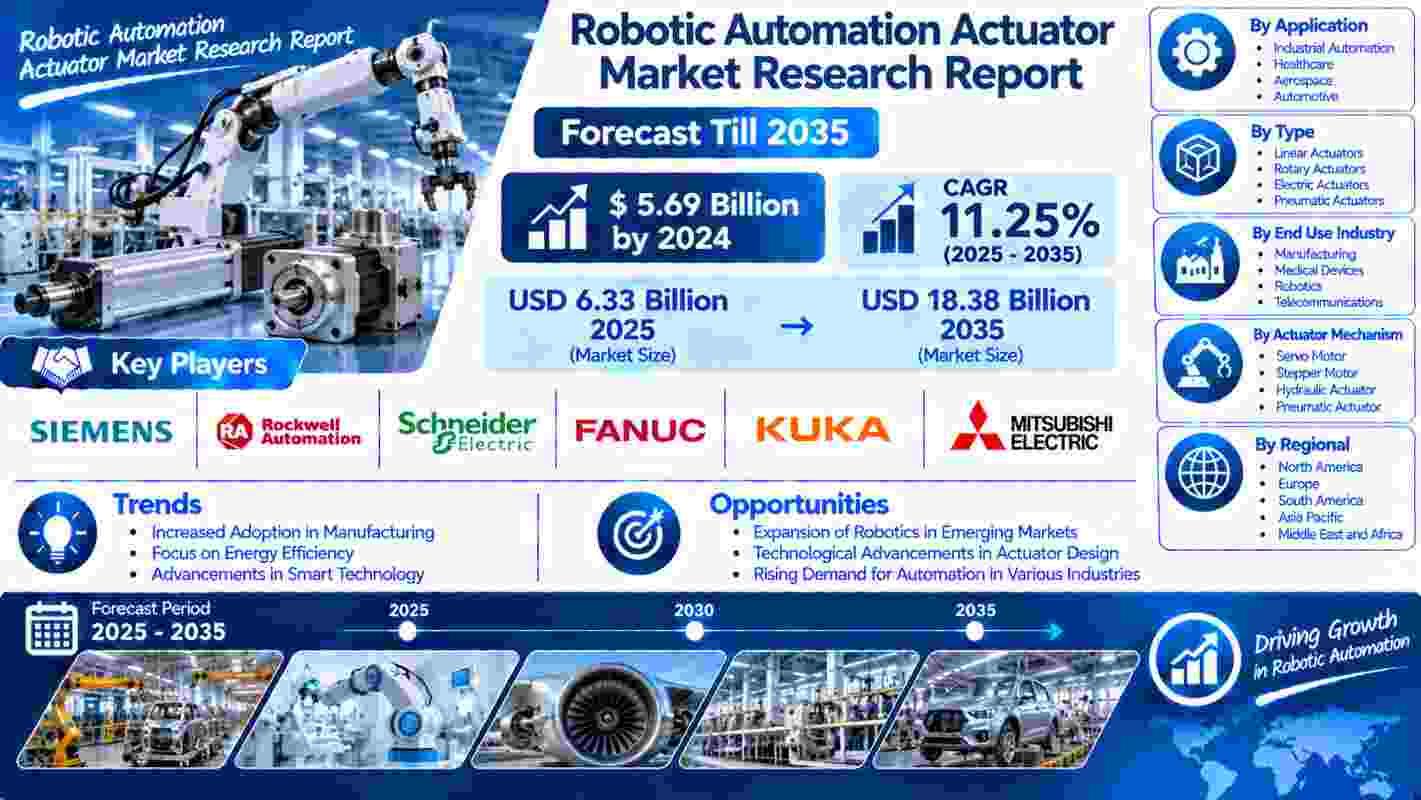
According to Market Research Future® (MRFR), the Robotic Automation Actuator Market was valued at USD 5.69 billion in 2024 and is estimated to reach USD 6.33 billion in 2025. The market is projected to expand to USD 18.38 billion by 2035, registering a compound annual growth rate (CAGR) of 11.25% during the 2025–2035 forecast period. Increasing adoption of automation in manufacturing, growing interest in energy-efficient equipment, and advancements in smart technologies are supporting market development. Expansion of robotics across emerging markets and rising demand for automation in multiple industries are also creating opportunities for actuator manufacturers.
Market Overview and Industry Role
Actuators are essential components of robotic and automated systems because they convert energy into controlled mechanical movement. They enable machines to perform actions such as lifting, rotating, positioning, gripping, and moving components with precision. In robotic automation, actuator performance influences motion accuracy, operating speed, load handling, repeatability, and system reliability.
The market covers several actuator technologies, including linear actuators, rotary actuators, electric actuators, and pneumatic actuators. These products serve different motion requirements and are selected according to factors such as force, speed, precision, operating environment, energy consumption, and control-system compatibility. Actuator selection also depends on the design of the robot or automated equipment and the requirements of the production process.
The growing use of robotics across industrial and service applications is increasing the importance of reliable motion-control components. As businesses automate repetitive, physically demanding, and precision-oriented tasks, actuators become critical elements in determining system performance. Their role extends beyond industrial robots to applications in healthcare equipment, aerospace systems, automotive production, and telecommunications-related infrastructure.
Manufacturing Automation Supporting Demand
Manufacturing is a major end-use industry for robotic automation actuators. Factories increasingly deploy automated equipment to improve production consistency, reduce manual intervention, and manage repetitive operations. Robots equipped with suitable actuators can perform tasks such as material handling, assembly, welding, inspection, and component positioning.
The increased adoption of automation in manufacturing is encouraging demand for actuators that can provide accurate and repeatable motion. Production environments often require equipment to operate over extended periods while maintaining performance under varying loads and operating conditions. Manufacturers therefore evaluate actuator systems based on durability, maintenance requirements, integration capabilities, and overall operating costs.
Automation is also becoming relevant to production facilities seeking greater flexibility. Reconfigurable robotic systems can support different product configurations and manufacturing tasks, provided their motion systems can be adapted to the required movements and payloads. This trend creates opportunities for actuator suppliers offering products that can integrate with advanced controllers and industrial automation platforms.
Energy Efficiency and Actuator Selection
Energy efficiency is an important trend shaping product development. Automated equipment can operate for long production cycles, making power consumption an important consideration for manufacturers. The choice of actuator technology affects energy use, system complexity, maintenance, and operating performance.
Electric actuators are often selected where precise positioning and controllable movement are important. Servo motor-based systems can provide closed-loop motion control, while stepper motor-based solutions are used in applications requiring controlled incremental movement. Pneumatic actuators can offer relatively simple and rapid motion in suitable applications, although their overall energy efficiency depends on compressed-air generation and system design. Hydraulic actuators are relevant where high force or load capacity is required, but their suitability depends on the equipment's operating and maintenance requirements.
These differences mean that energy efficiency cannot be evaluated through actuator type alone. System design, duty cycle, control strategy, load, operating conditions, and maintenance all affect total energy consumption. Manufacturers increasingly assess these factors when selecting motion technologies for automated equipment.
Smart Technology and Advanced Motion Control
Advancements in smart technology are influencing the development of robotic actuators. Modern automation systems increasingly integrate sensors, digital controllers, communication interfaces, and monitoring functions. These capabilities can support more precise motion control and provide information about equipment operating conditions.
Smart actuator systems can contribute to condition monitoring and predictive maintenance when integrated with suitable sensors and analytics platforms. Information about temperature, position, vibration, load, or operating cycles can help maintenance teams identify performance changes and schedule interventions. The availability of such data can reduce unexpected downtime when supported by effective monitoring and maintenance processes.
Advances in actuator design are another identified market opportunity. Manufacturers are working to improve compactness, precision, response characteristics, load capacity, and integration with control systems. The growing use of robotics in different industries is encouraging demand for actuator solutions tailored to specific applications rather than relying on one technology across all equipment categories.
Applications Across Healthcare, Aerospace and Automotive Industries
Healthcare is an important application area for robotic automation actuators. Medical devices and robotic systems require controlled movement, reliability, and precise positioning. Actuators can be used in selected medical equipment, rehabilitation systems, laboratory automation, and robotic-assisted applications. Product requirements vary significantly according to the intended use, safety standards, and operating environment.
Aerospace applications may require actuator systems that meet demanding expectations for reliability, weight, precision, and performance under specific environmental conditions. Automated inspection, manufacturing equipment, and specialized robotic systems can incorporate actuators designed for controlled movement. Qualification and engineering requirements are important considerations in these applications.
The automotive industry is another major area of opportunity. Vehicle production facilities use automation for assembly, material handling, welding, painting, and inspection. Robotic actuators support the movement and positioning required in these operations. As automotive manufacturers upgrade production lines and introduce new vehicle technologies, demand for adaptable automation systems may create additional opportunities for actuator suppliers.
Telecommunications is also included among the end-use industries. Actuator-based mechanisms can support selected positioning, equipment-handling, and infrastructure-related functions, although the specific applications depend on system design.
Market Segmentation and Regional Coverage
The Robotic Automation Actuator Market is segmented by application, type, end-use industry, actuator mechanism, and region. Applications include industrial automation, healthcare, aerospace, and automotive. The type categories comprise linear actuators, rotary actuators, electric actuators, and pneumatic actuators.
End-use industries include manufacturing, medical devices, robotics, and telecommunications. The actuator mechanism segmentation covers servo motors, stepper motors, hydraulic actuators, and pneumatic actuators. These categories reflect differences in movement requirements, force generation, control precision, and equipment design. Some classifications may overlap because electric, pneumatic, and hydraulic describe actuation technologies, while servo and stepper motors identify particular motor-driven mechanisms.
Regional coverage includes North America, Europe, South America, Asia-Pacific, and the Middle East and Africa. Demand across these regions is influenced by industrial investment, manufacturing modernization, robotics adoption, infrastructure development, and the availability of automation technology.
Competitive Landscape and Market Opportunities
Key companies profiled include Siemens, Rockwell Automation, Schneider Electric, FANUC, KUKA, and Mitsubishi Electric. These companies participate in the broader industrial automation, robotics, and motion-control ecosystem, although their product portfolios and roles in the actuator value chain differ.
Competition is shaped by product reliability, precision, energy performance, integration capabilities, technical support, and compatibility with automation platforms. Manufacturers that can provide actuator systems suited to specific industrial requirements may be better positioned as customers modernize their production facilities.
Opportunities include the expansion of robotics in emerging markets, technological advancements in actuator design, and rising automation demand across industries. Emerging economies may offer opportunities as manufacturing facilities invest in productivity improvements and automated production systems. Healthcare, aerospace, automotive, and telecommunications applications also provide avenues for specialized actuator development.
Market Outlook to 2035
The Robotic Automation Actuator Market is projected to increase from USD 6.33 billion in 2025 to USD 18.38 billion by 2035, representing a CAGR of 11.25%. Increased manufacturing automation, energy-efficiency priorities, and smart technology integration are expected to remain important market influences.
Future development will depend on the ability of actuator manufacturers to deliver precise, reliable, and adaptable motion solutions. Continued robotics adoption, advances in control technologies, and investment in automated production systems are likely to shape demand across the market's major application and end-use categories.
