

Low Density Polyethylene Foams Industry: Key Players, Market Trends, and Growth Prospects

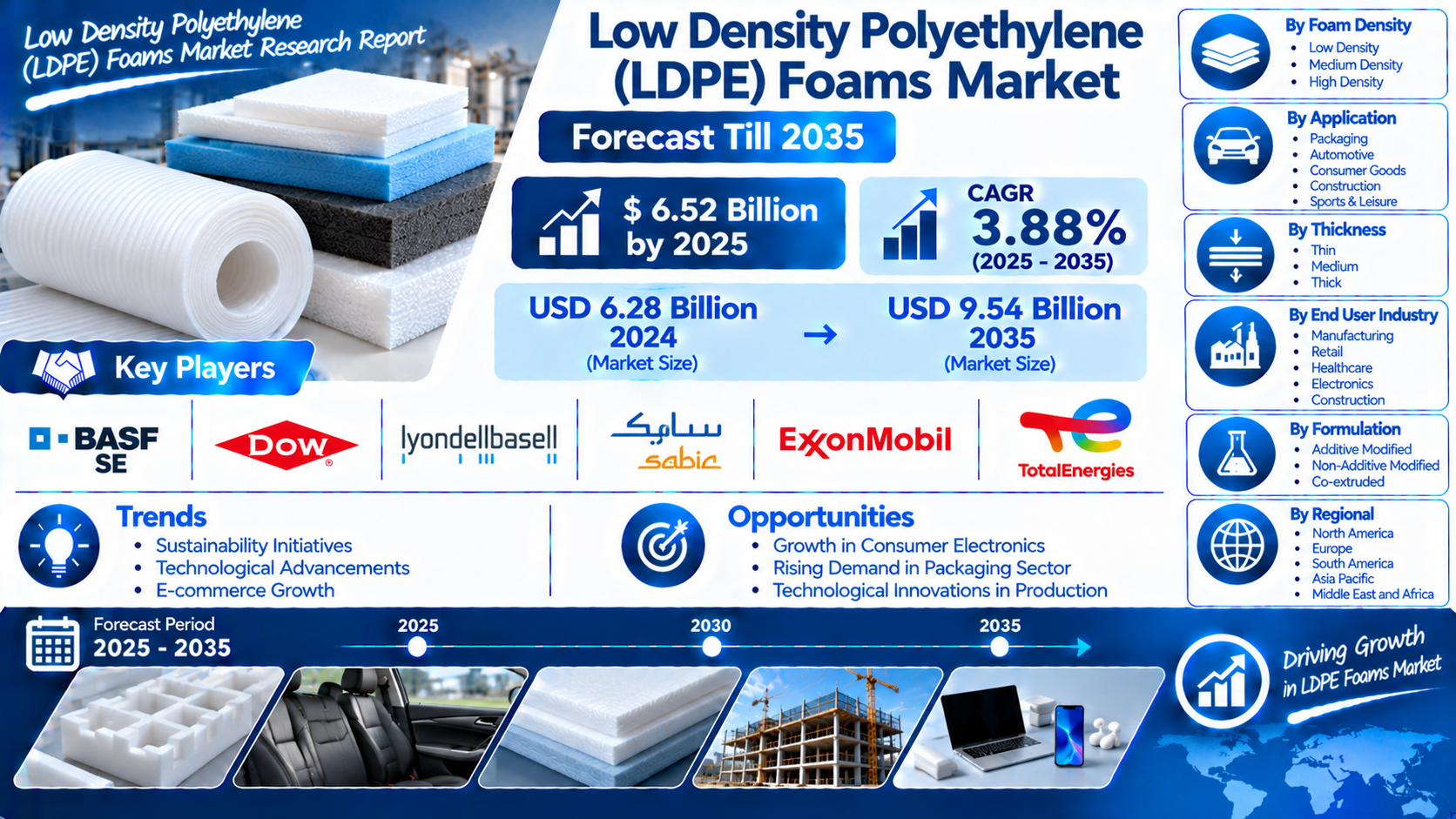
According to Market Research Future® (MRFR), the Low Density Polyethylene (LDPE) Foams Market is expected to grow from USD 6.52 billion in 2025 to USD 9.54 billion in 2035, at a CAGR of 3.88% over the 2025–2035 forecast period. The market recorded a value of USD 6.28 billion in 2024. Demand is supported by the use of lightweight, flexible foam materials in product protection and in applications across packaging, automotive, consumer goods, construction, and sports and leisure. Developments in production technology, sustainability initiatives, and the continued expansion of e-commerce are among the factors shaping the industry's outlook.
A Broad Application Base Underpins Demand
Low density polyethylene foams serve a range of industrial and commercial purposes because their physical characteristics can be adapted to different product requirements. Their lightweight structure and cushioning properties make them suitable for applications where protection, flexibility, and ease of handling are important. The market's coverage across several industries gives manufacturers opportunities to supply different customer groups rather than relying exclusively on one application.
Packaging is a central area of use. Foam materials can help protect products from impact and abrasion during handling, storage, and transportation. Packaging requirements vary considerably: fragile goods may need cushioning, while other products may require separation or protective layers. LDPE foams can be manufactured in different thicknesses and densities to address these varying needs. Their relatively low weight can also be useful when packaging designers seek protection without adding unnecessary shipment weight.
The growth of e-commerce reinforces the importance of protective packaging. Products sold online often pass through several distribution and delivery stages before reaching customers. This creates a need for packaging materials that can accommodate different product sizes and help limit damage during transit. As online retail expands, suppliers of protective foam materials may find additional opportunities among packaging manufacturers and businesses managing product distribution.
Automotive, consumer goods, construction, and sports and leisure are other application categories identified in the report. Automotive uses can involve cushioning and other foam-related functions, while consumer goods and leisure products may require lightweight and flexible materials. Construction applications can involve protective or insulation-related requirements. The role of LDPE foam differs across these sectors, and suitability depends on the specific product design, operating conditions, and performance standards.
Density, Thickness, and Formulation Determine Product Choice
The market is segmented by foam density into low-density, medium-density, and high-density products. Density influences important physical characteristics and helps determine which foam grade is appropriate for a particular use. Buyers consider the balance between cushioning, compression response, flexibility, and material requirements when selecting products. Manufacturers therefore need to maintain product specifications that align with the demands of individual applications.
Thickness is another important product dimension. Thin, medium, and thick foam formats allow suppliers to address different levels of cushioning and space requirements. The choice is not determined by thickness alone: density, formulation, foam structure, and the nature of the product being protected also influence performance. A packaging solution for a compact electronic component, for instance, may require different material characteristics from a solution intended for a larger consumer or industrial product.
Formulation further expands the range of available products. The report identifies additive-modified, non-additive-modified, and co-extruded formulations. Additive modification can help tailor selected properties for particular applications, depending on the materials and processing methods used. Non-additive-modified foams provide options where additional modification is unnecessary. Co-extrusion allows manufacturers to produce structures that combine layers or material characteristics, offering another route to application-specific product design.
The end-user segmentation includes manufacturing, retail, healthcare, electronics, and construction. Each sector evaluates foam materials according to its own operating and product requirements. Electronics businesses may prioritize protection during shipping and storage, whereas retail and manufacturing users may focus on packaging efficiency and material handling. Healthcare applications can involve more specific requirements for product protection and suitability. This diversity encourages suppliers to develop product ranges that can serve different technical and commercial needs.
Production Innovation and Sustainability Considerations
Technological innovation in production is an important opportunity for the market. Improvements in processing methods and formulation control can support consistent product quality and help manufacturers respond to more specialized customer requirements. Greater control over foam density, thickness, and structure can be relevant when products must meet defined cushioning or dimensional specifications. Production improvements may also help suppliers manage material use and manufacturing efficiency.
Sustainability initiatives are influencing decisions across the polymer and packaging value chains. Buyers are paying greater attention to packaging waste, resource efficiency, and the environmental characteristics of materials. For LDPE foam producers, these considerations create incentives to examine production practices, material efficiency, and options for improving the management of used products. However, sustainability performance depends on factors such as product design, collection and sorting systems, recycling infrastructure, and local waste-management conditions. It should not be assumed that every foam product is recyclable in every market.
The combination of technological progress and sustainability expectations may influence product development. Manufacturers that can demonstrate reliable performance while addressing customer concerns about material use and waste may strengthen their competitive position. These considerations are particularly relevant in packaging, where businesses must balance product protection, cost, logistics, and environmental objectives.
Regional Coverage and Industry Participants
The report examines the market across North America, Europe, South America, Asia Pacific, and the Middle East and Africa. Demand conditions differ among these regions according to the scale of manufacturing, retail distribution, construction activity, and packaging consumption. The presence of multiple end-use sectors across the regional landscape creates varied opportunities for producers and suppliers.
Asia Pacific is included as a major regional market in the report's geographic framework, alongside North America and Europe. South America and the Middle East and Africa provide additional markets for consideration. Regional growth will be shaped by industrial development, local packaging needs, supply-chain activity, and access to foam production and distribution capabilities. Differences in environmental regulations and waste-management infrastructure may also influence material selection and product development.
The key players identified by MRFR are BASF SE, Dow Inc., LyondellBasell Industries N.V., SABIC, ExxonMobil Chemical Company, and TotalEnergies SE. These companies form part of the market's competitive landscape. Competition may be influenced by polymer and foam expertise, production scale, product consistency, innovation, and the ability to serve customers across different applications. Their specific activities and positions may vary across the broader materials value chain.
Opportunities and Market Outlook
Growth in consumer electronics offers potential for suppliers of protective foam materials. Electronic devices and components often require packaging designed to limit damage from impact and movement during transportation. As product categories and distribution channels evolve, packaging suppliers may seek foam solutions that meet changing protection and handling requirements.
The packaging sector provides another significant opportunity, supported by e-commerce and the wider movement of goods. Demand for packaging materials is shaped not only by shipment volumes but also by the need to protect products with different levels of fragility and dimensions. Technological innovations in production can help manufacturers respond through more consistent products and specialized formats.
The market's projected increase to USD 9.54 billion by 2035 reflects a steady growth outlook. Its development will depend on demand across packaging and industrial applications, alongside advances in manufacturing and changing sustainability expectations. Suppliers that align product characteristics with customer requirements and continue to improve production processes may be positioned to participate in the market's expansion through 2035.
