

What Is the R Value Per Inch of Closed-Cell Foam Insulation in Alpine, WY, for Residential Applications?

Closed-cell foam insulation typically provides about R-5.8 to R-6.9 per inch, depending on the product and its tested thermal performance. The U.S. Department of Energy's Building America guidance lists aged closed-cell spray foam at about R-6.1 per inch, while EPA describes professional closed-cell SPF as having an R-value around R-6.5 per inch.
For residential applications in Alpine, WY, that high R-value per inch can be useful where insulation space is limited. Actual results still depend on the home's existing insulation, moisture conditions, construction, foam thickness, and the location being insulated. This guide explains closed-cell thermal performance, open-cell alternatives, practical residential applications, cold-weather considerations, and what homeowners should check before installation.
Why Closed-Cell Foam Makes Sense for Limited Space
A higher R-value per inch allows more thermal resistance within a smaller cavity. That can matter in older homes, rim joists, narrow wall cavities, roof areas, and foundation assemblies where adding thick insulation is difficult.
Closed-cell foam also helps control air movement when installed at the required thickness. DOE guidance explains that spray foam can fill gaps, cracks, and voids that contribute to uncontrolled air leakage.
For an Alpine home, the decision should focus on the complete assembly rather than choosing the foam with the highest number on the label.
Benefits of High R-Value Spray Foam
The main advantage of closed-cell foam is the combination of thermal resistance and air control in one material.
-
More R-value in less space: Higher insulation value per inch can help where wall or roof cavities are shallow.
-
Air leakage control: Properly installed foam can seal gaps around framing, penetrations, and other difficult areas.
-
Moisture resistance: Closed-cell foam has a dense cell structure and can have very low vapor permeance at sufficient thickness.
-
Rigid cured foam: Closed-cell foam forms a harder material than open-cell foam, which can be useful in certain building assemblies.
These benefits do not mean closed-cell foam is the right material for every part of a house. The assembly and moisture conditions still need to be considered.
Where Residential Closed-Cell Foam Can Help
Closed-cell foam can be used in several parts of a residential building envelope.
Common applications include:
-
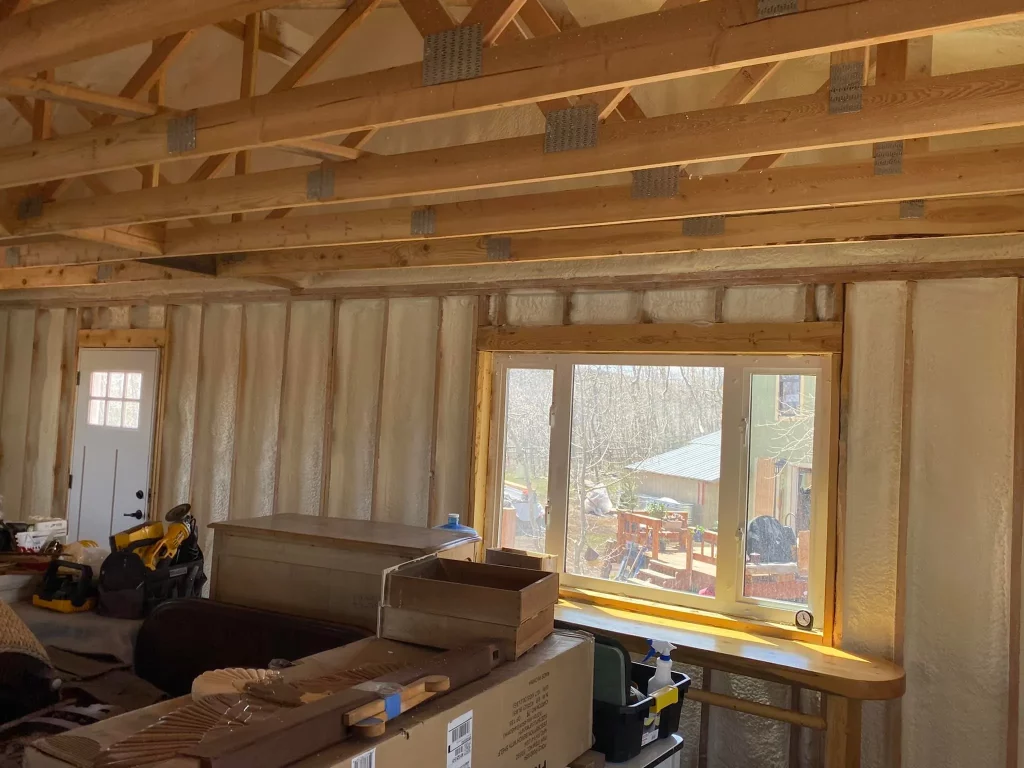
Rim joists and band joists: These areas can have numerous joints and penetrations where uncontrolled air movement occurs.
-
Exterior wall cavities: Higher R-value per inch can help when cavity depth limits insulation thickness.
-
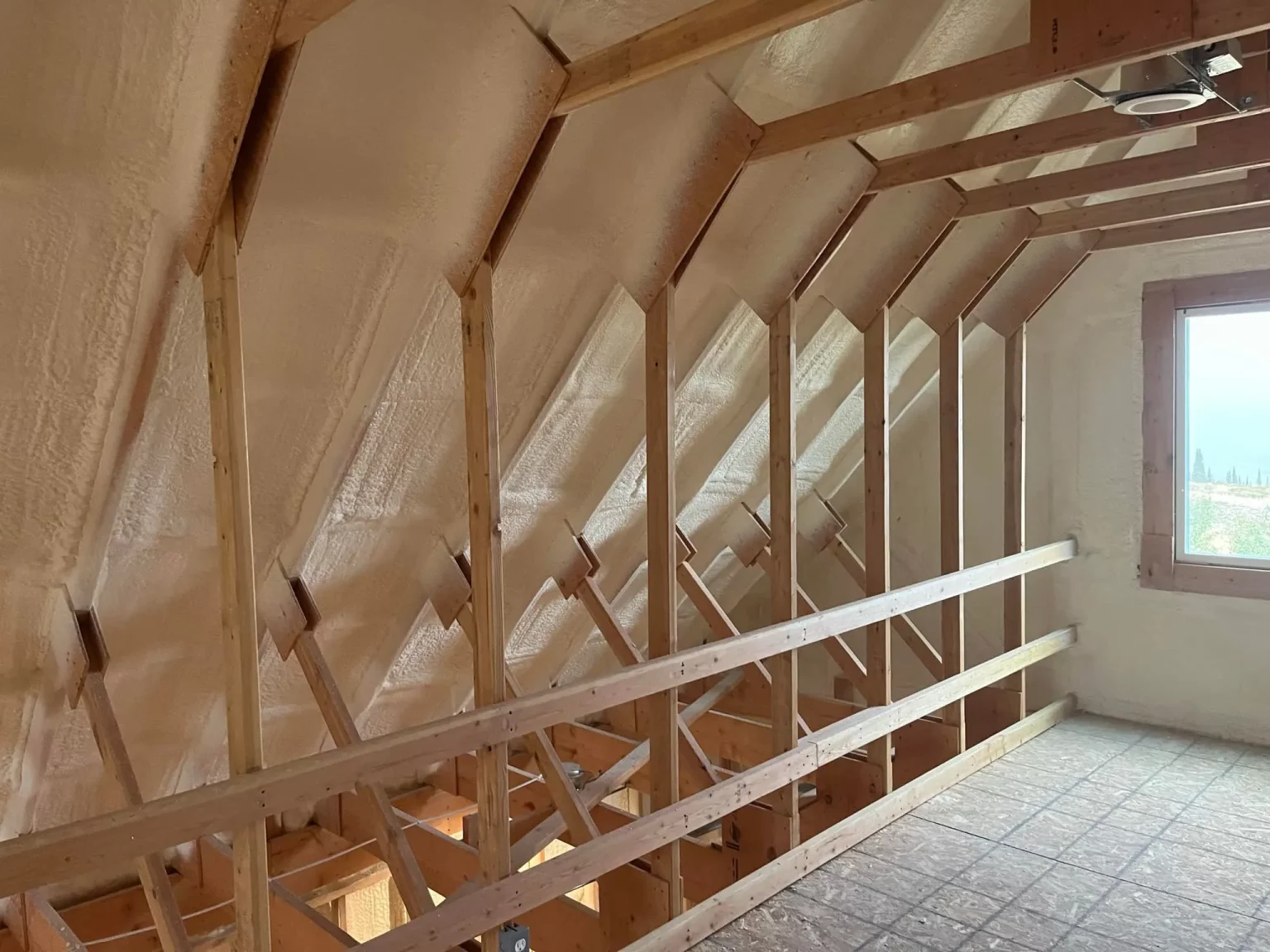
Roof rafters: Foam can insulate sloped roof assemblies where space and air sealing are important.
-
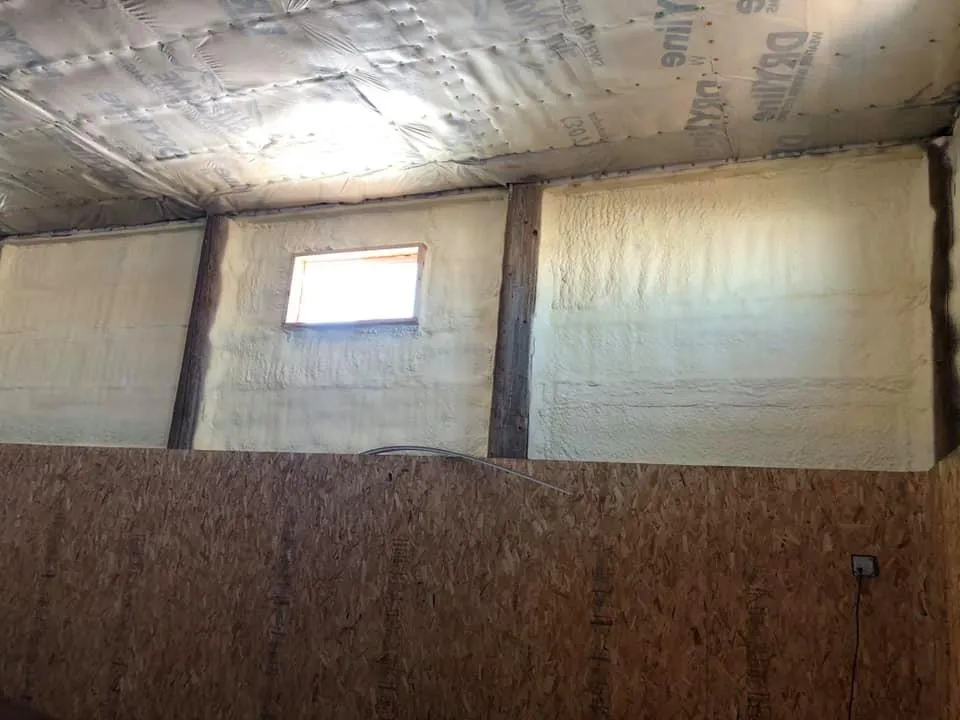
Foundation areas: Closed-cell foam may be appropriate for certain below-grade assemblies because of its moisture-resistant characteristics.
The right location depends on how the wall, roof, or foundation handles heat and moisture.
Closed-Cell vs. Open-Cell Foam
Both products can provide air-sealing benefits, but their thermal and moisture characteristics are different.
|
Feature |
Closed-Cell Foam |
Open-Cell Foam |
|
Typical R-value per inch |
About R-5.8 to R-6.9 |
About R-3.6 to R-4.5 |
|
Cell structure |
Mostly closed |
Mostly open |
|
Density |
Higher |
Lower |
|
Moisture behavior |
More moisture resistant |
More vapor permeable |
|
Best advantage |
High R-value in limited space |
Lower-density insulation for deeper cavities |
The Spray Polyurethane Foam Alliance lists closed-cell foam at roughly R-5.8 to R-6.9 per inch and open-cell foam at roughly R-3.6 to R-4.5 per inch. Actual product values should always be checked against the manufacturer's technical data.
Pros And Cons For Alpine Homes
Closed-cell foam offers clear advantages, but the higher R-value does not make it automatically better for every project.
Pros
-
High thermal resistance per inch helps when cavity space is limited.
-
Foam can reduce air leakage when installed correctly.
-
Its closed-cell structure provides greater resistance to moisture than open-cell foam.
-
It can work well in selected walls, roofs, rim joists, and foundation assemblies.
Cons
-
It generally costs more than open-cell foam.
-
Installation conditions must meet the product manufacturer's requirements.
-
Applying foam over an existing moisture problem can create building-envelope concerns.
-
Fire-protection requirements may apply depending on where the foam is installed.
Real Problems Homeowners May Run Into
A homeowner may notice a cold bedroom, drafty floor, uneven temperatures, or a chilly area above an attached garage. The problem is not always simply a lack of insulation.
Air can move through gaps around framing, penetrations, rim joists, and other parts of the envelope. Adding insulation without addressing the actual leakage path may leave the comfort problem unresolved.
Moisture is another concern. If a wall, roof deck, or foundation area has an active leak or condensation problem, that issue should be investigated before insulation is installed.
How Alpine Weather Affects Installation
Cold weather makes installation planning more important. Spray foam products have specific requirements for chemical temperature, substrate temperature, moisture, and application conditions.
Yes, SPF ko official EPA link ke sath link karna better hai. Sentence ko is tarah rakhein:
EPA guidance on spray polyurethane foam (SPF) recommends evaluating air and surface temperatures, humidity, surface moisture, and other site conditions before application. It also stresses following the manufacturer's application instructions. US EPA
This is especially relevant in Alpine, where cold conditions can affect the substrate and work area. A professional installer may need to control the work environment and confirm that surfaces are suitable before spraying.
Alpine also has specific building-code requirements. The Town of Alpine states that it has adopted the 2021 International Building Codes, while Wyoming has adopted newer statewide codes, so the applicable requirements should be confirmed for the specific project.
Understanding R-Value Per Inch
R-value describes resistance to heat flow. A higher number means greater resistance to heat transfer through the insulation material itself.
For example, using a product rated at R-6.5 per inch:
-
1 inch: approximately R-6.5
-
2 inches: approximately R-13
-
3 inches: approximately R-19.5
These are simple nominal calculations. They do not represent the R-value of the entire wall or roof because framing, windows, fasteners, thermal bridges, air leakage, and other materials also affect assembly performance.
DOE's residential building guidance lists closed-cell SPF at approximately R-6.1 per inch aged, showing why the exact product data sheet matters when calculating insulation performance.
How High Country Solutions Approaches Residential Foam
High Country Solutions evaluates the area before recommending closed-cell foam. The goal is to match the insulation to the assembly, available space, moisture conditions, and intended performance rather than selecting material based on R-value alone.
For residential projects, relevant services include closed-cell spray foam, residential spray foam insulation, air sealing, foundation insulation, exterior spray foam insulation, and thermal barrier coatings.
The installation plan should also account for product thickness, surface conditions, application temperatures, and any required protection after the foam is installed.
Conclusion
Closed-cell foam is a strong option for residential areas where a higher R-value per inch is useful. Its value comes from the combination of thermal resistance, air-sealing capability, and moisture resistance rather than the R-value number alone.
For Alpine homes, the better approach is to evaluate the complete assembly, identify air or moisture problems first, and then select the foam thickness and product that fit the application.
Contact High Country Solutions
Homeowners considering closed-cell foam or residential insulation in Alpine, WY can contact High Country Solutions to discuss the specific area, existing insulation, and installation requirements.
-
Phone: (307) 248-9063
-
Email: [email protected]
Frequently Asked Questions
Is R-6.5 Per Inch Good For Residential Insulation?
Yes. It is a relatively high R-value per inch, which can be useful when wall, roof, or foundation space is limited. The actual product rating should be confirmed before installation.
Does Two Inches Of Closed-Cell Foam Equal R-13?
If the specific product is rated R-6.5 per inch, two inches gives a nominal R-13. The complete building assembly will have a different effective R-value.
Is Closed-Cell Foam Better Than Open-Cell Foam?
Not in every application. Closed-cell offers higher R-value per inch and greater moisture resistance, while open-cell can make sense where deeper cavities and different moisture characteristics are appropriate.
Can Closed-Cell Foam Be Installed During Cold Weather?
It can be installed under suitable conditions, but the product and substrate must meet the manufacturer's temperature and moisture requirements. Professional installers should verify those conditions before spraying.
Author & Reviewer
Author: I’m Skeeter Aimone, owner of High Country Solutions in Alpine, Wyoming. I’ve led this locally owned spray foam insulation company since 2019. I focus on quality workmanship, proper installation practices, and building science to deliver reliable insulation solutions suited to Wyoming and eastern Idaho’s harsh winters, temperature swings, and high-altitude conditions. I’m committed to honest service and lasting results for residential and commercial properties.
Reviewer: Samuel Harris has worked across various roles in spray foam insulation over 11 years. His review focused on how businesses can better present their services to both new and returning clients.
