

Swiss Turn System Market Forecast to 2035: Technology and Flexibility Drive Demand

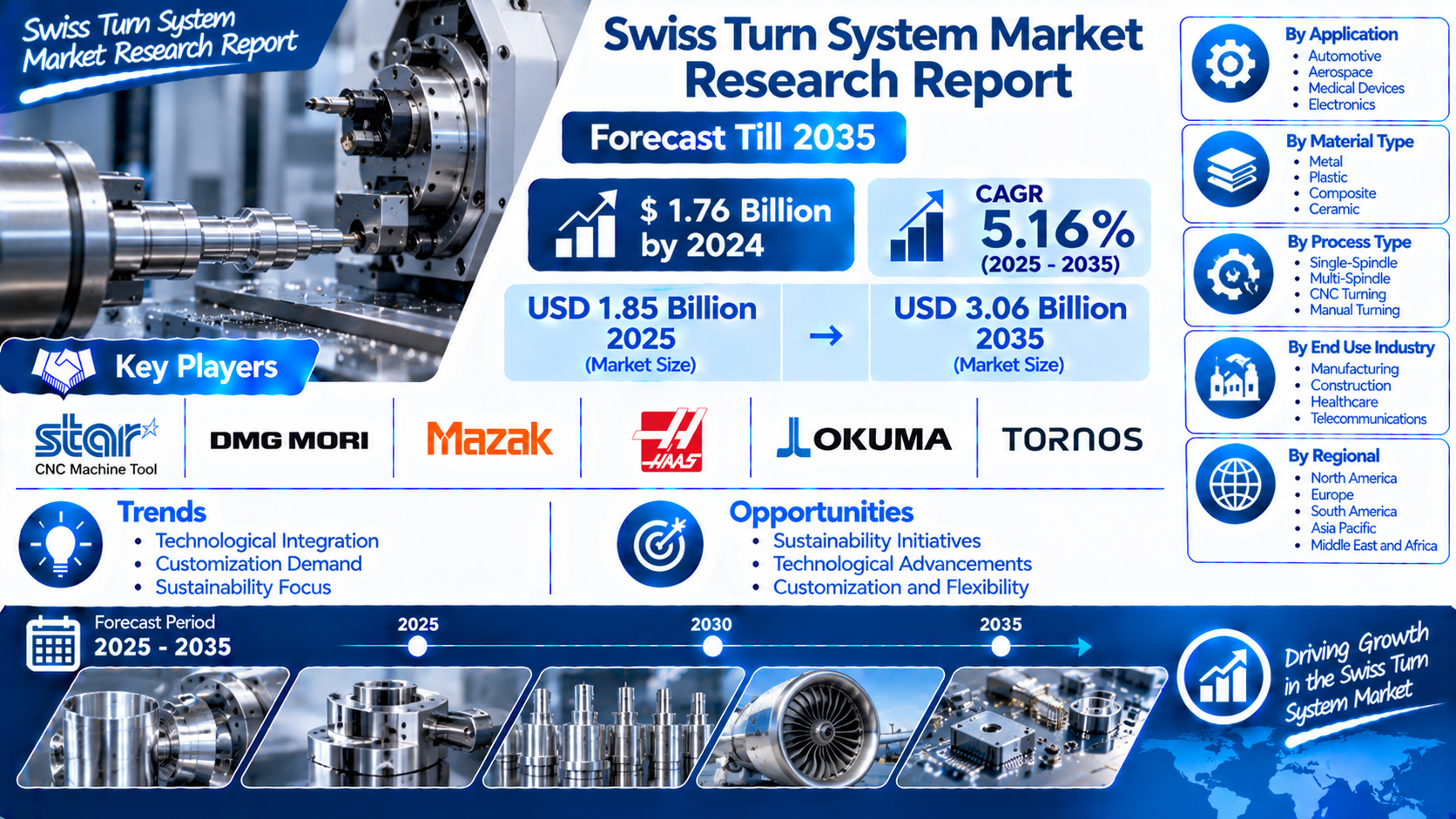
According to Market Research Future® (MRFR), the Swiss Turn System Market is expected to increase from USD 1.85 billion in 2025 to USD 3.06 billion by 2035, reflecting a CAGR of 5.16% over the 2025–2035 forecast period. The market's 2024 valuation stood at USD 1.76 billion. Growth is associated with the increasing need for precision machining in industries that rely on small, complex, and accurately manufactured components. Automotive, aerospace, medical devices, and electronics are among the applications supporting demand for Swiss turning equipment.
Swiss Turning and the Need for Component Accuracy
Swiss turning systems are used in precision machining, particularly when manufacturers need to produce slender parts or components with tight dimensional tolerances. In a typical Swiss-type lathe, bar material is supported close to the cutting area by a guide bushing. This support helps limit workpiece deflection during machining, making the system suitable for certain long, narrow, or intricate components.
The process is relevant to manufacturers that need repeatable results across production runs. Component accuracy can affect assembly, functionality, and the performance of finished products. Swiss turning systems can support these requirements through controlled cutting operations and machine configurations designed for precision work. The specific capabilities depend on the machine, tooling, material, and part design.
Automotive applications provide one source of demand. Vehicles contain numerous small machined components, and manufacturers must maintain consistency across parts used in different systems. Swiss turning can be used for suitable components where dimensional control and efficient production are important. The development of vehicle technologies and changes in component design may influence machining requirements, although the exact demand depends on the parts and manufacturing methods selected by automotive producers.
Aerospace applications can also require high-precision components. Parts used in aerospace equipment may be subject to demanding dimensional, material, and quality requirements. Swiss turning systems can serve selected machining needs, particularly where small component geometry is compatible with the process. Manufacturers must ensure that machining procedures, inspection, and traceability meet the relevant industry and customer specifications.
Medical Devices and Electronics Expand Application Scope
Medical device manufacturing is an important application area because instruments and equipment can contain small components with complex geometries. Precision-machined parts may be required for assemblies where fit, finish, and dimensional consistency matter. Swiss turning systems can manufacture suitable components, with material selection and production controls determined by the device's design and intended use.
Electronics manufacturing adds another source of demand. Connectors, pins, contacts, and other precision parts may require controlled dimensions and repeatable machining. As electronic products and equipment evolve, component designs and production specifications can change. Manufacturers may therefore seek machine tools that can handle specialized geometries and maintain consistent output.
The market also includes manufacturing, construction, healthcare, and telecommunications as end-use industries. Manufacturing covers a broad range of industrial requirements, while healthcare is closely associated with medical equipment and devices. Telecommunications equipment can require small precision components, and construction-related demand may arise from equipment and systems that incorporate machined parts. These categories show the potential reach of Swiss turning beyond a single product sector.
Materials and Process Configurations
The report identifies metal, plastic, composite, and ceramic as material types. Metals are important to Swiss turning because many precision components are produced from metal bar stock. Different grades offer different combinations of strength, machinability, corrosion resistance, and other properties. Plastics may be selected where low weight, electrical insulation, or specific chemical characteristics are needed. Composite and ceramic materials can require specialized machining approaches because their behavior during cutting differs from that of conventional metals.
Material choice must be aligned with the intended function of the component. A part designed for an automotive or aerospace assembly may have different mechanical requirements from a component used in medical equipment or telecommunications hardware. The material's machinability also affects tooling selection, cutting parameters, cycle time, and finished surface characteristics.
Process segmentation includes single-spindle, multi-spindle, CNC turning, and manual turning. Single-spindle systems are used for precision operations centered on one spindle, while multi-spindle configurations can support higher-output production for suitable component families. CNC turning provides programmed control of machining movements and operations, supporting repeatability and complex part production. Manual turning relies on direct operator control and is relevant to selected tasks where its capabilities and production economics are appropriate.
These process categories do not represent identical or mutually exclusive machine characteristics in every context. CNC control, for example, can be incorporated into different machine configurations. Buyers assess machine architecture and control systems according to their production objectives, part complexity, and required output.
Customization, Technology, and Sustainability
Technological integration is influencing equipment design and factory operations. Advanced CNC controls, automation, digital monitoring, and improved software can support more efficient production management. Connectivity between machines and manufacturing systems may help operators monitor performance and coordinate machining activities. These capabilities can also assist with repeatability and process optimization when implemented effectively.
Customization and flexibility are important because precision manufacturers often produce components with distinct geometries, material specifications, and production volumes. Equipment suppliers may offer different machine configurations, tooling options, automation features, and support services to meet these requirements. A flexible machine setup can help manufacturers respond to product changes, but the benefits depend on machine capability, operator expertise, and the economics of the production process.
Sustainability initiatives are becoming part of manufacturing decisions. Machining processes use electricity, cutting fluids, tooling, and raw materials, while producing chips and other waste. Manufacturers may seek to reduce scrap, improve cutting efficiency, manage fluids responsibly, and limit unnecessary energy consumption. More effective process planning and machine utilization can support resource efficiency. The actual environmental impact depends on material choice, machine operation, maintenance, and waste-management practices.
Regional Market and Competitive Environment
The report examines North America, Europe, South America, Asia Pacific, and the Middle East and Africa. Regional market conditions are influenced by manufacturing investment and the presence of automotive, aerospace, medical device, electronics, and telecommunications industries. The scale of precision engineering activity and the availability of skilled operators can also affect the adoption of Swiss turning equipment.
The competitive landscape includes Star CNC Machine Tool, DMG Mori, Mazak, Haas Automation, Okuma, and Tornos. These companies are identified as key players in the report. Competition among machine tool suppliers can involve precision, productivity, machine reliability, automation options, customization, service networks, and technical assistance. Buyers may also consider training, spare parts availability, maintenance requirements, and the ability to integrate new machines into existing facilities.
Market Opportunities and Forecast
The market's opportunities include sustainability initiatives, technological advancements, and customization and flexibility. These factors are connected to manufacturers' efforts to improve production performance while responding to changing component requirements. Advanced machine features may support more controlled operations, while flexible configurations can help address specialized production needs. Sustainability-related improvements may encourage better use of energy and materials.
With a projected value of USD 3.06 billion in 2035, the Swiss turn system market is expected to expand at a steady pace over the forecast period. Automotive, aerospace, medical device, and electronics manufacturers will remain relevant customer groups because of their demand for precision components. Suppliers that provide capable equipment, application-specific configurations, and reliable technical support may be positioned to benefit from continued investment in precision manufacturing.
