

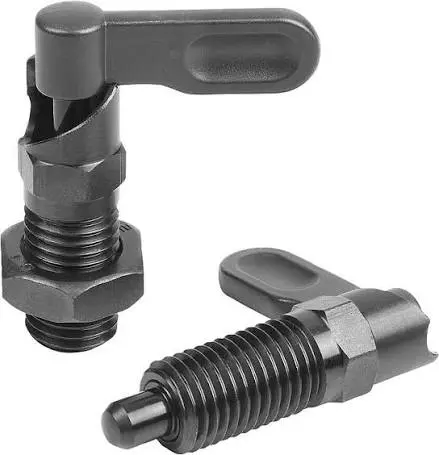

Indexing plungers are essential mechanical components used to position, locate, and secure moving parts in machinery and industrial equipment. They provide a simple and reliable way to establish repeatable positions during manufacturing, assembly, and equipment adjustment. By using a spring-loaded pin that engages with a matching hole, indexing plungers help operators achieve accurate positioning while improving convenience and operational efficiency. Manufacturers can choose from different designs, materials, and operating styles to meet the requirements of their applications.
What Are Indexing Plungers?
An indexing plunger is a mechanical positioning device that generally consists of a threaded body, a spring-loaded plunger pin, and an operating feature such as a knob, ring, or handle.
The spring pushes the pin outward so it can engage with a corresponding hole or locating point. When an operator pulls or lifts the knob, the pin retracts and allows the connected component to move. Releasing the control allows the spring to return the pin to its engaged position.
This straightforward mechanism makes indexing plungers useful wherever machinery requires repeatable positioning, adjustment, or temporary locking.
Common Applications of Indexing Plungers
Indexing plungers are used across many industries because they make positioning tasks easier and more consistent.
1. Industrial Machinery
Manufacturing equipment often includes adjustable components that need to move between predetermined positions. Indexing plungers help secure these parts during operation and make adjustments easier for machine operators.
2. Workholding and Assembly Equipment
Fixtures and workholding systems require accurate positioning to maintain consistent production results. Indexing plungers can help locate adjustable plates, supports, and other machine components.
3. Packaging Machinery
Packaging equipment frequently needs adjustments for different product dimensions and production requirements. Spring-loaded positioning components can help operators change machine settings and secure movable sections.
4. Automation Systems
Automated equipment may include adjustable guards, guides, platforms, and mechanical assemblies. Indexing plungers provide a practical positioning solution for components that require repeatable movement.
5. Adjustable Industrial Fixtures
Industrial fixtures often need to support different workpiece sizes or configurations. An indexing plunger allows an operator to release, reposition, and secure selected components without complicated locking procedures.
Different Types of Indexing Plungers
Selecting the right design is important because different machines require different positioning and operating methods.
Threaded Indexing Plungers
Threaded indexing plungers are among the most common designs. Their threaded bodies allow installation into compatible mounting holes. They are suitable for many general-purpose mechanical and industrial applications.
Indexing Plungers with Rest Position
Some models include a feature that keeps the plunger retracted after the operator pulls and turns the knob. This allows a machine component to move freely without requiring the operator to hold the knob continuously.
Lockable Indexing Plungers
Lockable designs provide additional control over the plunger position. Depending on the model, safety features can help prevent unintended pin movement during operation.
Ring-Operated Indexing Plungers
Ring-operated versions allow users to retract the pin by pulling a lifting ring. They are useful in applications where a traditional knob may not provide the most convenient operating arrangement.
Stainless Steel Indexing Plungers
Stainless steel models are suitable for applications where corrosion resistance and material compatibility are important considerations. They are commonly considered for machinery used in food processing, pharmaceutical production, and other demanding environments.
Choosing the Right Material
Material selection has a direct impact on the performance and service life of an indexing plunger.
Steel: Steel components are commonly used in industrial machinery where strength and dependable mechanical performance are important.
Stainless Steel: Stainless steel offers corrosion resistance and is a practical option for equipment exposed to moisture or frequent cleaning.
SUPER-technopolymer: Certain indexing plungers use SUPER-technopolymer bodies. This material combines low weight with mechanical resistance and resistance to corrosion and repeated washing cycles. It can be useful in food and pharmaceutical applications, depending on the selected product and operating conditions.
Manufacturers should consider the surrounding environment, expected loads, cleaning procedures, and equipment requirements before choosing a material.
Important Factors When Selecting Indexing Plungers
Choosing the correct indexing plunger involves more than selecting a component that fits a mounting hole. Several technical details should be evaluated.
-
Thread size: Confirm that the threaded body matches the mounting requirements of the equipment.
-
Pin diameter: Select a plunger diameter that works with the matching locating hole.
-
Engagement depth: Make sure the pin can engage sufficiently to provide the required positioning.
-
Operating style: Decide whether a knob, lifting ring, or another control arrangement is most suitable.
-
Rest position: Determine whether the application needs the pin to remain retracted during adjustment.
-
Material: Consider corrosion resistance, mechanical strength, and cleaning conditions.
-
Safety features: Evaluate whether a locking or safety mechanism is needed to reduce accidental movement.
Checking these details helps prevent installation problems and supports reliable machine operation.
Benefits of Using Quality Indexing Plungers
Quality indexing plungers offer several practical advantages for industrial equipment manufacturers and machine operators.
Repeatable positioning: Spring-loaded pins engage with defined locating points, helping users return components to consistent positions.
Convenient adjustments: Operators can retract the pin to reposition equipment components quickly.
Simple installation: Threaded designs can be installed in compatible mounting holes without complex assembly arrangements.
Design flexibility: Different materials, operating styles, and configurations help manufacturers select components for specific applications.
Improved workflow: Reliable positioning mechanisms can make repeated adjustments more convenient and help reduce unnecessary handling.
The right component can support equipment functionality while making routine machine adjustments easier.
Why Consider Elesa Canada for Indexing Plungers?
When selecting industrial positioning components, it is important to work with a supplier that offers a broad product range and useful technical information. Elesa Canada provides access to indexing plungers in different designs, materials, and configurations for a variety of industrial requirements.
The ELESA product range includes options with threaded bodies, operating knobs, lifting rings, and rest-position features. Available materials include steel, stainless steel, and SUPER-technopolymer. Certain models also incorporate safety devices designed to help prevent accidental movement of the plunger pin.
Product families such as PMT.100, GN 607, GN 417, and GN 817.8 illustrate the range of available configurations. Depending on the model, users can select different operating arrangements and material specifications to suit their machinery.
Reviewing the technical details before purchasing helps ensure that the selected indexing plunger matches the equipment's mounting dimensions, positioning requirements, and operating environment.
Conclusion
Indexing plungers are practical components for machinery that requires accurate, repeatable, and convenient positioning. Their spring-loaded operation allows users to secure adjustable parts while making routine changes easier. With different body materials, pin designs, operating styles, and safety options available, manufacturers can find solutions for a wide range of industrial applications.
By considering thread size, pin dimensions, material compatibility, and operating requirements, businesses can select indexing plungers that support reliable equipment performance. Exploring the available range from Elesa Canada is a useful starting point for finding suitable positioning components for industrial machinery.
