

Geogrid Industry Analysis: Materials, Manufacturing Processes, and Infrastructure Applications

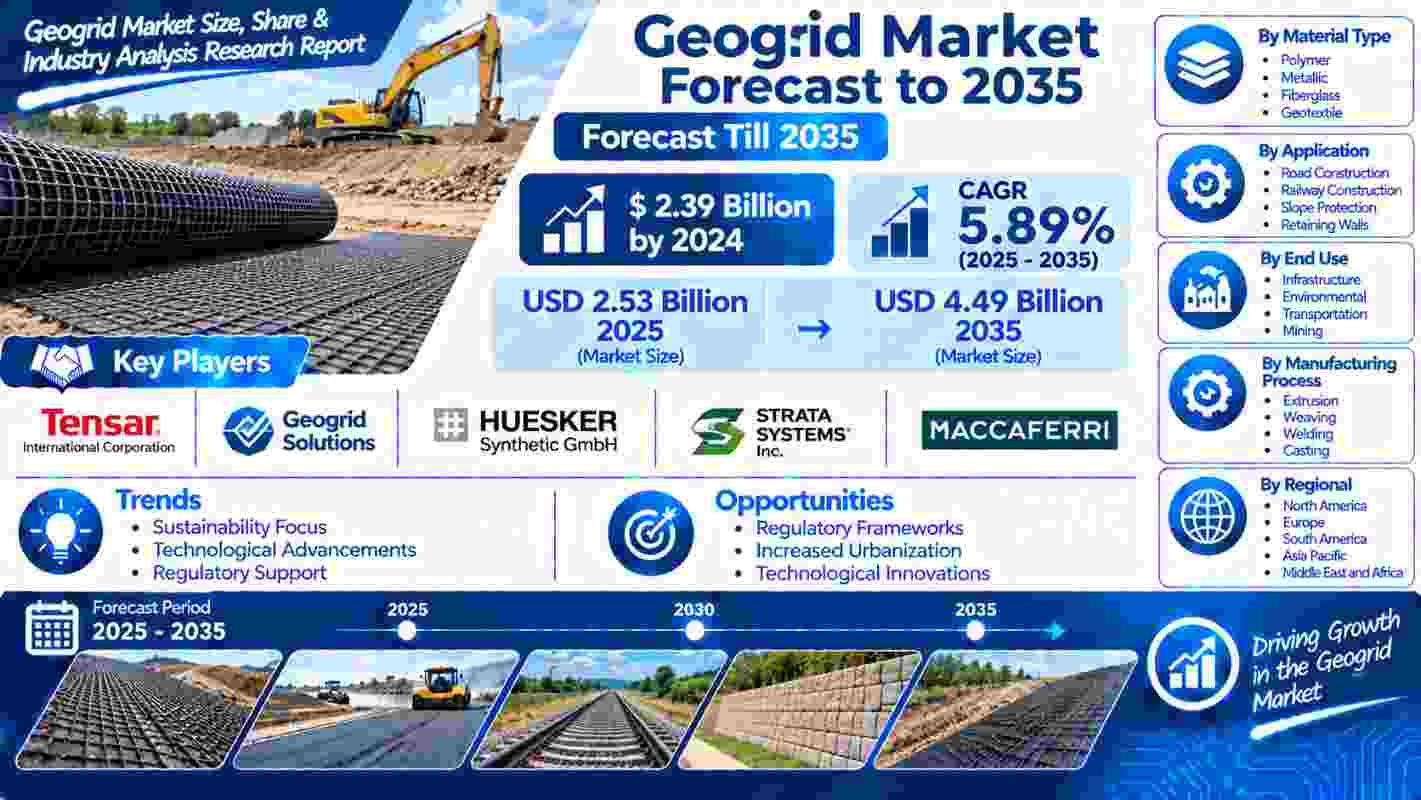
According to Market Research Future® (MRFR), the Geogrid Market was valued at USD 2.39 billion in 2024 and is projected to increase from USD 2.53 billion in 2025 to USD 4.49 billion by 2035. The market is expected to register a compound annual growth rate (CAGR) of 5.89% during the 2025–2035 forecast period. Geogrids are geosynthetic reinforcement materials used to improve the stability and load-bearing performance of soil and aggregate structures. Their role in road and railway construction, slope protection, retaining walls, and other infrastructure applications supports demand as urbanization and infrastructure development create requirements for durable ground-engineering solutions. Sustainability priorities, technological advancements, and regulatory support are also influencing market development.
Geogrid Market Overview
Geogrids are grid-like materials incorporated into soil or aggregate systems to provide reinforcement. Their open structure allows interaction with surrounding materials, helping distribute loads and improve the performance of engineered structures. They are used in projects where soil stability, reinforcement, and resistance to deformation are important considerations.
The market serves infrastructure developers, construction contractors, transportation authorities, mining operators, and organizations involved in environmental projects. The selection of a geogrid depends on several factors, including soil conditions, loading requirements, installation methods, exposure conditions, and project design specifications. Product performance is therefore closely connected to engineering assessment and the characteristics of the construction site.
Growing urbanization can increase the need for roads, railways, retaining structures, and supporting infrastructure. These projects often require ground-improvement and reinforcement measures to address challenging soil conditions or improve the performance of constructed systems. Geogrids form part of the range of materials available to engineers for these purposes.
Material Types and Product Characteristics
The market segmentation identifies polymer, metallic, fiberglass, and geotextile materials. Polymer geogrids are used in a range of civil engineering applications because polymer-based products can be designed with different tensile and durability characteristics. Their suitability depends on the polymer composition, manufacturing process, structural design, and conditions at the installation site.
Metallic reinforcement products offer a different material approach and may be considered where project specifications require particular strength characteristics. Fiberglass-based products are another category, with their application determined by design requirements and material properties. The report also includes geotextile in its material-type segmentation. Geotextiles and geogrids are distinct geosynthetic product categories with different structures and functions, so the classification should be understood in the context of the report's segmentation rather than as an indication that the terms are interchangeable.
Material selection is an important engineering decision. Factors such as tensile strength, durability, chemical exposure, installation conditions, and compatibility with surrounding soil influence product suitability. Contractors and designers need to evaluate these requirements before specifying a reinforcement solution.
Applications in Construction and Ground Engineering
Road construction is a major application category for geogrids. Reinforcement can help improve the performance of road structures by supporting load distribution and limiting deformation in suitable pavement and subgrade systems. The effectiveness of a product depends on soil characteristics, pavement design, installation quality, and traffic conditions.
Railway construction provides another area of demand. Rail infrastructure requires stable supporting layers capable of handling repeated loading and maintaining track geometry. Geogrids may be incorporated into engineered systems where reinforcement is required to address ground conditions or improve the performance of track-supporting structures.
Slope protection and retaining walls are also important applications. Geogrids can be used in reinforced soil structures to improve stability and support engineered slopes or retaining systems. Their use depends on factors such as slope geometry, soil properties, drainage, loading, and the design of the overall structure. Product specifications must be selected according to the project's geotechnical requirements rather than applied uniformly across sites.
End-Use Industries and Manufacturing Processes
The market's end-use categories include infrastructure, environmental, transportation, and mining. Infrastructure projects may use geogrids in roads, retaining structures, and other civil engineering works. Transportation applications include systems associated with roadways and railways, where reinforcement can contribute to the stability of supporting layers. Mining projects may require ground reinforcement and stabilization solutions, depending on site conditions and operational needs.
Environmental applications can involve engineered systems for erosion control, slope stabilization, and related ground-management requirements. The precise role of a geogrid varies according to the design and environmental conditions of each project.
Manufacturing processes covered in the market include extrusion, weaving, welding, and casting. Extrusion is used to form polymer-based structures through controlled material processing. Weaving and welding can create grid structures through different methods of joining or arranging reinforcing elements. Casting represents another manufacturing category identified in the report. The choice of process influences product structure, consistency, and performance characteristics. Manufacturers must maintain quality control so that products meet the specifications required for their intended applications.
Market Trends and Growth Opportunities
Sustainability focus is shaping demand for construction materials that can support durable infrastructure and efficient use of resources. Geogrids may contribute to engineered solutions that improve the performance of soil and aggregate systems, potentially reducing the need for certain conventional construction materials in suitable designs. Actual environmental benefits depend on project design, material production, service life, and end-of-life management.
Technological advancements are creating opportunities to improve product design, manufacturing consistency, and installation practices. Developments in material formulation and grid structures can help manufacturers address different engineering requirements. Improved testing and quality-control methods also support confidence in product performance.
Regulatory support is another market trend. Infrastructure projects are governed by technical specifications, construction standards, and safety requirements that influence the selection and use of reinforcement materials. Regulatory frameworks can encourage the adoption of tested products and consistent engineering practices. Increased urbanization is an important opportunity because expanding urban areas require transportation networks, public infrastructure, and supporting construction systems.
Regional Market Outlook
The market is segmented across North America, Europe, South America, Asia Pacific, and the Middle East and Africa. Regional demand is influenced by infrastructure investment, transportation development, urban expansion, mining activity, and construction standards. North America and Europe have established civil engineering markets where project specifications and technical requirements influence product selection.
Asia Pacific offers opportunities associated with urbanization, transportation networks, and infrastructure development. South America and the Middle East and Africa also represent areas of potential demand as governments and private-sector developers invest in infrastructure and resource-related projects. Market growth in each region will depend on funding availability, construction activity, regulatory conditions, and the adoption of geosynthetic reinforcement solutions.
Competitive Landscape and Future Outlook
Key players identified in the market include Tensar International Corporation, Geogrid Solutions, Huesker Synthetic GmbH, Strata Systems Inc., and Maccaferri. Competition is influenced by product performance, technical support, manufacturing capabilities, distribution networks, and the ability to meet project-specific requirements. Suppliers may differentiate their offerings through material innovation, quality assurance, and solutions designed for particular ground-engineering applications.
The Geogrid Market is projected to grow from USD 2.53 billion in 2025 to USD 4.49 billion by 2035, at a CAGR of 5.89%. Increased urbanization, regulatory frameworks, and technological innovations are identified as important opportunities. The market's long-term development will depend on infrastructure investment and the ability of manufacturers to deliver reliable reinforcement products suited to diverse soil conditions and engineering specifications.

