

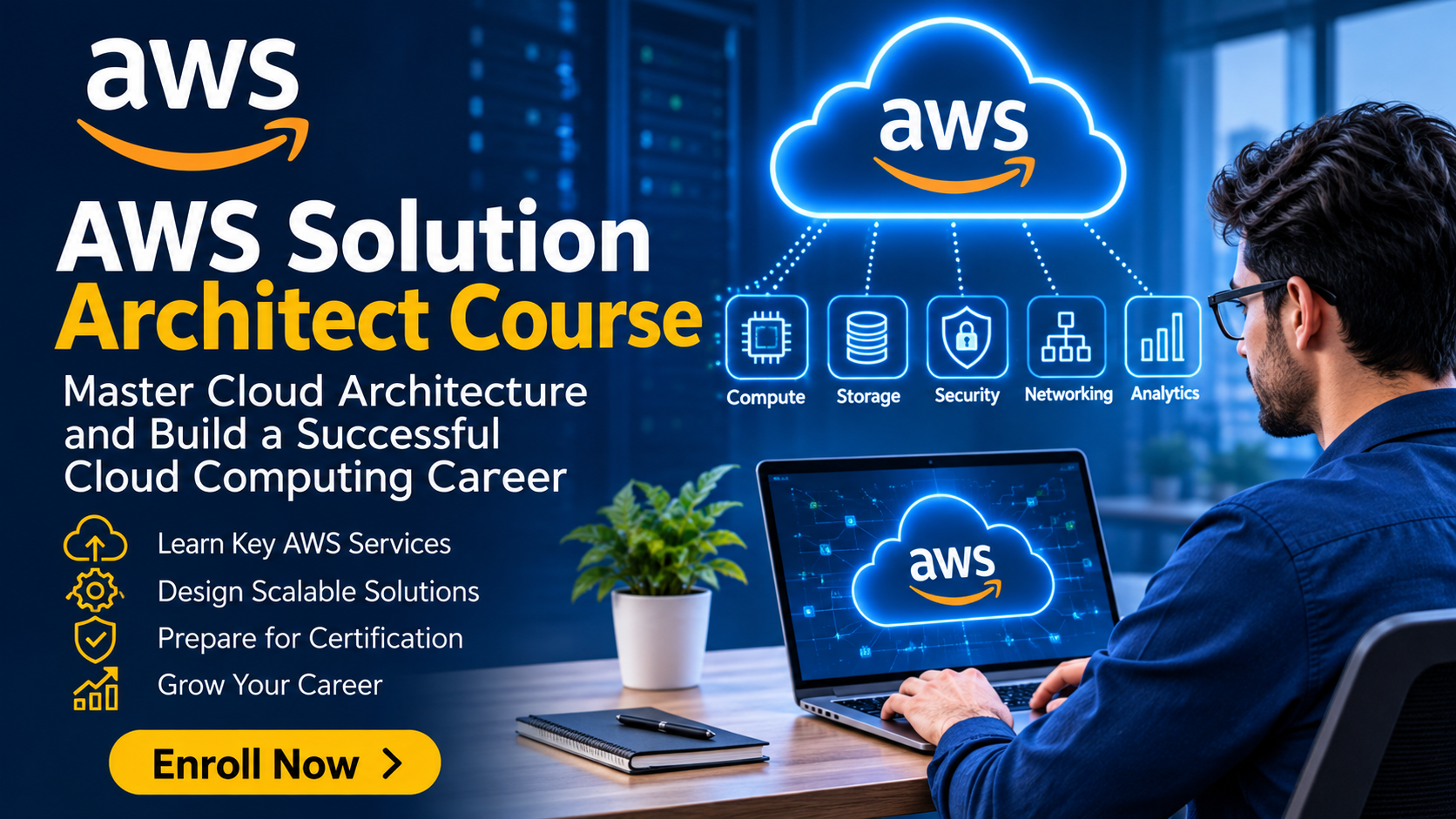
AWS Solution Architect Course: Master Cloud Architecture and Build a Successful Cloud Computing Career
Cloud computing has become an essential part of modern business operations. Organizations across industries are moving their applications, databases, and IT infrastructure to cloud platforms to improve scalability, flexibility, security, and cost efficiency. Among the available cloud service providers, Amazon Web Services (AWS) has established itself as a leading platform, creating significant career opportunities for professionals with cloud computing skills.
For individuals interested in developing expertise in cloud technologies, enrolling in an AWS Solution Architect Course can be a valuable step toward building a successful career. It provides practical knowledge of cloud architecture, infrastructure management, application deployment, and security principles. Whether you are a beginner or an experienced IT professional, learning AWS can help you understand modern cloud environments and prepare for industry-relevant roles.
Understanding the Role of an AWS Solutions Architect
An AWS Solutions Architect is responsible for designing, developing, and managing cloud-based solutions that meet business requirements. These professionals work with different AWS services to create reliable, secure, scalable, and cost-effective cloud infrastructures.
Their responsibilities generally include understanding business needs, selecting appropriate AWS services, designing cloud architecture, managing security configurations, and improving system performance.
Some common responsibilities of an AWS Solutions Architect include:
-
Designing scalable cloud infrastructure for business applications.
-
Selecting suitable AWS services according to project requirements.
-
Implementing cloud security and access management policies.
-
Monitoring cloud resources and optimizing performance.
-
Managing backup, recovery, and disaster recovery solutions.
-
Helping organizations reduce infrastructure costs.
As more companies adopt cloud-based technologies, skilled AWS professionals are becoming increasingly valuable in the IT industry.
Why Choose an AWS Solution Architect Course?
Learning cloud computing requires a combination of theoretical knowledge and practical experience. A structured AWS Solution Architect Course helps learners understand the fundamental concepts of AWS while developing the technical skills required to design cloud solutions.
Here are some important reasons to consider this learning path.
1. Growing Demand for Cloud Computing Professionals
Businesses are increasingly adopting cloud infrastructure to manage their operations efficiently. From startups to multinational organizations, companies require professionals who understand cloud architecture and can manage complex technical environments.
AWS knowledge can help candidates explore opportunities in cloud computing, IT infrastructure, software development, and enterprise technology management.
2. Develop Practical Cloud Architecture Skills
A good training program introduces learners to important AWS services and explains how these services work together.
Students can learn how to configure cloud environments, deploy applications, manage storage, create virtual networks, and monitor cloud resources.
Practical exercises and real-world projects help learners understand how cloud solutions are designed and implemented in professional environments.
3. Prepare for AWS Certification
AWS certifications help professionals demonstrate their understanding of cloud technologies and architectural best practices.
The AWS Certified Solutions Architect – Associate certification is a popular option for individuals who want to validate their ability to design secure, resilient, high-performing, and cost-optimized cloud solutions.
Structured learning and regular practice can help candidates prepare for the certification examination.
4. Explore Different Career Opportunities
AWS skills can open doors to several technical career paths. Depending on your experience and specialization, you may explore positions such as:
-
AWS Solutions Architect
-
Cloud Engineer
-
Cloud Administrator
-
DevOps Engineer
-
Cloud Infrastructure Engineer
-
Cloud Consultant
-
Systems Engineer
These roles involve different responsibilities, but they share a common requirement: understanding cloud infrastructure and its practical applications.
Important Topics Covered in AWS Solutions Architect Training
A comprehensive AWS Solutions Architect Training program generally covers the core services, tools, and concepts required to work with AWS cloud environments.
Understanding these topics can help learners develop a strong technical foundation.
1. Introduction to Cloud Computing
The learning journey usually begins with an introduction to cloud computing. Students explore cloud service models, including Infrastructure as a Service (IaaS), Platform as a Service (PaaS), and Software as a Service (SaaS).
They also learn about public, private, and hybrid cloud environments, along with the advantages of cloud adoption.
2. Amazon EC2 and Compute Services
Amazon Elastic Compute Cloud (EC2) allows users to run virtual servers in the AWS environment.
Learners understand how to launch EC2 instances, select instance types, configure security groups, and manage computing resources.
Other compute services, such as AWS Lambda and Amazon Elastic Container Service (ECS), may also be introduced to explain serverless computing and container-based applications.
3. AWS Storage Services
Storage is an important part of cloud architecture. AWS provides different storage solutions for various business requirements.
Important services include:
-
Amazon S3 for object storage.
-
Amazon EBS for block storage.
-
Amazon EFS for scalable file storage.
-
Amazon S3 Glacier storage classes for long-term archival.
Understanding these services helps learners choose suitable storage solutions based on accessibility, performance, durability, and cost.
4. Networking and Content Delivery
Networking knowledge is essential for designing secure and reliable cloud infrastructure.
During AWS training, learners explore Amazon Virtual Private Cloud (VPC), subnets, route tables, internet gateways, NAT gateways, and security groups.
They may also study Amazon CloudFront, which helps deliver content efficiently through a global content delivery network.
5. Identity and Access Management
Cloud security is a major responsibility of every solutions architect. AWS Identity and Access Management (IAM) helps organizations control access to cloud resources.
Students learn about users, groups, roles, policies, and permissions. They also understand the importance of applying the principle of least privilege to reduce unnecessary access.
6. Database Management
AWS offers multiple database services to support different application requirements.
Some commonly covered services include Amazon RDS, Amazon DynamoDB, and Amazon Aurora.
Learners understand the differences between relational and NoSQL databases and how to select suitable database solutions for different workloads.
7. Monitoring and Cost Optimization
Managing cloud resources efficiently requires continuous monitoring and cost control.
AWS CloudWatch helps monitor applications and infrastructure, while AWS CloudTrail records account activity for auditing and security purposes.
Learners also explore pricing models, resource optimization, and cost-management practices.
How AWS Solutions Architect Training Supports Career Growth
Choosing professional AWS Solutions Architect Training can help learners develop practical skills that are relevant to modern IT environments.
One major advantage is the opportunity to work on hands-on projects. Instead of learning concepts only through theoretical explanations, students can practice deploying applications, configuring cloud networks, managing storage, and securing infrastructure.
Another advantage is improved problem-solving ability. Solutions architects must evaluate different technical options before selecting an appropriate architecture. Training helps learners understand how to make decisions based on performance, security, availability, and budget requirements.
Additionally, AWS knowledge can complement existing skills in networking, Linux administration, programming, database management, and DevOps.
However, completing a course alone does not guarantee employment. Practical experience, technical understanding, certification preparation, and continuous learning are equally important for long-term career development.
Tips for Becoming a Successful AWS Solutions Architect
If you want to build a career in cloud architecture, consider following these practical steps:
Start with cloud fundamentals: Understand virtualization, networking, storage, databases, and basic security concepts before moving to advanced AWS services.
Practice regularly: Use the AWS Free Tier where eligible and review current pricing and usage limits before creating resources. Avoid leaving unnecessary services running.
Work on real-world projects: Build sample applications, configure secure networks, and experiment with backup and recovery strategies.
Prepare for certification: Study the official AWS exam guide, practice sample questions, and understand architectural scenarios rather than memorizing answers.
Stay updated: AWS regularly introduces new services and features. Follow official documentation and continue improving your technical knowledge.
Conclusion
Cloud computing is transforming the way organizations build, deploy, and manage technology solutions. As businesses continue adopting AWS services, professionals with cloud architecture knowledge can explore promising opportunities in the IT industry.
An AWS Solution Architect Course provides a structured learning path for understanding cloud infrastructure, security, networking, storage, databases, and architectural best practices. Combining this knowledge with practical experience and certification preparation can help learners develop the skills needed for professional growth.
Whether you are starting your IT journey or looking to upgrade your existing technical expertise, investing time in AWS learning can be a meaningful step toward a career in cloud computing.
Frequently Asked Questions (FAQs)
1. What is an AWS Solution Architect Course?
An AWS Solution Architect Course is a training program that teaches learners how to design, deploy, and manage cloud-based solutions using Amazon Web Services. It generally covers computing, networking, storage, databases, security, and cloud architecture.
2. Who can enroll in AWS Solutions Architect Training?
Beginners, IT professionals, software developers, system administrators, networking professionals, and cloud computing enthusiasts can enroll. Basic knowledge of computers, networking, and IT concepts can be helpful.
3. Is AWS certification necessary to become a Solutions Architect?
AWS certification is not mandatory for every solutions architect position, but it can help validate your cloud knowledge and demonstrate your understanding of AWS architectural practices to potential employers.
4. What career opportunities are available after AWS training?
After completing AWS training and developing practical skills, candidates can explore roles such as AWS Solutions Architect, Cloud Engineer, DevOps Engineer, Cloud Administrator, and Cloud Consultant.
5. How can I prepare for the AWS Solutions Architect certification?
Start by studying AWS fundamentals, reviewing the official certification exam guide, practicing with AWS services, building hands-on projects, and attempting practice examinations. Regular preparation and practical experience can improve your confidence.
