

India Non-Woven Fabric Market Forecast to 2035: Emerging Demand and Industry Developments

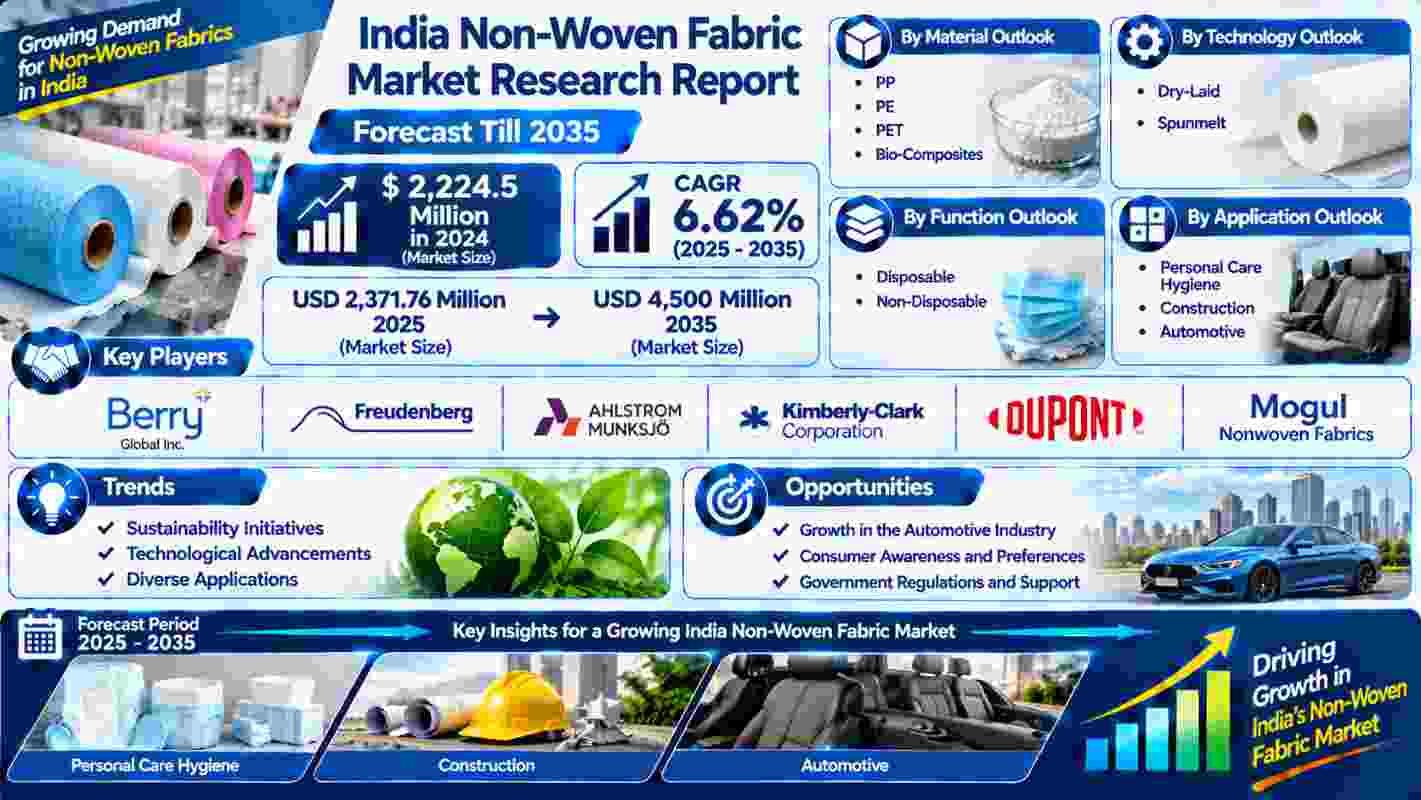
India's demand for engineered textile materials is developing alongside changes in consumer requirements, industrial production, and building practices. Non-woven fabrics are part of this shift because they can be designed for particular functions without relying on traditional weaving or knitting. According to Market Research Future® (MRFR), the India Non-Woven Fabric Market was valued at $2,224.5 million in 2024 and is estimated at $2,371.76 million in 2025. The market is forecast to reach $4,500 million by 2035, reflecting a CAGR of 6.62% from 2025 to 2035. Demand from personal care and hygiene, construction, and automotive applications is expected to contribute to this expansion.
An Engineered Materials Market with Diverse Uses
Non-woven fabrics are manufactured by assembling fibers into a web and bonding or interlocking them to create a functional material. The process can involve mechanical entanglement, chemical bonding, thermal bonding, or combinations of different techniques. Unlike conventional woven fabrics, non-wovens do not depend on an interlaced yarn structure. This gives producers flexibility to adjust thickness, weight, strength, absorbency, softness, and other characteristics according to the intended use.
The resulting materials serve both short-life consumer products and applications requiring longer service periods. Their versatility is one of the main reasons the market reaches across several industries. Manufacturers can select different fibers and production technologies to develop materials for hygiene products, building components, vehicle interiors, filtration, and other uses.
The Indian market's development is closely connected to the ability of producers to serve these varied requirements. Customers may prioritize softness and liquid handling in hygiene products, mechanical performance in construction materials, or acoustic and weight-related properties in automotive components. This creates opportunities for specialized grades rather than a single standardized product serving every sector.
Personal Care and Hygiene Demand
Personal care and hygiene is a major application area for non-woven fabrics. Products such as diapers, wipes, and feminine hygiene products use non-woven layers to provide functions that can include softness, liquid distribution, absorbency, and surface protection. Material requirements differ across product designs, and manufacturers may combine multiple layers to achieve the desired performance.
Consumer awareness and preferences are identified as an opportunity for the market. Buyers increasingly evaluate hygiene products through factors such as comfort, convenience, quality, and functionality. These expectations can influence the material specifications used by product manufacturers. Consistency is especially important because variations in fiber distribution, bonding, or web structure can affect the performance of finished goods.
The disposable function segment is closely associated with this application area. Disposable non-wovens are designed for limited use and are manufactured with attention to performance, production efficiency, and cost. However, the environmental implications of disposable products depend on material composition, manufacturing inputs, collection systems, and disposal conditions.
Construction and Automotive Applications
Construction offers a different set of requirements. Non-woven fabrics can be used in geotextiles, roofing-related materials, insulation systems, and filtration applications. In these settings, factors such as tensile strength, permeability, dimensional stability, and resistance to environmental exposure influence product selection. The material must be matched to the construction task and the conditions it will encounter.
Growth in infrastructure and building activity can therefore support demand for non-woven materials designed for durable performance. Their ability to provide specific combinations of physical properties makes them relevant to several construction applications, although not every non-woven grade is suitable for every building or civil engineering use.
The automotive industry is another opportunity area identified in the market outlook. Non-wovens can be incorporated into vehicle interiors, acoustic insulation, filtration, and selected protective components. Lightweight materials can help manufacturers manage vehicle weight, while acoustic and surface-related properties contribute to passenger comfort. The exact material requirements depend on the component, vehicle design, and operating environment.
Material Choices and Production Technology
The market's material categories include PP, PE, PET, and bio-composites. Polypropylene is valued for its low density and processing characteristics and is used in a variety of non-woven products. Polyethylene offers properties relevant to selected flexible and moisture-related applications. PET can provide strength and dimensional stability for products that need to retain their structure under use.
Bio-composites are attracting attention as manufacturers consider alternative raw materials and sustainability objectives. Their adoption depends on factors such as fiber availability, processing compatibility, product performance, and cost. The use of a bio-based component does not automatically make a finished product biodegradable or suitable for every disposal environment.
Production technology is divided into dry-laid and spunmelt categories. Dry-laid processes form fiber webs through air-based or mechanical methods, followed by bonding to create the required structure. Spunmelt technology brings together spunbond and meltblown processes. These methods can produce materials with different combinations of strength, fineness, and filtration characteristics. Technology selection depends on the intended product, manufacturing scale, and performance specifications.
Disposable and Non-Disposable Product Functions
Functionality segmentation distinguishes disposable from non-disposable materials. Disposable products are designed for applications in which replacement after use is expected. Hygiene products are an important example, with demand influenced by consumer requirements and product manufacturing volumes.
Non-disposable non-wovens are intended for applications where longer use or durability is necessary. Construction and automotive products may require resistance to mechanical stress, temperature variation, or environmental exposure. This segment can involve different quality controls and material specifications from those used for disposable products.
Sustainability, Innovation, and Regulatory Influence
Sustainability initiatives are shaping industry priorities. Producers are examining material selection, resource consumption, production efficiency, and waste management. Bio-composites provide one route for exploring alternative inputs, while process improvements can help reduce material losses and improve manufacturing consistency. The environmental value of these measures needs to be assessed across the product lifecycle rather than through a single material attribute.
Technological advancements and diverse applications are also among the market's identified trends. Improved production controls can support more consistent web structures and tailored performance. Product development may focus on lightweight materials, filtration properties, strength, absorbency, or other characteristics required by specific customers.
Government regulations and support are identified as additional opportunities. Regulatory requirements can influence product safety, manufacturing practices, waste handling, and the use of materials in particular applications. Their impact will depend on the relevant policy framework and the type of non-woven product.
Competitive Landscape and Market Outlook
The key players identified by MRFR include Berry Global Inc., Freudenberg Group, Ahlstrom-Munksjo, Kimberly-Clark Corporation, DuPont de Nemours Inc., and Mogul Nonwoven Fabrics. These participants operate in different areas of the non-woven fabric value chain, with capabilities and product portfolios that may vary across materials and end uses.
Competition is likely to reflect manufacturing efficiency, technical expertise, product quality, and the ability to respond to customer specifications. Suppliers that can serve multiple application areas while maintaining consistent performance may be positioned to benefit from market expansion.
The India Non-Woven Fabric Market is forecast to reach $4,500 million by 2035, supported by a stated CAGR of 6.62% during 2025–2035. Continued demand from hygiene, construction, and automotive industries, alongside material innovation and sustainability initiatives, provides the basis for the market's projected development.
