

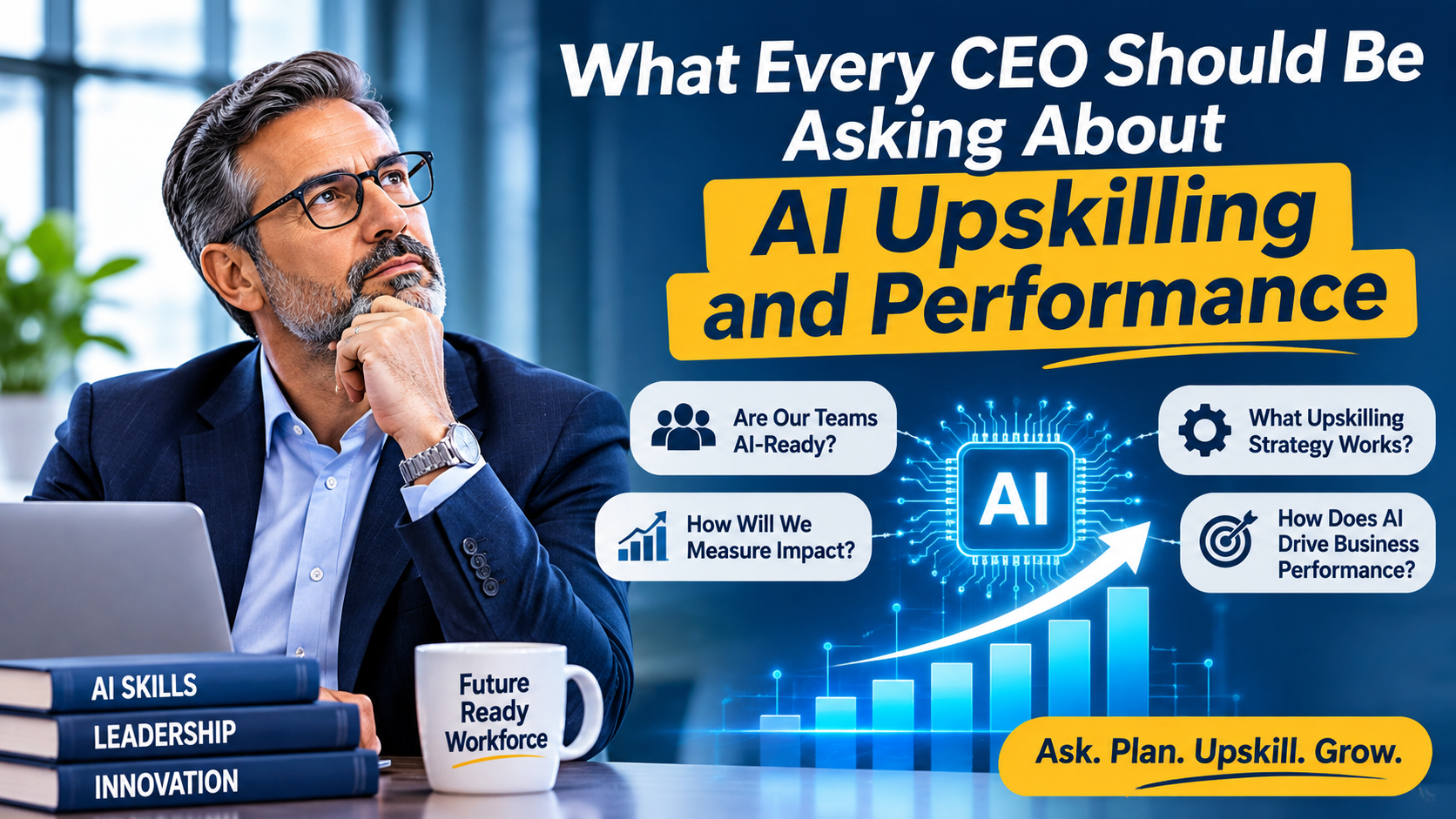

Most leadership teams have already approved AI upskilling, and many employees have already gone through their courses. CEOs now want to know whether all that learning is actually reflected in how the business does business.
Grant Thornton's 2026 AI Impact Survey of 950 senior leaders shows just how mixed the picture is. CIOs and CTOs were five times more likely than COOs to say the workforce was fully ready, and training was the most underfunded of AI investments. Where companies do get it right, the payoff is clear: organizations with fully integrated AI were almost four times as likely to report AI-driven revenue growth (58% versus 15%).
The outcome every AI training effort should aim for was described by Microsoft CEO Satya Nadella at the World Economic Forum in Davos in January 2026.
"People need to say, oh, I picked up this AI skill, and now I'm a better provider of some product or service in the real economy," he said.
CEOs can check whether that rebuilding with AI skills is genuinely happening by asking the five questions below.
Question 1: Are Our AI Training Programs Aligned With Business Goals?
Every good training plan begins with a business problem worth solving. That could be hours spent by a finance team on month-end reconciliations, a growing backlog in the customer service queue, or the slow pace of testing new product ideas.
Once you have a name for the challenge, you can tie training to a concrete outcome, whether it's productivity, customer experience, innovation, or operational efficiency.
Question 2: Are Employees Using AI Skills in Their Day-to-Day Work?
Knowing what a copilot does is one skill; actually using it to finish a client proposal in half the time is another. A few things worth checking:
● Where are AI tools, copilots, and agents showing up in real workflows?
● Which teams are using them every day, and for what tasks?
● Daily use tells you far more than course completion rates ever will
Build learning around hands-on projects, because practice is what turns knowledge into habit. BCG found that a hyperscaler embedded AI Training Programs into live software development, with coaching linked to real code, and saw code productivity increase by about 30%.
Shape the practice around each role: a frontline supervisor picks up skills through shift scheduling, a marketing lead through campaign briefs. Managers should keep providing feedback after formal training ends, since that's what helps new habits actually stick in day-to-day work.
Question 3: Are We Building the Right AI Skills in the Right Jobs?
AI skills sit on a spectrum. At one end is foundational literacy every employee needs: how to write a clear prompt, how to check an AI output, how to read the data behind a recommendation, how to use AI responsibly with company information. At the other end are advanced technical capabilities that let engineers and data teams evaluate tools, build automated workflows, and embed AI into existing systems.
Question 4: How Do We Measure AI Performance After Training?
Enrollment numbers, completion rates, and assessment scores show that a program attracted people. The work itself is what actually reflects performance, so these are the indicators worth following:
● Time saved on repetitive tasks like weekly reporting, invoice matching, or first drafts of customer responses
● Quality of work, such as fewer revisions on reports or cleaner data entry
● Speed of work from request through to delivery, to gauge workflow efficiency
● Adoption, tracked closely through weekly AI tool usage and what tasks employees are using it for
These numbers only mean something once you have a baseline to compare them against, so set that benchmark before training starts. Then layer the performance data on top of employee feedback to see which modules changed how people work, and which need reworking for the next cohort.
Question 5: Are We Selecting the Right AI Certifications for Workforce Development?
The best AI Certifications give employees a structured learning pathway and give leaders a clearer view of progress. For CEOs, upskilling moves faster when the people setting AI direction understand what transformation actually takes. These three AI leadership programs are worth a look:
1. USAII® Certified AI Transformation Leader (CAITL™)
A vendor-neutral, self-paced program for C-level executives, senior leaders, and decision-makers, with no programming required. It runs 8 to 14 weeks at 8 to 10 hours per week, covers AI strategy, data, product management, risk, and governance through 50+ real-world use cases, and ends with an AI transformation plan for your own organization.
The USAII® Certification Exam Journey: From Preparation to Certification walks through the entire journey, from preparation to the final exam.
2. Johns Hopkins University Executive Certificate in Artificial Intelligence
Offered through the Johns Hopkins Carey Business School, it covers AI literacy, productivity, team coordination, and organizational AI adoption. It targets managers and business leaders looking for practical capabilities they can take directly back to their teams.
3. University of Oxford Saïd Business School: AI Strategy and Leadership Programme
A five-day, in-person program in Oxford for senior executives. It covers AI strategy development, implementation and change management, and responsible AI, helping leaders shape an AI vision they can present at board level.
Creating a Culture to Propel AI Upskilling Performance
All five questions work best inside a culture where continuous learning is normal practice. Clear governance and security guidelines tell employees what tools and data they can use, but they still need room to experiment on real projects, where the results count,[SC1] within those guidelines.
That culture grows faster when leadership, HR, learning teams, and technical departments plan AI learning together, since each group sees a different slice of the skills picture.
Frequently Asked Questions
Q. What are the most critical AI skills for each department, and how do CEOs discover them?
- Start with the biggest time drains and decision points in each department, and ask what AI tools could help with those specifically.
Q. What should companies look for when choosing an AI certification program?
- Evaluate the relevance of the course material to the role, the level of practical hands-on experience provided, the credibility of the issuing organization, and the realistic time commitment expected of employees.
Q. How do organizations measure how well employees are adopting AI tools?
- Platform usage data is a good starting point, paired with short surveys and manager check-ins to learn how often and for what work people are actually using AI.
