

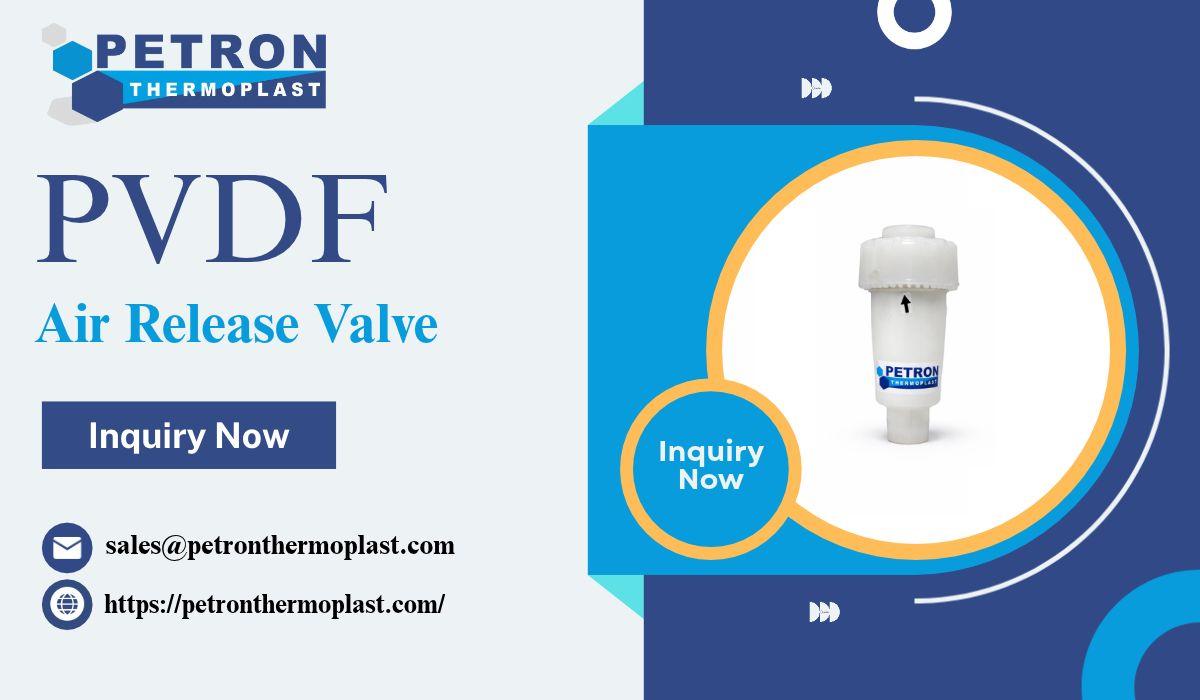

Industrial pipeline systems require proper fluid movement, pressure management and reliable equipment to maintain consistent operations. Air trapped inside a pipeline can affect flow performance, create unwanted pressure variations and interfere with connected equipment. A suitable PVDF Air Release Valve helps discharge accumulated air from compatible pipeline systems, supporting smoother fluid transportation and more efficient industrial operations.
PVDF (Polyvinylidene Fluoride) is a high-performance thermoplastic material known for its chemical resistance and suitability for demanding industrial environments. PVDF valves are considered for applications where material compatibility and operating conditions are important. Petron Thermoplast offers industrial thermoplastic piping solutions for businesses looking for customized products and bulk project requirements.
What Is a PVDF Air Release Valve?
A PVDF air release valve is a pipeline component designed to release accumulated air from a liquid-filled piping system. It helps prevent unwanted air pockets from remaining inside the pipeline during normal operation.
The valve is manufactured using PVDF material, which offers resistance to many chemicals and corrosive environments. This makes it a potential option for selected chemical processing and industrial fluid-handling applications.
Air release valves are generally installed at suitable high points in pipeline networks, where air naturally collects. Their design and operating mechanism determine how accumulated air is discharged.
It is important to distinguish an air release valve from an air and vacuum valve. An air release valve generally removes accumulated air from a pressurized, liquid-filled pipeline, while an air and vacuum valve also allows larger volumes of air to enter or leave during filling and draining operations.
How Does a PVDF Air Release Valve Work?
The operating principle depends on the specific valve design. Many automatic air release valves use a float mechanism to control the discharge opening.
The general operating process includes:
- Air Accumulation: Air collects inside the pipeline at a suitable high point.
- Air Entry into the Valve: Accumulated air moves into the valve chamber.
- Float Movement: As air collects, the liquid level inside the chamber changes and the float moves downward.
- Air Discharge: The movement opens the discharge orifice, allowing accumulated air to escape.
- Valve Closure: As liquid enters the chamber, the float rises and closes the discharge opening.
Key Features of Industrial PVDF Air Release Valves
1. Chemical Resistance
PVDF provides resistance to many acids, solvents and industrial chemicals. This makes it suitable for evaluating in selected corrosive fluid-handling environments. Compatibility must be verified for the exact chemical, concentration and operating temperature.
2. Corrosion-Resistant Construction
Unlike conventional metallic materials, PVDF does not rust. Its material properties can support long-term use in suitable corrosive industrial environments.
3. Lightweight Design
PVDF is lighter than many metallic alternatives. This can simplify handling and installation in compatible piping arrangements.
4. Industrial Application Suitability
PVDF valves can be considered for chemical processing, specialty chemical and other industrial applications where the material meets the process requirements.
5. Flexible System Integration
Depending on the product design, connection arrangements and dimensions can be evaluated according to the pipeline layout and project specifications.
Technical Considerations for PVDF Air Release Valve Selection
Choosing a suitable air release valve requires reviewing both the valve specifications and the pipeline operating conditions.
|
Technical Parameter |
Selection Consideration |
|
Body material |
PVDF |
|
Valve function |
Automatic or other specified air-release arrangement |
|
Operating mechanism |
Float or design-specific mechanism |
|
Valve size |
Based on pipeline and air-release requirements |
|
Connection type |
As per pipeline design and product availability |
|
Operating pressure |
Within the manufacturer's rated limits |
|
Temperature |
Suitable for the process conditions |
|
Chemical compatibility |
Verified against fluid type and concentration |
|
Installation position |
Suitable pipeline high point |
|
Maintenance |
Access for inspection and cleaning |
Applications of PVDF Air Release Valves
PVDF air release valves may be considered for different industrial systems where trapped air needs to be removed and PVDF is compatible with the process fluid.
Chemical Processing Plants
Chemical processing facilities use pipelines to transfer and circulate different liquids. Suitable air release arrangements can help remove accumulated air from selected process lines.
Water Treatment Facilities
Water treatment systems include pipelines for filtration, treatment and distribution. Air release valves may support air management at appropriate locations within compatible water-handling networks.
Pharmaceutical and Specialty Chemical Industries
These industries often require carefully selected materials and pipeline components. PVDF equipment can be evaluated for suitable applications after reviewing chemical compatibility and process requirements.
Electroplating Industries
Electroplating facilities use different chemical solutions in circulation and transfer systems. Appropriate PVDF valve arrangements may be considered for compatible pipeline applications.
Industrial Fluid Transfer Systems
Manufacturing facilities use interconnected pipelines to move process fluids between storage tanks, pumps and production equipment. Air release valves can help manage accumulated air in suitable installations.
Benefits of Using PVDF Air Release Valves
Selecting an appropriate PVDF air release valve can offer several practical benefits.
- Improved air management: Helps remove accumulated air from compatible liquid pipelines.
- Supports flow performance: Reduces problems associated with trapped air pockets.
- Chemical resistance: PVDF is suitable for many compatible chemical environments.
- Corrosion resistance: Helps avoid rust-related concerns associated with metallic materials.
- Lightweight construction: Can simplify handling and installation.
- Equipment support: Proper air management can help reduce air-related operating disturbances in connected systems.
How to Choose the Right PVDF Air Release Valve?
Before purchasing a PVDF air release valve, industrial buyers should consider the following factors.
1. Understand the Pipeline Requirement: Identify whether the system requires continuous air release, large-volume air discharge or both. Select the correct valve function.
2. Check the Fluid Compatibility: Confirm that PVDF and all internal sealing components are compatible with the process fluid.
3. Review Operating Pressure: Check the normal and maximum operating pressure against the valve's rated limits.
4. Evaluate Temperature Conditions: Confirm that the valve can operate within the expected process temperature range.
5. Determine the Required Size: Consider pipeline dimensions, air accumulation and the required discharge capacity.
6. Select the Correct Installation Point: Air release valves are generally positioned where air naturally collects. Pipeline profile and installation guidelines should be reviewed.
7. Plan Maintenance Access: Ensure that the valve can be inspected and serviced safely when required.
Customized PVDF Valve Solutions by Petron Thermoplast
Petron Thermoplast focuses on industrial thermoplastic products and customized piping requirements. Businesses planning chemical processing systems, industrial fluid-transfer networks or pipeline upgrades can discuss their PVDF valve requirements with the company.
For product evaluation and quotation, buyers can share:
- Required valve type and quantity.
- PVDF material requirements.
- Pipeline size and connection details.
- Process fluid and chemical concentration.
- Operating pressure and temperature.
- Air-release capacity or technical requirements.
- Installation drawings and project specifications.
- Delivery destination.
Conclusion
A suitable PVDF air release valve can support better air management in industrial pipeline systems. By removing accumulated air from compatible liquid pipelines, it helps reduce air-related operating problems and supports more consistent fluid transportation.
PVDF construction offers useful chemical and corrosion resistance for selected industrial applications. However, proper product selection requires careful consideration of valve function, pressure, temperature, fluid compatibility, connection type and installation location. Petron Thermoplast offers industrial thermoplastic piping solutions for customized project requirements. Contact the company to discuss your PVDF valve specifications, bulk requirements and industrial pipeline needs.
