

Patch Cable Market 2026 | Industry Size, Share, Growth, Trends & Future Outlook Report by 2034

Market Overview
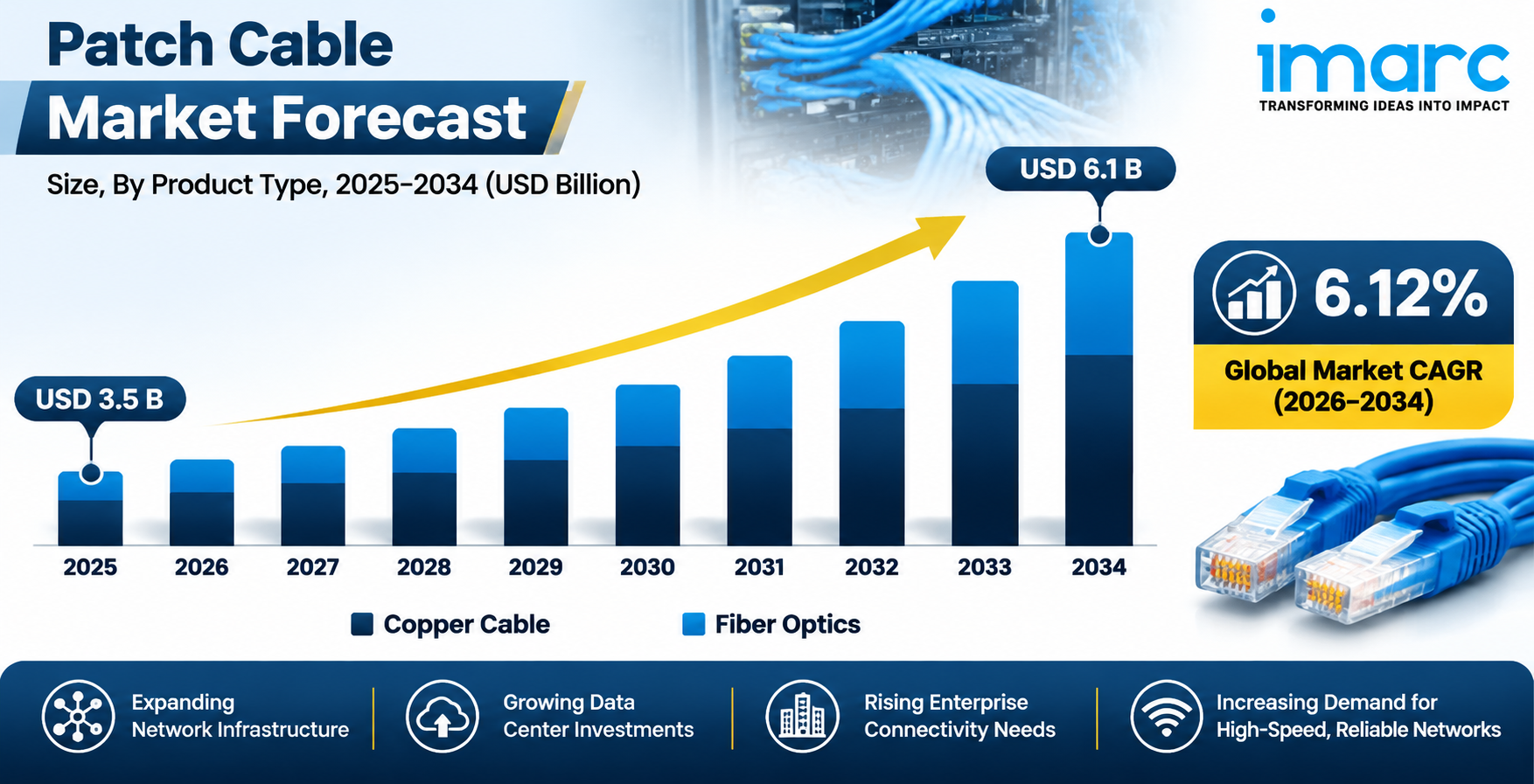
The global patch cable market size reached USD 3.5 Billion in 2025. Looking forward, the market is expected to reach USD 6.1 Billion by 2034, exhibiting a growth rate (CAGR) of 6.12% during 2026–2034. North America currently dominates the regional landscape, holding a market share of 37.6% in 2025, supported by its highly developed IT infrastructure, widespread broadband penetration, and strong presence of major technology companies. The market is primarily driven by rising demand for high-speed and dependable data transmission, expanding data center infrastructure, increasing adoption of cloud computing, ongoing 5G deployment, and growing investments in fiber-optic networks.
Patch Cable Market: Key Facts at a Glance
-
Base Year: 2025
-
Historical Period: 2020–2025
-
Forecast Period: 2026–2034
-
Market Size (2025): USD 3.5 Billion
-
Market Size (2026): USD 3.8 Billion
-
Market Forecast (2034): USD 6.1 Billion
-
CAGR (2026–2034): 6.12%
-
Leading Region: North America (37.6% share, 2025)
-
Dominant Product Type: Copper Cable
-
Dominant Cable Type: CAT 5
-
Leading Application: Networking (52.1% share)
Request for a Sample Report for Detailed Evaluation: https://www.imarcgroup.com/patch-cable-market/requestsample
Patch Cable Market Report: Key Highlights
-
Market Size and Growth: The global patch cable market reached USD 3.5 Billion in 2025 and is projected to grow to USD 6.1 Billion by 2034, registering a CAGR of 6.12% during 2026–2034.
-
Regional Leadership: North America represents the largest regional market, accounting for 37.6% of the global market share in 2025, supported by advanced IT infrastructure, broadband penetration, and substantial investments in digital connectivity.
-
By Product Type: The market is segmented into copper cable and fiber optics, with copper cables accounting for the largest share in 2025 owing to their affordability, ease of installation, and compatibility with existing Ethernet infrastructure.
-
By Cable Type: The market includes CAT 3, CAT 5, CAT 5E, CAT 6, CAT 6A, CAT 7, multimode optical fiber, and others, with CAT 5 representing the largest segment.
-
By Application: Networking and non-networking applications constitute the key market segments, with networking accounting for 52.1% of the market share.
-
By End Use: Major end-use segments include industrial, enterprise, IT and network security, and others. Industrial applications represent a significant share due to the growing adoption of factory automation and connected equipment.
-
Key Market Drivers: Rising demand for high-speed internet, expansion of data centers, increasing adoption of cloud computing, 5G deployment, and the growing digital transformation of enterprises are supporting market expansion.
-
Key Market Trends: Growing demand for high-speed connectivity, expansion of cloud services, technological advancements in cable standards, and increasing adoption of fiber-optic networking solutions are shaping the industry.
-
Key Market Players: Major companies operating in the market include Belden Inc., Black Box, CommScope, Corning Incorporated, CP Technologies, Graybar Electric Company, Inc., Legrand North America, LLC, NAI Group, LLC, Panduit Corp, Prysmian Group, and Quabbin Wire & Cable Co., Inc.
What Is Driving Patch Cable Market Growth in 2026?
Growing Demand for High-Speed Connectivity
The growing demand for high-speed internet and seamless network connectivity is driving the expansion of the global patch cable market. As businesses and consumers increasingly adopt cloud computing, video streaming, Internet of Things (IoT) devices, and digital collaboration platforms, the need for reliable and high-speed data transmission is rising. Network patch cables, including CAT 6 and CAT 7 Ethernet cables, play a vital role in supporting these applications by ensuring efficient data transfer, stable connectivity, and reduced latency. Furthermore, the increasing adoption of remote and hybrid working models is encouraging organizations to upgrade their IT and networking infrastructure to facilitate uninterrupted communication and maintain operational productivity. Growing investments in broadband expansion, data centers, and advanced networking infrastructure are further strengthening demand for LAN patch cables, Ethernet patch cables, and patch cable cords across residential, commercial, and enterprise environments.
Expansion of Data Centers and Cloud Services
The rapid expansion of data centers and cloud services is emerging as a major factor driving the patch cable market. As businesses increasingly migrate their operations, applications, and data storage systems to cloud-based platforms, the need for efficient and scalable networking infrastructure continues to rise. Data centers rely extensively on patch cables to establish connections between servers, switches, routers, and other networking equipment, ensuring uninterrupted data transmission and effective network management. As of March 2025, the United States had the highest number of data centers globally, with 5,426 facilities, followed by Germany with 529. Moreover, the increasing adoption of hyper-converged infrastructure, virtualization, and big data analytics is creating demand for high-quality patch cables capable of supporting greater data throughput. The continued development of hyperscale and enterprise data centers is therefore expected to provide sustained growth opportunities for manufacturers.
Technological Advancements and Innovations
Continuous technological advancements in cable standards, materials, and manufacturing processes are reshaping the patch cable industry. The introduction of advanced cable categories, including Category 8, is enabling higher bandwidths and faster data transmission to meet the growing requirements of enterprise networks and data center environments. Manufacturers are also improving cable durability, flexibility, shielding, and insulation to enhance performance and simplify installation. Furthermore, developments in fiber-optic technology, including multimode and single-mode fiber solutions, are expanding the applications of patch cables by supporting higher data rates over longer distances. The increasing integration of artificial intelligence (AI) into business operations is further creating demand for reliable, low-latency networking infrastructure. According to the information provided, 13.5% of businesses employing 10 or more people in the European Union used AI technologies in 2024, representing an increase of 5.5 percentage points from 8.0% in 2023. These developments are encouraging investments in advanced connectivity solutions, supporting the long-term expansion of the market.
Patch Cable Market Segmentation Analysis
IMARC Group provides an analysis of the key trends in each segment of the global patch cable market, along with forecasts at the global, regional, and country levels from 2026–2034. The market has been categorized based on product type, cable type, application, and end use.
By Product Type
-
Copper Cable
-
Fiber Optics
Copper cable represented the largest market share in 2025, owing to its widespread utilization across local area networks (LANs), data centers, and enterprise IT infrastructure. Its affordability, ease of installation, and ability to deliver reliable performance over short and medium distances make it a preferred connectivity solution across residential and commercial applications. The growing demand for high-speed internet and the increasing digitalization of offices are further reinforcing the adoption of copper patch cables in structured cabling systems. In addition, continuous improvements in shielding, bandwidth capabilities, and insulation materials are enhancing cable performance, durability, and resistance to electromagnetic interference (EMI). Copper cables also offer compatibility with established Ethernet infrastructure, allowing organizations to upgrade their networks without undertaking extensive infrastructure replacements. These advantages continue to support the segment's leading position in the global market.
By Cable Type
-
CAT 3
-
CAT 5
-
CAT 5E
-
CAT 6
-
CAT 6A
-
CAT 7
-
Multimode Optical Fiber
-
Others
CAT 5 accounts for the largest market share, supported by its established presence and cost-effectiveness across small-scale networking applications. These cables are widely used in residential environments, small businesses, and other settings where economical connectivity solutions are preferred over advanced high-bandwidth infrastructure. CAT 5 cables support data transmission speeds of up to 100 Mbps and frequencies of up to 100 MHz, making them suitable for basic internet connectivity, voice-over-IP (VoIP), and conventional data transmission requirements. Their relatively low installation costs and backward compatibility with existing network hardware further strengthen their appeal among budget-conscious users. Additionally, their suitability for short-distance connections and non-critical networking systems continues to sustain their utilization across various applications. These factors collectively reinforce the segment's position in the global patch cable market.
By Application
-
Networking
-
Non-Networking
Networking holds around 52.1% of the market share, reflecting the essential role of patch cables in establishing reliable, high-speed, and stable connections across enterprise networks, data centers, and telecommunications infrastructure. These cables facilitate the transmission of data, voice, and video signals with minimal latency, supporting uninterrupted business operations and internet-based services. The growing adoption of cloud computing, IoT, and 5G technologies is further increasing the need for robust networking infrastructure, where patch cables serve as critical connectivity components. Their ease of installation, flexibility, and compatibility with different networking devices make them indispensable across wired LAN and WAN environments. Moreover, organizations are increasingly investing in scalable and secure network infrastructure to accommodate growing data traffic and digital transformation requirements. As businesses continue to expand their connectivity capabilities, networking applications are expected to maintain their dominant position in the market.
By End Use
-
Industrial
-
Enterprise
-
IT and Network Security
-
Others
Industrial applications account for a significant share of the market, driven by the growing integration of connected equipment, sensors, and automated control systems across manufacturing and industrial facilities. Patch cables play an important role in interconnecting machinery, industrial controllers, and monitoring equipment, ensuring reliable communication across production environments. Their robust construction enables them to withstand electromagnetic interference, vibration, and temperature fluctuations. Furthermore, the increasing adoption of Industry 4.0 technologies, factory automation, and process control systems is strengthening demand for durable and high-performance patch cables.
Enterprise applications represent another important segment, supported by the extensive use of structured cabling systems across corporate offices, conference rooms, and server facilities. Patch cables facilitate voice, data, and video communication within internal networks, helping businesses maintain efficient connectivity across their operations. The transition toward hybrid working arrangements, growing bandwidth requirements, and increasing reliance on digital collaboration tools are encouraging enterprises to upgrade their networking infrastructure with reliable cabling solutions.
IT and network security applications also account for a substantial portion of the market. These applications rely on patch cables to establish high-speed connections between switches, firewalls, servers, surveillance systems, and other critical networking equipment. As organizations increasingly prioritize cybersecurity, uninterrupted connectivity, and network reliability, the demand for dependable physical infrastructure is rising. Patch cables support the effective functioning of mission-critical IT systems by facilitating stable connections and minimizing network disruptions.
Patch Cable Market Regional Analysis
-
North America (United States, Canada)
-
Asia-Pacific (China, Japan, India, South Korea, Australia, Indonesia, Others)
-
Europe (Germany, France, United Kingdom, Italy, Spain, Russia, Others)
-
Latin America (Brazil, Mexico, Others)
-
Middle East and Africa (Others)
North America holds the leading position in the global patch cable market, accounting for a share of 37.6% in 2025. The region benefits from highly developed IT infrastructure, widespread broadband penetration, and the presence of major technology companies. Growing adoption of advanced networking solutions across data centers, enterprises, and industrial facilities is generating sustained demand for high-performance patch cables. Significant investments in cloud computing, 5G deployment, and IoT integration are further increasing the requirement for reliable connectivity solutions. In addition, the presence of established manufacturers and continuous advancements in cable technology are contributing to regional market growth. The increasing adoption of smart home systems and connected devices is also supporting demand for efficient residential networking infrastructure. According to IMARC Group, the North America home automation systems market reached USD 33.8 Billion in 2024. Furthermore, the region's focus on network security, operational efficiency, and minimal downtime is encouraging the adoption of premium patch cables featuring enhanced shielding and durability.
Key Regional Takeaways: North America's Strategic Position
North America's leadership in the patch cable market is supported by its mature digital ecosystem, extensive data center infrastructure, and continuous investments in telecommunications and enterprise networking. The United States represents a major contributor to regional demand, driven by widespread adoption of cloud computing, smart home technologies, and high-speed broadband services. The increasing deployment of 5G networks and growing reliance on digital collaboration platforms are further strengthening the need for reliable wired connectivity solutions. In addition, investments in hyperscale data centers, edge computing, and AI-based systems are encouraging the use of advanced copper and fiber-optic patch cables across commercial and industrial applications.
United States Patch Cable Market Analysis
The United States patch cable market is supported by ongoing developments in telecommunications, cloud computing, and enterprise networking. The country has a well-established digital infrastructure, a large concentration of data centers, and an extensive network of interconnected technology ecosystems that require dependable high-speed cabling solutions. In early 2025, the United States recorded 411 Million active cellular mobile connections, representing 119% of its total population. The widespread deployment of structured cabling systems and growing preference for higher-specification cable categories, including CAT 6A and CAT 7, are among the prominent trends shaping the market. These cables offer enhanced bandwidth and improved resistance to electromagnetic interference, making them suitable for advanced networking environments. Furthermore, the increasing adoption of smart home devices, high-definition streaming services, and 5G connectivity is supporting demand for efficient and low-latency cable infrastructure. Growing investments in edge computing and AI-based systems, particularly across major technology hubs, are also encouraging the adoption of fiber-optic and advanced Ethernet patch cables.
Europe Patch Cable Market Analysis
The patch cable market in Europe is experiencing steady growth, supported by IT infrastructure modernization, business digitalization, and widespread broadband connectivity. According to the industry forecast provided, IT expenditure in Europe is expected to reach USD 1.28 Trillion in 2025, representing an increase of 8.7% compared with 2024. Countries such as Germany, the United Kingdom, France, and the Netherlands are advancing network modernization initiatives, creating significant demand for high-performance patch cables. The deployment of gigabit broadband networks and fiber-to-the-home (FTTH) infrastructure, alongside investments in sustainable and energy-efficient data centers, is strengthening the requirement for structured cabling systems. Patch cables are essential for connecting networking components within high-density IT environments and supporting efficient data transmission. Moreover, public sector digitalization, smart manufacturing, and smart transportation initiatives are encouraging the adoption of advanced networking infrastructure. The increasing emphasis on cybersecurity and data sovereignty is also prompting organizations across banking, healthcare, and government sectors to modernize their connectivity systems.
Asia-Pacific Patch Cable Market Analysis
The Asia-Pacific patch cable market is expanding rapidly, driven by urbanization, growing internet penetration, and government initiatives aimed at strengthening digital connectivity. India alone recorded 806 Million internet users at the beginning of 2025, with internet penetration reaching 55.3%. The increasing deployment of fiber-optic networks across China, India, Japan, and South Korea is generating substantial demand for reliable patch cable solutions. The development of smart cities, hyperscale data centers, and high-speed broadband infrastructure is further supporting the adoption of fiber-based and advanced Ethernet cables, including CAT 6 and CAT 7. In addition, the growing use of cloud computing, IoT-enabled infrastructure, and enterprise networking solutions is strengthening demand across telecommunications, commercial, and residential applications. The availability of cost-competitive local manufacturing and rising requirements for low-latency, high-bandwidth connectivity are also supporting market development. Furthermore, expanding mobile connectivity and continuous 5G network rollouts are reinforcing the strategic importance of patch cables across the region.
Latin America Patch Cable Market Analysis
The patch cable market in Latin America is witnessing growth on account of rising internet penetration, increasing business digitalization, and the growing adoption of cloud-based services. Brazil, Mexico, Argentina, and Chile are witnessing investments in telecommunications infrastructure and data center development, creating additional demand for structured cabling and high-quality patch cable solutions. The region's expanding mobile connectivity and broadband access, supported by urbanization and a digitally engaged population, are encouraging the modernization of networking infrastructure. According to the information provided, 53% of mobile connections in Latin America are anticipated to be 5G by 2030. This transition is expected to increase the need for reliable connectivity solutions across telecommunications and enterprise networks. Moreover, the adoption of fiber-optic technology and the development of smart city initiatives in major metropolitan areas are supporting the expansion of advanced networking applications across the region.
Middle East and Africa Patch Cable Market Analysis
The patch cable market in the Middle East and Africa is gaining momentum as governments and businesses increasingly prioritize digital transformation and advanced telecommunications infrastructure. Countries across the Gulf region are investing in smart cities, e-governance platforms, and 5G networks, creating demand for high-performance patch cables that support reliable data transmission. According to GSMA Intelligence, the United Arab Emirates recorded 21.9 Million cellular mobile connections at the beginning of 2025. The expansion of fiber-to-the-home (FTTH) and fiber-to-the-premises (FTTP) infrastructure, particularly in the UAE, Saudi Arabia, and Qatar, is further supporting the adoption of advanced cabling solutions. These deployments require dependable patch cables to establish connections between network components and maintain seamless communication. Meanwhile, increasing enterprise connectivity requirements and the gradual modernization of digital infrastructure across developing African markets are creating additional opportunities for market participants.
Competitive Landscape in the Patch Cable Industry
The competitive landscape of the global patch cable market is characterized by continuous product innovation, technological improvements, and strategic collaborations among established manufacturers and networking solution providers. Companies are focusing on developing advanced copper Ethernet and fiber-optic patch cables to address the evolving connectivity requirements of data centers, telecommunications operators, and enterprise networks. Significant investments in research and development (R&D) are being directed toward improving cable durability, signal quality, bandwidth capabilities, and compatibility with emerging technologies such as 5G and advanced networking systems. Manufacturers are also pursuing strategic partnerships with telecom operators, data center providers, and IT infrastructure companies to expand their distribution networks and strengthen their market presence. In addition, competitive pricing strategies, efficient supply chain management, and sustainable product development are emerging as important differentiators. The growing emphasis on environmentally responsible materials and packaging is further encouraging companies to introduce products that address changing customer expectations.
Key Patch Cable Market Players Include:
-
Belden Inc.
-
Black Box
-
CommScope
-
Corning Incorporated
-
CP Technologies
-
Graybar Electric Company, Inc.
-
Legrand North America, LLC
-
NAI Group, LLC
-
Panduit Corp
-
Prysmian Group
-
Quabbin Wire & Cable Co., Inc.
Latest News and Developments in the Patch Cable Industry
-
July 2025: Lightware expanded its cable portfolio with the launch of Cable-PopUp and two new USB-C cables. These solutions were designed to improve cable organization and connectivity across workspaces and meeting environments.
-
June 2025: CommScope introduced its FiberREACH solution and CableGuide 360 platform as part of its SYSTIMAX portfolio. The solutions aim to improve network-edge connectivity and cable management, facilitating more organized and efficient installations while protecting copper and fiber cables.
-
June 2025: Cleerline introduced a web-based customization tool that enables customers to configure and order fiber patch cables according to specific project requirements. Users can select cable types, lengths, connectors, and optional features, with products tested to exceed applicable industry standards before shipment.
-
May 2025: Belden launched its 10GXM13 Category 6A patch cable, featuring a compact 0.230-inch diameter and TIA compliance to support 10 Gigabit performance. The product is designed to simplify installation in confined spaces, reduce conduit requirements, and support more efficient installations through its filler-free construction.
-
April 2025: PureLink GmbH introduced the FlexInstall series patch cable, featuring ultra-flexible jackets infused with graphene and EMI-resistant shielding. Designed for high-performance AV installations in confined spaces, the product line also includes space-saving connectors and InstallerPack packaging intended to improve cable organization and reduce waste.
Patch Cable Market Drivers, Challenges & Opportunities
Major Market Drivers
-
Growing Demand for High-Speed Connectivity: Increasing internet usage, cloud computing adoption, and the expansion of digital services are driving demand for high-performance patch cables that enable fast and reliable data transmission.
-
Expansion of Data Centers: The growing number of hyperscale and enterprise data centers is increasing the need for efficient cabling infrastructure to connect servers, switches, routers, and other networking equipment.
-
5G and Fiber-Optic Network Deployment: Investments in 5G infrastructure, broadband modernization, and fiber-optic networks are creating opportunities for advanced copper and fiber-optic patch cable solutions.
Key Market Challenges
-
Evolving Bandwidth Requirements: Rapid advancements in networking technologies require manufacturers to continuously improve cable performance and compatibility with higher-speed standards.
-
Infrastructure Modernization Costs: Upgrading existing networking systems to accommodate advanced connectivity requirements can involve substantial installation and infrastructure expenditure for businesses.
Emerging Opportunities
-
Growth in Cloud Computing and AI Infrastructure: The increasing adoption of AI, cloud-based applications, and edge computing is creating opportunities for high-performance patch cables capable of supporting low-latency and high-bandwidth connectivity.
-
Expansion of Smart Cities and IoT: Growing investments in smart city infrastructure, connected devices, and industrial automation are increasing the need for reliable and scalable cabling solutions.
-
Advancements in Fiber-Optic Technology: Continuous improvements in fiber-optic cables and advanced Ethernet standards are enabling manufacturers to address evolving requirements across data centers, telecommunications, and enterprise networks.
Patch Cable Market FAQs
1. How big is the patch cable market?
The global patch cable market reached USD 3.5 Billion in 2025 and is expected to reach USD 3.8 Billion in 2026.
2. What is the future outlook of the patch cable market?
The global patch cable market is projected to reach USD 6.1 Billion by 2034, exhibiting a CAGR of 6.12% during 2026–2034.
3. What are the key factors driving the patch cable market?
Key factors include rising demand for high-speed internet connectivity, expansion of data centers, increasing adoption of cloud computing and IoT, 5G network deployment, and growing investments in fiber-optic infrastructure.
4. Which region accounts for the largest patch cable market share?
North America dominates the global patch cable market, accounting for 37.6% of the market share in 2025, supported by advanced IT infrastructure, widespread broadband penetration, and substantial investments in digital connectivity.
5. Which are the leading companies in the global patch cable market?
Major companies operating in the global patch cable market include Belden Inc., Black Box, CommScope, Corning Incorporated, CP Technologies, Graybar Electric Company, Inc., Legrand North America, LLC, NAI Group, LLC, Panduit Corp, Prysmian Group, and Quabbin Wire & Cable Co., Inc.
Conclusion: Patch Cable Market Outlook to 2034
The global patch cable market is positioned for sustained growth through 2034, supported by rising demand for high-speed connectivity, expanding data center infrastructure, and increasing adoption of cloud computing, IoT, and 5G technologies. As businesses and consumers become increasingly dependent on digital services, the need for reliable and high-performance networking infrastructure is continuing to grow. Advancements in cable standards, fiber-optic technology, and manufacturing processes are further enhancing the performance, flexibility, and durability of patch cable solutions.
With North America maintaining its position as the leading regional market and Asia-Pacific, Europe, Latin America, and the Middle East and Africa offering further growth opportunities, the industry outlook remains positive. Manufacturers focusing on advanced cable technologies, improved signal performance, sustainable product development, and strategic partnerships will be well-positioned to capitalize on the growing demand for efficient connectivity solutions across residential, commercial, industrial, and telecommunications environments.
About the Author:
IMARC Group is a leading global market research company providing data-driven insights and expert consulting services to businesses seeking to achieve their strategic objectives. With a multidisciplinary team of industry experts, IMARC delivers comprehensive and reliable market intelligence across sectors including Food and Beverages, Healthcare, Chemicals and Materials, Consumer Goods, and more.
Media & Sales Contact:
IMARC Group
United States: +1-201-971-6302
India: +91-120-433-0800
United Kingdom: +44-753-714-6104
