

IoT Sensors and Predictive Maintenance Transform Industrial Plate Heat Exchangers

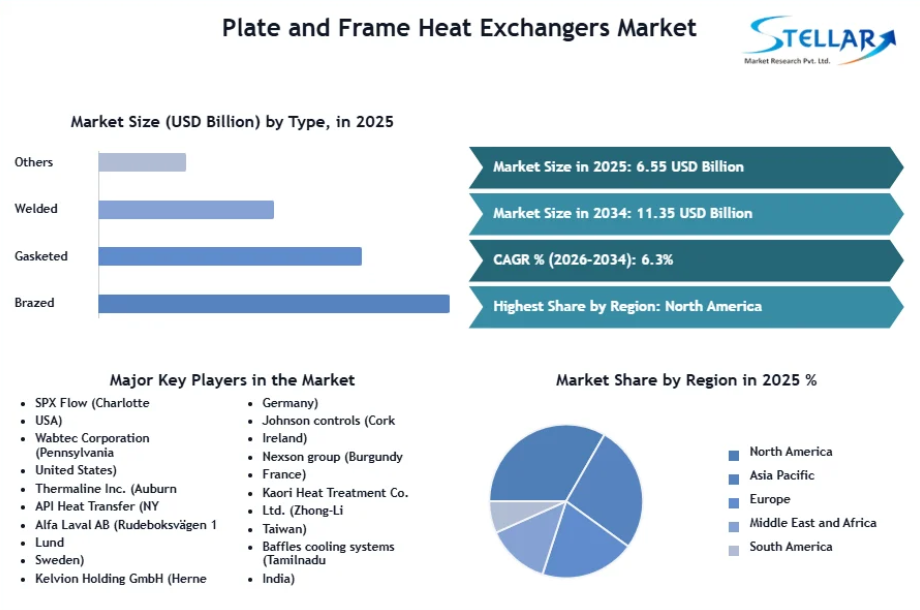
The Plate and Frame Heat Exchangers Market is experiencing an unprecedented industrial transformation, propelled by global imperatives for carbon neutrality and stringent thermal efficiency standards. According to a comprehensive market intelligence report published by Stellar Market Research, the global market size was valued at USD 6.55 billion in 2025 and is projected to scale to USD 11.35 billion by 2034, expanding at a robust compound annual growth rate (CAGR) of 6.3% over the forecast period. This market expansion is strategically vital as heavy process industries, data center operators, and district cooling networks seek compact, high-performance thermal management technologies to minimize operational energy loss and curb greenhouse gas emissions.
Plate and frame heat exchangers directly resolve this operational bottleneck by delivering heat transfer coefficients up to three to five times higher than traditional shell-and-tube units within a fraction of the physical floor space. Furthermore, the explosive build-out of hyperscale data centers, district heating networks, green hydrogen electrolyzers, and carbon capture facilities has unlocked high-margin demand for specialized brazed, welded, and semi-welded units capable of operating under extreme pressures and corrosive media.
Key Findings from the Stellar Market Research Report
-
Market Valuation & Trajectory: Valued at USD 6.55 billion in 2025, the global Plate and Frame Heat Exchangers Market is forecast to reach USD 11.35 billion by 2034 at a 6.3% CAGR (2026–2034).
-
Product Type Dominance: Gasketed plate heat exchangers hold the largest market revenue share, favored across food, beverage, and chemical processing for their modular plate expandability and ease of mechanical cleaning.
-
Fastest-Growing Technology: Brazed and all-welded plate heat exchangers are recording the fastest growth rates, propelled by compact commercial HVAC heat pumps, natural refrigerant systems, and high-temperature petrochemical duty.
-
End-Use Leadership: HVAC & Refrigeration alongside Chemical and Oil & Gas processing represent the primary revenue engines, collectively accounting for over half of global unit installations.
-
Service & Lifecycle Revenue: Aftermarket services—including installation, commissioning, maintenance, repair, and retrofit upgrades—represent a critical recurring revenue stream as plants modernize aging thermal infrastructure.
-
Regional Leadership & Momentum: North America and Europe maintain high market penetration anchored by strict industrial efficiency mandates, while Asia-Pacific stands as the fastest-growing expansion hub fueled by rapid industrial capacity additions in China and India.
-
Investment & M&A Relevance: Tier-one thermal engineering firms are actively deploying capital into cryogenic heat transfer, data center liquid cooling, and localized manufacturing capacity to capture energy-transition demand.
Market Drivers and Restraints
Drivers
-
Industrial Decarbonization and Waste Heat Recovery Mandates: Stringent emission reduction targets and rising energy expenditures are compelling chemical plants, refineries, and district heating utilities to deploy high-efficiency plate heat exchangers for closed-loop thermal recovery.
-
Expansion of HVAC, Heat Pumps, and Data Center Cooling: Rapid urbanization, green building certifications (such as LEED and BREEAM), and the surge in liquid-cooled AI data centers are driving massive procurement of compact brazed and gasketed heat exchangers.
-
Rapid Industrialization in Emerging Manufacturing Hubs: Large-scale capital investments in petrochemicals, pharmaceuticals, and food processing across Asia-Pacific and Latin America are generating sustained greenfield demand for reliable thermal transfer equipment.
Restraints
-
Fouling, Scaling, and Maintenance Complexity in Harsh Media: Processing viscous fluids, hard water, or particulate-heavy slurries can cause channel clogging and gasket degradation, increasing maintenance downtime and lifecycle servicing costs.
-
Pressure and Temperature Ceilings on Standard Gasketed Units: While versatile, conventional elastomer-gasketed exchangers face operational limits under extreme pressure-temperature combinations, requiring buyers to invest in higher-cost welded or exotic-alloy alternatives.
Technology, Regulation, and Sustainability Trends
-
Technology Innovation & Smart Monitoring: Manufacturers are upgrading traditional chevron plate geometries with micro-plate and high-turbulence asymmetric designs to minimize refrigerant charge and pressure drop. Concurrently, Industry 4.0 integration—embedding IoT differential-pressure and thermal sensors—enables predictive fouling detection before unplanned shutdowns occur.
-
Regulatory & Refrigerant Compliance: Global phase-downs of high-GWP hydrofluorocarbons (HFCs) under the Kigali Amendment and EU F-Gas regulations are accelerating the transition toward natural refrigerants such as CO₂ (R744), ammonia (R717), and propane (R290), requiring high-pressure brazed and semi-welded plate designs.
-
ESG & Circular Manufacturing: Leading vendors are introducing low-carbon stainless steel and recycled titanium plate options alongside glue-free, recyclable gasket systems that simplify refurbishment and extend asset lifespans.
Regional Insights
-
North America & Europe (High Penetration & Retrofit Leaders): North America and Europe lead in technology adoption and high-value retrofit activity. Growth in the United States is heavily buoyed by hyperscale data center construction, domestic pharmaceutical manufacturing, and industrial decarbonization incentives. In Europe—led by Germany, France, and the Nordic nations—stringent EU Energy Efficiency Directives and municipal district heating expansions anchor steady demand.
-
Asia-Pacific (Fastest-Growing Engine): Asia-Pacific represents the most dynamic growth frontier, driven by aggressive industrial expansion across China, India, and Southeast Asia. India’s booming chemical, pharmaceutical, and commercial cold-chain infrastructure—backed by domestic manufacturing incentives—is positioning the country as a premier hub for both heat exchanger consumption and export-oriented fabrication.
-
Middle East & Latin America: Refinery upgrades in the GCC and expanding food, beverage, and mining operations in Brazil and Mexico are creating steady incremental demand for corrosion-resistant titanium and semi-welded exchangers.
Recent Industry Developments
-
Alfa Laval (2026): Deepened its global food, pharmaceutical, and hygienic processing footprint by expanding its next-generation gasketed plate heat exchanger and UltraPure portfolio in high-growth Asian manufacturing hubs.
-
Kelvion (2026): Launched K Focus Carbon Capture & Storage (CCS), a specialized digital engineering and selection platform designed to guide industrial operators in configuring high-efficiency thermal solutions for carbon capture and energy-transition projects.
-
KRN Heat Exchanger & Refrigeration (2026): Raised approximately USD 3.65 billion via a Qualified Institutional Placement (QIP) to significantly expand manufacturing capacity and scale heat exchanger production for commercial HVAC and industrial heat recovery.
-
Alfa Laval (2025): Completed the USD 865.8 million acquisition of Fives Energy Cryogenics, integrating specialized cryogenic heat transfer capabilities to accelerate expansion across liquefied natural gas (LNG), hydrogen, and carbon capture markets.
-
Danfoss (2025): Introduced a high-pressure CO₂-to-water brazed plate heat exchanger engineered for transcritical refrigeration systems, combining gas cooling, condensing, and heat recovery in a compact, low-carbon footprint.
Competitive Landscape
The global Plate and Frame Heat Exchangers Market is moderately consolidated among established multinational thermal engineering leaders alongside agile regional specialists. Dominant competitors include Alfa Laval, Kelvion Holding GmbH, Danfoss, SPX Flow, SWEP International AB, GEA Group, Hisaka Works, API Heat Transfer, Wabtec Corporation, and Thermaline Inc.
Market leaders are competing on thermal efficiency, material durability (titanium, Hastelloy, SMO alloys), and rapid aftermarket service turnaround. Strategic priorities center on M&A to acquire niche cryogenic and clean-tech capabilities, expanding automated brazing and pressing lines in Asia-Pacific, and offering digital sizing tools that lock in engineering specifications early in plant design cycles.
Analyst Commentary
"Heat exchangers were once treated as commoditized balance-of-plant hardware, but industrial decarbonization has completely rewritten their strategic value," said a Senior Research Analyst at Stellar Market Research. "When chemical producers, data center operators, and district utilities are mandated to slash energy intensity without expanding plant footprints, compact plate-and-frame architectures become non-negotiable. Over the next decade, competitive advantage will belong to manufacturers that pair high-pressure, natural-refrigerant-ready hardware with predictive digital maintenance and localized aftermarket support."
Future Outlook
Through 2034, the Plate and Frame Heat Exchangers Market will evolve toward specialized, application-engineered thermal systems integrated directly into clean-energy and digital infrastructure value chains. Rising capital inflows into green hydrogen, carbon capture, industrial heat pumps, and liquid-cooled AI compute clusters will progressively shift product mix toward high-margin welded, semi-welded, and brazed configurations. Meanwhile, tightening global efficiency standards and lifecycle service contracts will reinforce market consolidation around technologically advanced, globally serviced suppliers.
Stellar Market Research is a multifaceted market research and consulting company with professionals from several industries. Some of the industries we cover include medical devices, pharmaceutical manufacturers, science and engineering, electronic components, industrial equipment, technology and communication, cars and automobiles, chemical products and substances, general merchandise, beverages, personal care, and automated systems. To mention a few, we provide market-verified industry estimations, technical trend analysis, crucial market research, strategic advice, competition analysis, production and demand analysis, and client impact studies.
Address
Phase 3, Navale IT Zone, S.No. 51/2A/2, Office No. 202, 2nd floor, Near, Navale Brg, Narhe, Pune, Maharashtra 411041
Email
[email protected]
Mobile
+91 9607365656
