

United States Lime Market Size, Share, Latest Insights Trends and Forecast 2026-2034

IMARC Group has recently released a new research study titled "United States Lime Market Size, Share, Trends and Forecast by Type, Application, and Region, 2026-2034", offering a detailed analysis of the market drivers, segmentation, growth opportunities, trends, and competitive landscape to understand the current and future market scenarios.
United States Lime Market Size & Share 2026-2034
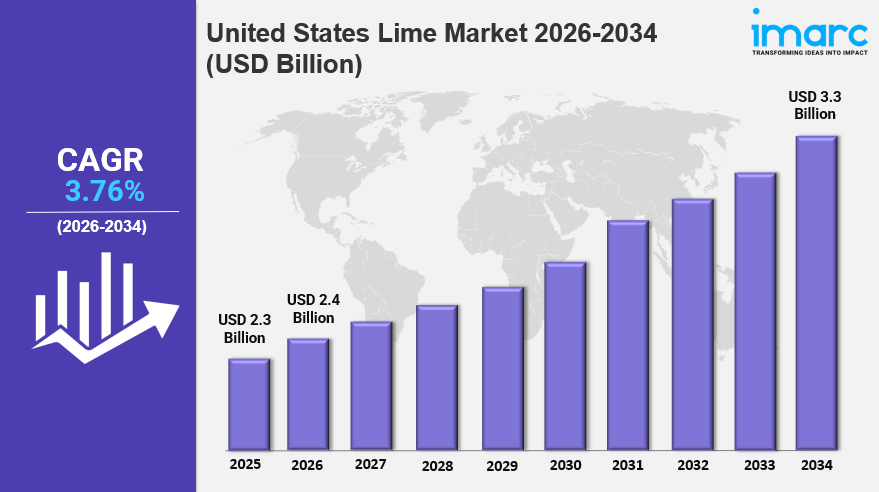
The United States lime market grew from USD 2.3 Billion in 2025 to approximately USD 2.4 Billion in 2026 and is projected to reach USD 3.3 Billion by 2034, expanding at a CAGR of 3.76% during 2026-2034. In 2026, the market continues to see steady demand, supported by steelmaking, flue gas treatment, water treatment, construction, and agricultural uses, along with new kiln capacity and consolidation among leading producers.
The market is segmented by type (quick lime and hydrated lime), application (agriculture, building material, mining and metallurgy, water treatment, and others), and region (Northeast, Midwest, South, and West). The South region led with a 39.8% share in 2024, while quick lime accounted for about 82.2% of the market by type. The industry is increasingly shaped by scale, with a small group of integrated producers expected to hold a growing influence on the United States lime market share throughout the forecast period.
Key Market Statistics at a Glance
- Base Year: 2025
- Historical Years: 2020-2025
- Forecast Period: 2026-2034
- Market Size (2025): USD 2.3 Billion
- Market Size (2026): USD 2.4 Billion
- Projected Market Size (2034): USD 3.3 Billion
- Growth Rate: CAGR of 3.76% (2026-2034)
Explore Opportunities in the United States Lime Market: Download the IMARC Sample Report: https://www.imarcgroup.com/united-states-lime-market/requestsample
Key Growth Drivers and Trends in the United States Lime Market
Growth in the United States lime market is being driven primarily by steady industrial and construction demand. According to the U.S. Geological Survey (USGS), the country produced an estimated 15 million tons of quicklime and hydrated lime in 2025 across 24 companies and 70 primary lime plants in 30 states. The major markets for lime, in descending order of consumption, were steelmaking, chemical and industrial applications, flue gas treatment, construction, water treatment, and nonferrous-metal mining. Urbanization, public infrastructure spending, and the upgrading of aging assets add to demand, with U.S. construction spending exceeding USD 2.1 Trillion in April 2025 and lime used in mortar, plaster, asphalt stabilization, and soil stabilization for road foundations.
One of the leading United States lime market trends is the growing role of environmental applications. Lime neutralizes acidic waste, adjusts pH, precipitates heavy metals, and helps remove pathogens in wastewater and sewage sludge treatment, while its use in flue gas desulfurization limits sulfur dioxide emissions from industrial plants. At the same time, pricing has become a visible contributor to market value. USGS data show the average plant value of quicklime rising from USD 132.8 per metric ton in 2021 to roughly USD 260 in 2025, and hydrated lime from USD 158.0 to about USD 280, even as domestic production eased from 16.7 million tons in 2022 to 15.0 million tons in 2024 and 2025.
Another key factor supporting United States lime market growth is investment in capacity, efficiency, and agriculture. Farmers apply lime to correct soil acidity, improve nutrient uptake, and raise crop yields, and the country’s large chemical industry, which accounts for more than 13% of world output, relies on lime for pH regulation, neutralization, and as a reagent. Producers are upgrading kilns to improve quality and fuel efficiency: United States Lime & Minerals is commissioning a new kiln at its Texas plant, and Mississippi Lime Company is building a natural gas-fired kiln at its Bonne Terre, Missouri facility. Consolidation is also reshaping the industry, with Martin Marietta completing its combination with Lhoist North America in August 2026.
Speak to an Analyst: https://www.imarcgroup.com/request?type=report&id=21720&flag=C
United States Lime Industry Segmentation Insights
Breakup by Type:
- Quick Lime: The dominant type, with a share of about 82.2% in 2024. Used in steelmaking, flue gas treatment, chemical production, wastewater treatment, and mining, where its high reactivity and calcium content support fast, efficient chemical reactions.
- Hydrated Lime: A dry calcium hydroxide powder made by reacting quicklime with a controlled amount of water. Used in chemical and industrial, construction, and environmental applications, including water treatment and soil stabilization, and commanding a slightly higher average plant price than quicklime.
Breakup by Application:
- Agriculture: Lime is applied to correct acidic soils, improve nutrient absorption, and raise crop yields, and is also used in turf care, horticulture, and organic farming.
- Building Material: Used in mortar, plaster, limewash, cement blending, asphalt and soil stabilization, and road foundations, supported by housing, commercial, and highway construction activity.
- Mining and Metallurgy: The largest application segment, driven by lime’s role as a flux in steelmaking and non-ferrous metal refining and as a reagent in flotation and cyanide treatment for gold and silver extraction.
- Water Treatment: Used by municipal and industrial plants for water softening, pH control, heavy-metal precipitation, and sludge treatment, in line with tighter environmental standards.
- Others: Includes flue gas desulfurization, chemical and fertilizer manufacturing, glass, paper and pulp, precipitated calcium carbonate, and sugar refining.
Breakup by Region:
- Northeast: Covered in the IMARC report with regional forecasts for 2026-2034.
- Midwest: Home to leading lime-producing states such as Missouri and Ohio, according to USGS, and to Mississippi Lime Company’s new kiln project at Bonne Terre, Missouri.
- South: The largest regional market, with a 39.8% share in 2024. States such as Texas, Alabama, and Georgia host steel mills, chemical plants, and mining activity, and proximity to limestone deposits lowers production and transport costs.
- West: Covered in the IMARC report with regional forecasts for 2026-2034, with demand linked to mining, agriculture, and water treatment across the region.
Key Challenges and Growth Opportunities in the United States Lime Market
The United States lime market faces flat volumes, cost pressures, and substitution risk. USGS reported that domestic production was unchanged in 2025 from 2024, so recent market value growth has relied heavily on higher prices. Fuel and transportation costs are a concern: United States Lime & Minerals reported that third-quarter 2026 revenue rose 4.1% to USD 106.2 Million, yet gross profit fell 2.7% because of higher diesel and transportation costs and inefficiencies while integrating its new Texas kiln. The company also noted weaker construction demand, including softer Texas homebuilding. Lime can be replaced in some uses by limestone, cement kiln dust, fly ash, or magnesium hydroxide, and the calcination of limestone is energy and carbon intensive, which raises pressure to decarbonize.
The market offers considerable growth opportunities driven by steel demand, environmental regulation, and capacity upgrades. United States Lime & Minerals attributed higher third-quarter 2026 volumes to steel customers, and Lhoist North America has pointed to new steel mills, LNG export facilities, lithium-hydroxide plants, and water-treatment projects in the South as sources of demand. Decarbonization is creating further opportunities, as seen in the Portland Cement Association’s May 2025 renaming to the American Cement Association to reflect lime-based and lower-carbon products. Efficient kilns, digital demand forecasting, and customized formulations for industrial, agricultural, and environmental users are expected to create additional opportunities through 2034.
Competitive Landscape
The United States lime market is competitive and moving toward greater consolidation, with large integrated manufacturers and regionally focused suppliers competing on process innovation, cost, consistent quality, geographic reach, and distribution. According to USGS, the five leading lime companies produced lime in 23 states in 2025 and accounted for about 80% of U.S. production. Competition is increasingly defined by kiln efficiency, access to limestone reserves, long-term supply contracts with construction, steel, agriculture, and environmental customers, and the shift toward lower-carbon production. Key players covered by IMARC include Cheney Lime & Cement Company, Minerals Technologies Inc., Mississippi Lime Company, Pete Lien & Sons, Inc., and United States Lime & Minerals, Inc., while other major producers include Carmeuse, Graymont, and Martin Marietta Materials, which added Lhoist North America in 2026. The IMARC report covers market structure, key player positioning, top winning strategies, a competitive dashboard, and a company evaluation quadrant, along with detailed profiles of all major companies.
Recent Developments in the United States Lime Market
- October 2026: United States Lime & Minerals reported third-quarter revenue of USD 106.2 Million, up 4.1%, on higher prices and steel demand; gross profit slipped 2.7% on fuel and transportation costs, and final commissioning of its new Texas kiln is expected in the fourth quarter of 2026.
- August 2026: Martin Marietta Materials completed its combination with Lhoist North America on August 21, 2026, in a transaction valued at roughly USD 13 Billion, creating the nation’s leading producer of limestone products and expanding its lime and specialties platform.
- February 2026: USGS’s Mineral Commodity Summaries 2026 estimated 2025 U.S. lime production at 15 million tons from 24 companies and 70 primary lime plants, with the five leading companies accounting for about 80% of output.
- May 2025: The Portland Cement Association was renamed the American Cement Association to reflect a broader product mix, including lime-based and lower-carbon materials, in support of industry decarbonization goals.
- January 2024: Mississippi Lime Company announced investment in an environmentally sustainable, natural gas-fired kiln at its Bonne Terre, Missouri facility, with commissioning planned by 2026.
Author IMARC Group
IMARC Group is a leading global market research company providing data-driven insights and expert consulting services to businesses seeking to achieve their strategic objectives. With a multidisciplinary team of industry experts, IMARC delivers reliable market intelligence across sectors including Chemicals and Materials, Healthcare, Technology, Agriculture, and Retail.
Contact Us:
IMARC Group
Email: [email protected]
United States: +1-201-971-6302
