

Mexico Perfume Market 2026: Industry Size to Reach USD 953.1 Million by 2034, at a CAGR of 4.67%

IMARC Group has recently released a new research study titled "Mexico Perfume Market Size, Share, Trends and Forecast by Perfume Type, Category, and Region, 2026-2034", offering a detailed analysis of the market drivers, segmentation, growth opportunities, trends, and competitive landscape to understand the current and future market scenarios.
Mexico Perfume Market Size & Share 2026-2034
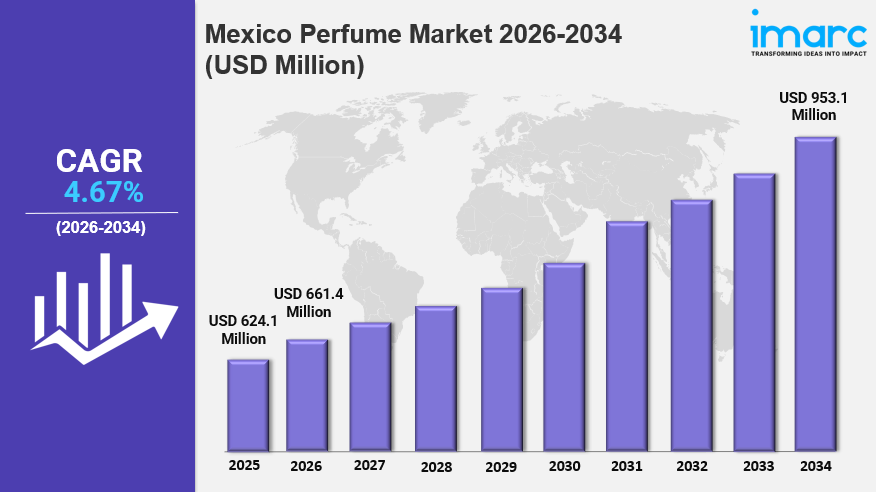
The Mexico perfume market grew from USD 624.1 Million in 2025 to approximately USD 661.4 Million in 2026 and is projected to reach USD 953.1 Million by 2034, expanding at a CAGR of 4.67% during 2026-2034. In 2026, the market continues to see steady demand, fueled by rising disposable incomes, growing personal care consciousness, and the deepening penetration of international fragrance brands across modern retail and digital channels.
The market is segmented by perfume type (premium and mass perfume products), category (female, male, and unisex fragrances), and region (Northern, Central, and Southern Mexico, and Others). Mass perfume products led with a 71.6% share in 2025, female fragrances accounted for 48.7% of the category split, and Central Mexico held 45.6% of the regional market. The market has grown from USD 496.7 Million in 2020 and is estimated to reach USD 784.2 Million by 2030, with premium products and unisex fragrances expanding faster than the overall market.
Key Market Statistics at a Glance
- Base Year: 2025
- Historical Years: 2020-2025
- Forecast Period: 2026-2034
- Market Size (2025): USD 624.1 Million
- Market Size (2026): USD 661.4 Million
- Projected Market Size (2034): USD 953.1 Million
- Growth Rate: CAGR of 4.67% (2026-2034)
Explore Opportunities in the Mexico Perfume Market: Download the IMARC Sample Report: https://www.imarcgroup.com/mexico-perfume-market/requestsample
Key Growth Drivers and Trends in the Mexico Perfume Market
Growth in the Mexico perfume market is being driven primarily by rising disposable incomes and premiumization. Expanding middle-class purchasing power in urban centers is sustaining demand for fragrances across price tiers, and consumers are trading up from basic body sprays to mid-range and premium eau de parfum formulations. A growing female workforce adds to personal care spending: according to INEGI's 2025 Intercensal Survey, women's economic participation in Mexico reached 41% in 2025, up 2.2 percentage points from 2020. Tourism and a strong gifting culture around Mother's Day, Valentine's Day, and Christmas create recurring demand peaks, and Mexico hosted a record 47.79 Million foreign visitors in 2025, with duty-free and travel retail channels at major airports boosting premium fragrance exposure.
One of the leading Mexico perfume market trends is the rise of unisex and gender-neutral fragrances. Younger consumers, particularly millennials and Gen Z, are driving growth in this sub-segment as inclusive beauty norms become mainstream, and brands with minimalist packaging or shared scent profiles are gaining traction among urban, style-conscious buyers. Alongside this, e-commerce and social commerce are reshaping discovery, with brand websites, online marketplaces, influencers, and social platforms giving both established houses and indie labels a direct route to Mexican consumers.
Another key factor supporting Mexico perfume market growth is the expansion of retail and the emphasis on sustainability and technology. Specialty beauty retailers, pharmacy-based beauty counters, and online platforms are widening access across income groups, while department stores expand prestige fragrance floor space. Interest in natural, vegan, cruelty-free, and eco-packaged fragrances is gradually entering the market, and brands are adopting AI-assisted scent development, virtual try-on tools, biotechnology-derived ingredients, and QR-code and NFC authentication packaging to protect authenticity.
Speak to an Analyst: https://www.imarcgroup.com/request?type=report&id=32107&flag=C
Mexico Perfume Industry Segmentation Insights
Breakup by Perfume Type:
- Mass Perfume Products: The dominant type, with a share of 71.6% in 2025. Supported by affordability, wide distribution across pharmacies, supermarkets, and direct-sales channels, and consistent demand from middle-income consumers in urban and semi-urban areas.
- Premium Perfume Products: Held a 28.4% share in 2025 and is expanding faster than the overall market. Growth reflects aspirational spending, urbanization, and the presence of international prestige houses, luxury gift sets, and niche fragrances in department stores and specialty retailers.
Breakup by Category:
- Female Fragrances: The leading category, with a share of 48.7% in 2025, supported by established brand loyalty, high gifting demand around Mother's Day and Valentine's Day, and steady seasonal purchasing.
- Male Fragrances: Accounted for 38.5% in 2025, supported by growing grooming awareness, rising fragrance use among younger men, and expanding men's lines in mass and premium retail.
- Unisex Fragrances: Make up the balance of roughly 12.8% by difference, and are among the fastest-growing sub-segments, driven by younger, digitally engaged consumers who discover gender-neutral scents through social media.
Breakup by Region:
- Central Mexico: The largest regional market, with a 45.6% share in 2025. Anchored by Mexico City's dense retail ecosystem, flagship fragrance stores, department store chains, and strong seasonal gifting cycles.
- Northern Mexico: The second-largest region, with a 33.4% share in 2025, driven by high per-capita incomes in industrial cities such as Monterrey, cross-border retail influence, and an expanding premium channel.
- Southern Mexico: Held a 16.0% share in 2025 and is the most significant emerging geographic opportunity, supported by rising tourism, urban population growth, and expanding formal retail.
- Others: Accounted for 5.0% in 2025, with demand from rural and smaller urban markets, direct-sales penetration, and informal retail.
Key Challenges and Growth Opportunities in the Mexico Perfume Market
The Mexico perfume market faces tariff, counterfeit, and currency pressures. Mexico applies tariffs on imported fragrance products and cosmetics, which raise the landed cost of international brands and challenge price competitiveness in premium tiers. Counterfeit and grey-market fragrances in informal retail erode consumer confidence and compress price realization, while peso depreciation and macroeconomic volatility raise the cost of imported inputs and finished goods. The market is also price-sensitive, with consumers frequently trading down in periods of economic stress, and Mexican shoppers favor familiar scent families such as florals, orientals, and fresh aquatics, which can limit acceptance of experimental compositions from emerging houses.
The market offers considerable growth opportunities driven by premiumization beyond the major cities, direct-sales innovation, and digital channels. Tier-2 cities such as Puebla, Querétaro, León, and Mérida are seeing rapid retail expansion and rising incomes, creating untapped demand for aspirational fragrance brands. Direct-sales networks, long a major distribution channel, are opening new avenues through social media, influencer marketing, and live commerce. Smart packaging that authenticates products can help address counterfeiting, and investment is flowing into e-commerce infrastructure, omnichannel retail, flagship store upgrades in Mexico City, and travel retail partnerships at major airports through 2034.
Competitive Landscape
The Mexico perfume market is moderately concentrated, with global fragrance and beauty conglomerates leading on brand portfolio breadth, retail distribution, and marketing investment, while regional and domestic players compete through direct-sales models and price-accessible fragrance lines. Entry barriers for premium fragrances include established brand equity, heavy marketing spend, access to department store shelf space, and licensing and product development costs, although digital channels have lowered barriers for niche and indie brands. Key players covered by IMARC include L'Oréal S.A. (Lancôme, Giorgio Armani Beauty, YSL Beauté), Coty Inc. (Marc Jacobs, Burberry, Calvin Klein, Hugo Boss), Puig S.L. (Carolina Herrera, Rabanne, Nina Ricci, Jean Paul Gaultier), and Revlon Group Holdings LLC (Charlie, Elizabeth Arden). The IMARC report covers market structure, key player positioning, top winning strategies, a competitive dashboard, and a company evaluation quadrant, along with detailed profiles of all major companies.
Recent Developments in the Mexico Perfume Market
- Global industry: Talks on a merger between Puig and Estée Lauder ended without a deal, according to Modaes' 2026 ranking of the perfumery leaders, in which L'Oréal retained a clear lead.
- Global industry: Coty completed its exit from Wella by selling its remaining stake to KKR for USD 750 Million, sharpening its focus on its fragrance portfolio.
- 2025: Mexico hosted a record 47.79 Million foreign visitors, supporting duty-free and travel retail fragrance sales, while INEGI data showed women's economic participation reaching 41%.
- September 2024: Maison Solís launched an agave-inspired fragrance line in Mexico, blending olfactory art with the country's tequila heritage.
Author IMARC Group
IMARC Group is a leading global market research company providing data-driven insights and expert consulting services to businesses seeking to achieve their strategic objectives. With a multidisciplinary team of industry experts, IMARC delivers reliable market intelligence across sectors including Chemicals and Materials, Healthcare, Technology, Agriculture, and Retail.
Contact Us:
IMARC Group
Email: [email protected]
United States: +1-201-971-6302
