

Solar Tracker Market Size, Share, Industry Overview, Growth and Forecast 2026-2034

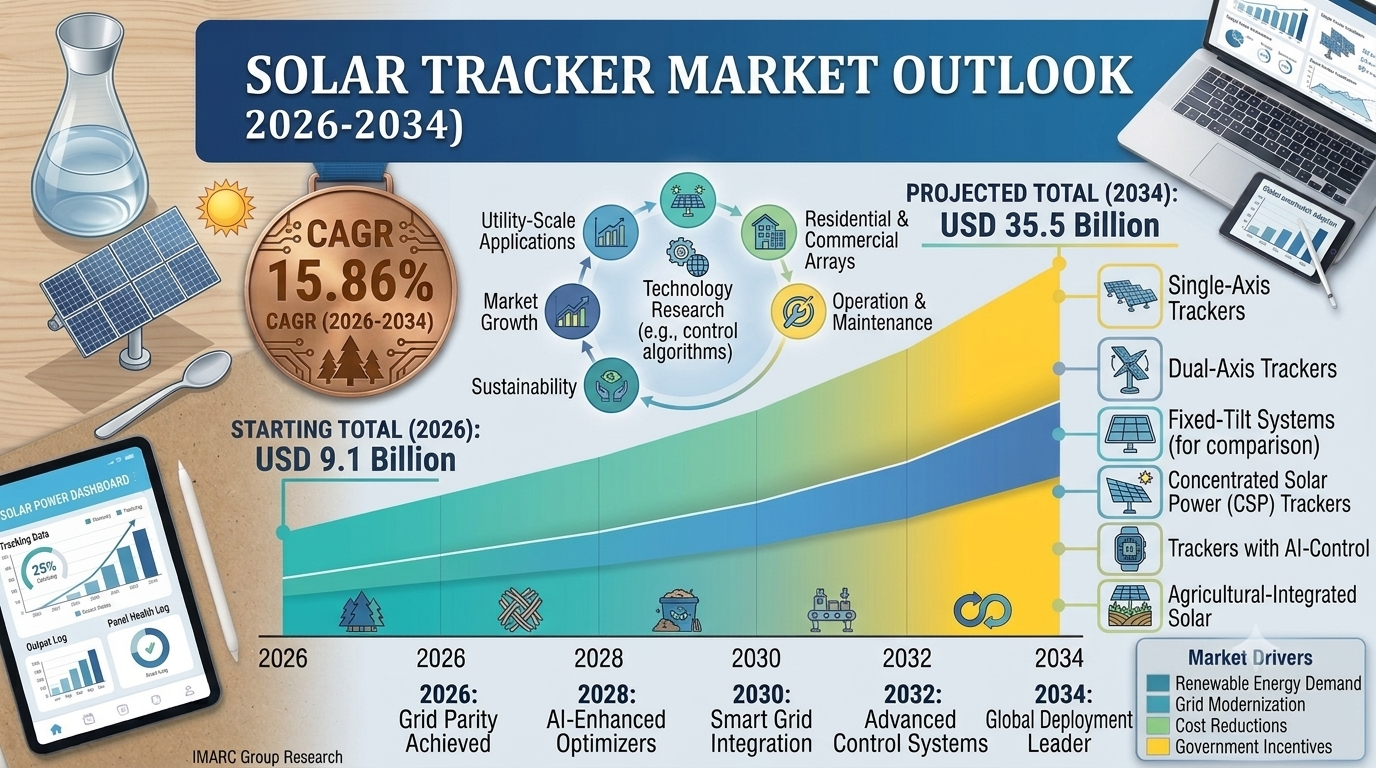
According to IMARC Group, the global solar tracker market size reached USD 9.1 Billion in 2025 and is projected to reach USD 35.5 Billion by 2034, expanding at a CAGR of 15.86% during 2026-2034. This strong solar tracker market growth is being driven by rising renewable energy adoption, falling solar technology costs, increasing demand for utility-scale projects, large investments in renewable infrastructure, and supportive regulations, tax credits, and subsidies.
Solar Tracker Industry Overview
A solar tracker is a mounting system that moves solar panels throughout the day to follow the sun’s path. Active trackers use motors and sensors to track the sun’s movement, enabling panels to capture more energy than fixed systems. Trackers are available in single-axis and dual-axis configurations and are deployed across photovoltaic and concentrated solar technologies.
Solar trackers are deployed across a broad continuum of use cases:
• Utility-scale solar farms: Large installations where tracking boosts energy yield and supports efficient land use
• Commercial installations: Rooftop and ground-mount systems seeking higher output from limited space
• Residential installations: Smaller systems adopting tracking as costs fall and technologies mature
• Smart and AI-enabled systems: AI and IoT integration for real-time optimization of panel positioning
• Emerging solar regions: Large-scale renewable programs across Asia Pacific, Latin America, and the Middle East and Africa
Global Solar Tracker Market Size & Key Statistics
Below are the key solar tracker market statistics drawn from IMARC Group’s comprehensive market analysis:
|
Report Attribute |
Key Statistics |
|
Base Year |
2025 |
|
Historical Period |
2020-2025 |
|
Forecast Period |
2026-2034 |
|
Solar Tracker Market Size in 2025 |
USD 9.1 Billion |
|
Market Forecast in 2034 |
USD 35.5 Billion |
|
Market Growth Rate (2026-2034) |
15.86% CAGR |
|
Largest Region |
North America (over 32.0% share) |
|
Leading Type Segment |
Active Solar Trackers |
|
Leading Tracking Type Segment |
Single-Axis Tracking (~90.0% share) |
|
Leading Technology Segment |
Solar Photovoltaic (~92.5% share) |
|
Leading Application Segment |
Utility Sector (~86.6% share) |
Request for a Sample Report for Detailed Solar Tracker Market Share Evaluation: https://www.imarcgroup.com/solar-tracker-market/requestsample
Key Market Drivers & Solar Tracker Market Trends in 2026
Several powerful forces are shaping solar tracker market trends and fuelling sustained growth expectations across global renewable energy markets:
1. Growing Renewable Energy Adoption
Governments, utilities, and businesses worldwide are scaling up renewable energy to meet sustainability and carbon-reduction targets. Global renewable power capacity is projected to reach 7,300 GW during 2023-2028 under current policies and market conditions, and renewable electricity generation is expected to exceed 17,000 TWh by 2030, almost 90% higher than in 2023, according to the IEA, expanding the solar tracker market size.
2. Technological Advances Including AI and IoT Integration
AI-enabled and IoT-connected trackers allow real-time optimization of panel positioning, improving energy yield and operational efficiency. Innovations in dual-axis systems and smart tracking technologies are widening the range of solutions available to project developers.
3. Falling Solar Technology Costs
Solar panel and tracker costs have declined over the past decade, making tracking systems more economical and strengthening their business case across both new and existing solar projects.
4. Rising Demand for Utility-Scale Projects
Utility-scale solar farms favor trackers because they raise energy output per installed panel and support efficient land use, which is why the utility sector commands the largest solar tracker market share by application.
5. Large Investments in Renewable Infrastructure
Substantial public and private investment in renewable infrastructure is accelerating project pipelines. In the United States, for example, the Biden-Harris Administration announced USD 71 million on May 16, 2024 for solar manufacturing and innovation, including USD 16 million from the Bipartisan Infrastructure Law, funding 18 projects across 10 states.
6. Supportive Regulation, Tax Credits, and Subsidies
Policy support is a major tailwind for solar tracker market growth. U.S. renewable capacity is expected to rise by almost 500 GW between 2024 and 2030, driven by the Inflation Reduction Act, while in Brazil, businesses that began photovoltaic generation in 2022 will reportedly pay no taxes until 2045.
7. Energy Security, Grid Stability, and Storage Integration
Trackers help maximize output from large solar farms while supporting energy security goals. Growing emphasis on grid stability and energy storage integration is further reinforcing demand for efficient solar generation assets.
Key Market Segmentation
By Type
Active Solar Trackers - Largest Segment: Active trackers use motors and sensors to follow the sun’s movement, enabling panels to capture more energy than fixed systems. They lead the market owing to their higher energy capture and compatibility with AI and IoT-based optimization.
Passive Solar Trackers: A complementary tracker category used across solar installations that do not rely on motorized, sensor-driven tracking.
By Tracking Type
Single-Axis Tracking - Largest Segment (~90.0% Share): Single-axis trackers rotate panels along one axis and account for roughly 90.0% of the market in 2025. Sub-types include Horizontal Single Axis Tracker (HSAT), Vertical Single Axis Tracker (VSAT), Tilted Single Axis Tracker (TSAT), and Polar Aligned Single Axis Tracker (PSAT).
Dual-Axis Tracking: Dual-axis trackers follow the sun on two axes for further optimized alignment. Sub-types include Tip-Tilt Dual Axis Tracker (TTDAT) and Azimuth-Altitude Dual Axis Tracker (AADAT), with ongoing innovations in dual-axis systems supporting adoption.
By Technology
Solar Photovoltaic (PV) - Largest Segment (~92.5% Share): Solar PV dominates the technology landscape with approximately 92.5% share in 2025, supported by falling costs and large-scale deployment worldwide.
Concentrated Solar Power (CSP): Uses mirrors or lenses to concentrate sunlight for power generation, with trackers essential for continuously aligning the concentrating optics to the sun.
Concentrated Photovoltaic (CPV): Combines concentrating optics with photovoltaic cells, relying on precise tracking to maintain focus on the sun.
By Application
Utility Sector - Largest Segment (~86.6% Share): Utility-scale solar projects account for approximately 86.6% of the market in 2025, as trackers raise energy yield and support efficient land use in large solar farms.
Residential Sector: Adoption of tracking solutions in homes is supported by declining solar technology costs and supportive incentives.
Commercial Sector: Commercial installations use tracking to maximize energy generation from limited site area and reduce long-term energy costs.
Regional Solar Tracker Market Analysis
|
Region |
Key Highlights |
|
North America - Largest |
United States & Canada; accounted for over 32.0% share in 2025; U.S. renewable capacity expected to rise by almost 500 GW during 2024-2030 under the Inflation Reduction Act; USD 71 million federal funding for solar manufacturing and innovation announced in May 2024 |
|
Europe |
Germany, France, United Kingdom, Italy, Spain, Russia, and others; about 55.9 GW of new solar PV installed in the EU-27 in 2023 (up 40% from 2022); cumulative EU solar PV reached 263 GW (up 27%), with Germany the largest contributor at 82 GW |
|
Asia Pacific |
China, Japan, India, South Korea, Australia, Indonesia, and others; India’s renewable capacity additions projected to rise from 15 GW in 2023 to 62 GW by 2030, more than quadrupling |
|
Latin America |
Brazil, Mexico, and others; Brazil’s tax advantages for businesses that began photovoltaic generation in 2022 support investment |
|
Middle East and Africa |
Dubai targets 100% clean energy by 2050; Saudi Arabia’s NEOM, a USD 500 billion megacity, is planned with a 50% renewable energy mix at launch and 100% by 2030 |
North America accounted for the largest Solar Tracker Market Share, with over 32.0% in 2025, driven by supportive policies such as the Inflation Reduction Act, tax credits and subsidies, large investments in renewable infrastructure, and a strong focus on grid stability and energy storage integration.
Connect for Detailed Solar Tracker Market Share Segmentation Analysis - Speak to an Analyst: https://www.imarcgroup.com/request?type=report&id=2401&flag=C
Leading Players in the Global Solar Tracker Industry
The global solar tracker industry features a mix of dedicated tracker specialists and diversified energy and industrial groups. Key companies covered in the IMARC Group report include:
|
Company |
Parent / Affiliation |
Highlighted in the Report |
|
Arctech Solar Holding Co. Ltd. |
- |
Expanded into Turkey via partnership with Alpon Energy (January 2024) |
|
Array Technologies Inc. |
- |
Partnership with ALUPCO to expand renewable projects in the Middle East (February 2024) |
|
Convert Italia SpA |
Valmont Industries Inc. |
Profiled key player |
|
DEGER energie GmbH & Co KG |
- |
Profiled key player |
|
First Solar Inc. |
- |
Partnered with cleantech solar to supply clean electricity to its 3.3 GW Sriperumbudur facility (January 2024) |
|
Nextracker Inc. |
Flex Ltd. |
Launched NX Horizon tracker (October 2024) |
|
Powerway Renewable Energy Co. |
SinoTech Power Group |
Profiled key player |
|
Soltec Energias Renovables S.L. |
- |
Profiled key player |
|
Sunpower Corporation |
Total S.A. |
Profiled key player |
Latest Solar Tracker Market Industry Developments
October 2024 - Nextracker Inc.
Nextracker launched its NX Horizon tracker, featuring AI optimization and IoT capabilities along with a 35% reduced carbon footprint and Carbon Trust certification.
February 2024 - Array Technologies Inc.
Array Technologies and ALUPCO formed a partnership to expand renewable projects in the Middle East.
January 2024 - Arctech Solar Holding Co. Ltd.
Arctech expanded into Turkey through a partnership with Alpon Energy, a tracker and EPC company.
January 2024 - First Solar Inc.
First Solar partnered with cleantech solar to supply clean electricity to its 3.3 GW Sriperumbudur manufacturing facility.
About Us
IMARC Group is a leading global market research company providing data-driven insights and expert consulting services to businesses seeking to achieve their strategic objectives. With a multi-disciplinary team of industry experts, IMARC delivers thorough, reliable market intelligence across sectors including Energy and Power, Chemicals and Materials, Construction, Automotive, and more.
Contact Us
IMARC Group
United States: +1-201-971-6302
India: +91-120-433-0800
United Kingdom: +44-753-714-6104
