

Cut Flower Market Outlook: How Everyday Self-Purchase Drives USD 62B Valuation

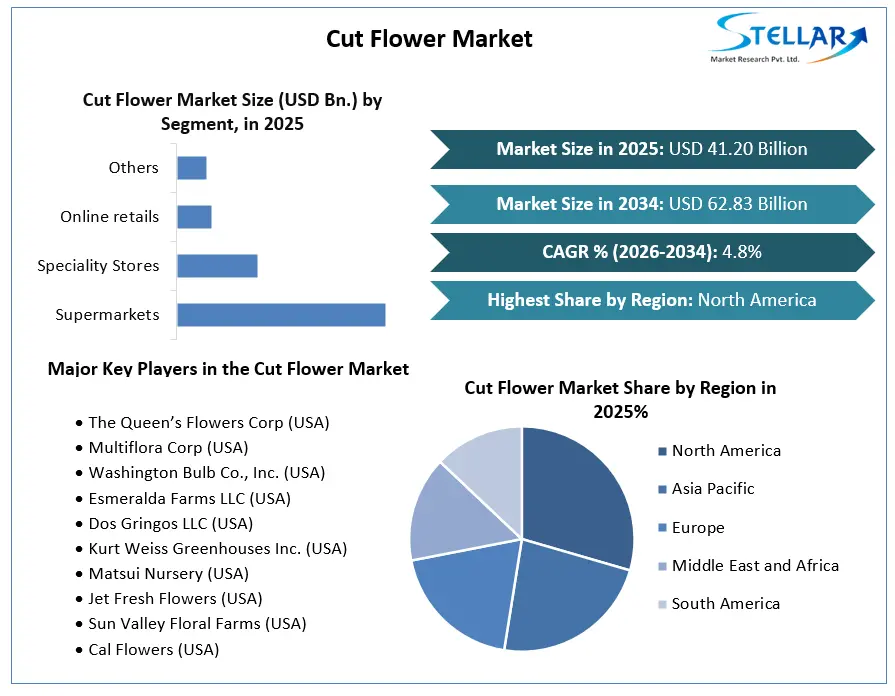
The global Cut Flower Market is entering a transformative era of digital commerce and eco-conscious sourcing, projected to scale from USD 41.20 billion in 2025 to USD 62.83 billion by 2034. According to a comprehensive market intelligence report released by Stellar Market Research, the sector is poised to register a steady compound annual growth rate (CAGR) of 4.8% across the forecast period. This expansion is heavily underpinned by surging everyday self-purchase trends, direct-to-consumer online floral platforms, and strategic export hubs bridging Southern Hemisphere cultivation with Western consumer demand.
The cut flower industry has fundamentally shifted from an occasion-driven commodity market (traditionally dominated by Valentine’s Day and weddings) into a year-round lifestyle and home-décor staple. Urbanization, rising disposable incomes, and the normalization of online flower subscriptions have unlocked fresh avenues for growth. Consumers increasingly view fresh floral arrangements as essential elements of personal wellness and interior aesthetics. However, the industry is simultaneously navigating complex supply chain bottlenecks, heightened phytosanitary compliance demands, and a decisive pivot toward sustainable, carbon-efficient horticulture.
Key Findings from the Report
-
Market Valuation & Trajectory: The global cut flower market stood at USD 41.20 billion in 2025 and is projected to achieve USD 62.83 billion by 2034.
-
Growth Rate: Expanding at a steady CAGR of 4.8% throughout the 2026–2034 forecast window.
-
Dominant Flower Type: Cut roses capture the largest revenue share, sustained by timeless consumer preference and continuous breeding innovations in color, fragrance, and vase life.
-
Application Segmentation: Commercial applications (hotels, events, corporate spaces, and luxury retail) command the majority of revenue, though residential home styling is the fastest-growing segment.
-
Distribution Channel Shift: Online retail and e-commerce floral platforms are expanding at over 25% annually, disrupting traditional brick-and-mortar retail florists.
-
Regional Leadership: Europe maintains its position as the largest regional market, anchored by major trade hubs like the Netherlands and strong per-capita floral consumption.
-
Investment Relevance: Heightened focus on cold-chain optimization, vacuum cooling, and blockchain-enabled traceability is attracting significant venture and private equity interest across logistics nodes.
For further information, click the following link:https://www.stellarmr.com/report/req_sample/cut-flower-market/2748
Market Drivers and Restraints
Drivers
-
Proliferation of E-Commerce & Subscription Models: Digital storefronts and direct-to-consumer bouquet services have eliminated geographic barriers, driving repeat purchases via automated subscriptions.
-
Rising Popularity of Everyday Floral Gifting & Self-Purchase: A cultural shift toward wellness and home aesthetics has transformed flowers into regular household items rather than gifts reserved strictly for milestone events.
-
Expansion of Hospitality and Event Sectors: Rapid recovery and growth in luxury tourism, upscale dining, destination weddings, and corporate hospitality create consistent baseline B2B demand.
Restraints
-
High Logistics Costs & Cold-Chain Vulnerabilities: Cut flowers are perishable, heavy when wet-packed, and highly sensitive to transit delays, resulting in elevated air-freight tariffs and post-harvest spoilage.
-
Strict Phytosanitary Regulations & Border Friction: Increased border inspections (such as post-Brexit checks in the UK and strict EU pest compliance on African imports) introduce administrative delays and elevate operational overhead.
Technology, Regulation, and Sustainability Trends
-
Technology Adoption: Industry stakeholders are rapidly integrating AI-powered inventory forecasting, IoT-based temperature monitoring (maintaining strict 2–8°C thresholds), and blockchain traceability to curb the 20–30% average post-harvest waste.
-
Regulatory Compliance: Regulatory frameworks in Europe and North America have intensified oversight regarding pesticide residues and pest risks (e.g., false codling moth inspections), compelling growers to adopt rigorous integrated pest management (IPM).
-
Sustainability & ESG Integration: Eco-conscious consumer mandates have accelerated the adoption of Fairtrade certifications, closed-loop water systems, and biodegradable or recyclable packaging innovations, such as plant-based flower food sachets.
Regional Insights
-
Europe (Leading Region): Europe commands the largest global revenue share, anchored by sophisticated distribution networks like Royal FloraHolland in the Netherlands. Despite high energy costs for greenhouse heating, European demand remains resilient due to deep-rooted cultural floral traditions.
-
Asia Pacific (Emerging Region): Asia Pacific is poised as the fastest-growing regional market, propelled by surging middle-class demographics in China, India, and Southeast Asia, alongside expanding domestic commercial floriculture production.
-
Latin America & Africa (Export Powerhouses): Nations like Kenya, Colombia, and Ecuador continue to scale export volumes, leveraging favorable equatorial climates and eco-efficient farming models (e.g., Kenyan roses utilizing significantly less energy and water than heated greenhouse counterparts).
Recent Industry Developments
-
International Fresh Produce Association (IFPA) (2025): Highlighted the escalating integration of artificial intelligence, warehouse automation, and blockchain tracking across commercial flower production chains to maximize yield and transparency.
-
Chrysal (Americas) (2025): Unveiled recyclable polypropylene (PP) sachets paired with bio-based flower food, cutting plastic waste footprint in post-harvest retail care.
-
Chrysal (Netherlands) (2024): Launched specialized Transport Stickers engineered to monitor environmental exposure and preserve cut flower quality dynamically during international transit.
-
Floriday (2023): Introduced advanced digital "trade settings" to streamline electronic transactions, standardizing supply contracts between commercial growers and global buyers.
-
UK Horticultural Trade Board (2025/2026): Documented a 12% price inflation on imported florals driven directly by mandatory post-Brexit border checks and administrative friction.
Competitive Landscape
The global cut flower market features a consolidated core of elite breeders and distributors alongside a fragmented base of independent cultivators. Key market leaders include Dummen Orange, Royal FloraHolland, Marginpar BV, Selecta One, Chrysal, Florensis, and Porta Nova. Leading enterprises are heavily investing in proprietary genetic breeding (focusing on disease resistance, vase-life extension, and unique color profiles), strategic cross-border distribution partnerships, and sustainable greenhouse automation to protect market share against rising operating expenditures.
Analyst Commentary
"The cut flower industry is undergoing a structural evolution where traditional logistics are no longer sufficient on their own. To capture value through 2034, market participants must bridge consumer-facing digital convenience with rigorous cold-chain integrity and verifiable sustainability credentials. Automation and data-driven inventory management are now baseline requirements for mitigating perishability risk and thriving in a competitive global ecosystem."
— Senior Research Analyst, Stellar Market Research
Future Outlook
Through the remainder of the forecast period, the cut flower market will be defined by hyper-personalized consumer offerings, aggressive digital marketplace penetration, and strict environmental accountability. As supply chain optimization tools mature and cold-chain infrastructure penetrates secondary emerging economies, profit pools will shift toward technology-enabled exporters and sustainable breeders capable of delivering premium, ethically sourced botanicals with minimal carbon footprints.
For further information, click the following link:https://www.stellarmr.com/report/req_sample/cut-flower-market/2748
About Stellar Market Research
Stellar Market Research is a multifaceted market research and consulting company with professionals from several industries. Some of the industries we cover include medical devices, pharmaceutical manufacturers, science and engineering, electronic components, industrial equipment, technology and communication, cars and automobiles, chemical products and substances, general merchandise, beverages, personal care, and automated systems. To mention a few, we provide market-verified industry estimations, technical trend analysis, crucial market research, strategic advice, competition analysis, production and demand analysis, and client impact studies.
Address
Phase 3, Navale IT Zone, S.No. 51/2A/2, Office No. 202, 2nd floor, Near, Navale Brg, Narhe, Pune, Maharashtra 411041
Email
[email protected]
Mobile
+91 9607365656
